
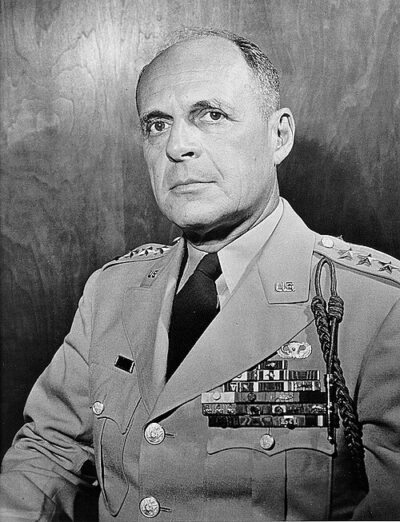
Matthew Ridgway
Matthew Ridgway was an United States Army general. Born March 3, 1895, in Fort Monroe National Monument. Died July 26, 1993, in Fox Chapel. Positions held include Supreme Allied Commander Europe (1952–1953) and Chief of Staff of the United States Army (1953–1955). Educated at United States Army Command and General Staff College and United States Military Academy. Awards include Bronze Star Medal, Legionnaire of Legion of Merit and Purple Heart.
Facts
36 facts · 2 confirmed by two sources · 9 cited · 25 from one source
Where this comes from
Papalocal keeps its own record. It started from these sources; what each one said is kept here as it was copied, so a change on their side never changes this page by itself. Tap one to read its version.
What Wikidata says · copied November 15, 2026 · revision 2558162508
- Described as
- United States Army general (1895–1993)
- Other names
- Matthew Bunker Ridgway, Matthew B. Ridgway
- Born
- March 3, 1895 · 6 references
- Died
- July 26, 1993 · 6 references
- Born in
- Fort Monroe National Monument · 2 references
- Died in
- Fox Chapel · 1 reference
- Buried in
- Arlington National Cemetery (1993) · 1 reference
- Cause of death
- cardiovascular disease
- Citizen of
- United States · 1 reference
- Occupation
- army officer; politician; soldier · 2 references; military officer · 1 reference
- Positions held
- Supreme Allied Commander Europe (1952–1953); Chief of Staff of the United States Army (1953–1955) · 1 reference
- Education
- United States Army Command and General Staff College; United States Military Academy · 1 reference; Boston English High School · 1 reference; United States Army War College
- Awards
- Bronze Star Medal; Legionnaire of Legion of Merit; Purple Heart; Presidential Medal of Freedom (1986) · 1 reference; Silver Star; Congressional Gold Medal; World War II Victory Medal; Distinguished Service Cross · 1 reference; Distinguished Service Medal · 1 reference; Inter-Allied Victory Medals · 1 reference; American Campaign Medal · 1 reference; European-African-Middle Eastern Campaign Medal · 1 reference; Asiatic-Pacific Campaign Medal · 1 reference; Army of Occupation Medal · 1 reference; National Defense Service Medal · 1 reference
- Field
- military affairs · 1 reference
- Military branch
- United States Army
- Military rank
- general · 1 reference; general · 1 reference
- Wikipedias with a page
- 27
Wikidata item Q494930 (wikidata.org/wiki/Q494930), public domain (CC0). Copied November 15, 2026.
What Wikipedia says · copied November 15, 2026 · revision 1383849198
Matthew Bunker Ridgway (3 March 1895 – 26 July 1993) was a senior officer in the United States Army, who served as Supreme Allied Commander Europe (1952–1953) and the 19th Chief of Staff of the United States Army (1953–1955). Although he saw no combat service in World War I, he was intensively involved in World War II, where he was the first Commanding General (CG) of the 82nd Airborne Division, leading it in action in Sicily, Italy and Normandy, before taking command of the newly formed XVIII Airborne Corps in August 1944. He held the latter post until the end of the war in mid-1945, commanding the corps in the Battle of the Bulge, Operation Varsity and the Western Allied invasion of Germany.
Ridgway held several major commands after World War II and is most well-known for resurrecting the United Nations (UN) war effort during the Korean War. Several historians have credited Ridgway for turning the war around in favor of the UN side. He also persuaded President Dwight D. Eisenhower to refrain from direct military intervention in the First Indochina War to support French colonial forces, thereby essentially delaying the United States' Vietnam War by over a decade. He received the Presidential Medal of Freedom on 12 May 1986. Ridgway died in 1993 at the age of 98.
- Born, in its opening lines
- March 3, 1895
- Died, in its opening lines
- July 26, 1993
From the Wikipedia article “Matthew Ridgway” (en.wikipedia.org/wiki/Matthew_Ridgway), by its contributors, under CC BY-SA 4.0 (creativecommons.org/licenses/by-sa/4.0/). Copied November 15, 2026; not changed.
Confirmed Two sources agree. Cited One source, and it names where it got it. One source One source, without a reference of its own. Sources disagree The sources disagree. We show the best-supported value and keep theirs below.
