
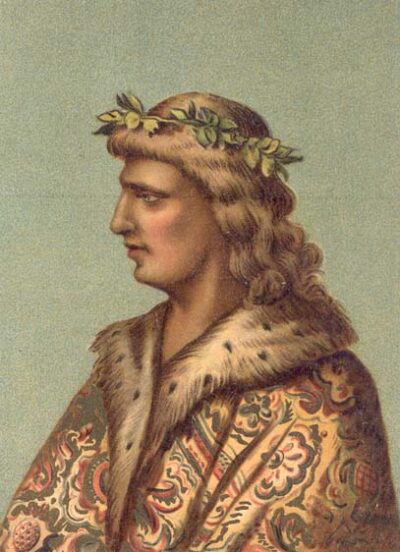
Matthias Corvinus
Matthias Corvinus was a King of Hungary and Bohemia, Duke of Austria. Born February 23, 1443, in Cluj-Napoca. Died April 6, 1490, in Vienna. Positions held include Apostolic King of Hungary (1458–1490) and King of Bohemia (1478–1490).
Facts
22 facts · 2 confirmed by two sources · 3 cited · 17 from one source
What’s different
- Born: we show February 23, 1443 (Confirmed). Wikidata also lists February 24, 1443
- Died: we show April 6, 1490 (Confirmed). Wikidata also lists April 7, 1490
Where this comes from
Papalocal keeps its own record. It started from these sources; what each one said is kept here as it was copied, so a change on their side never changes this page by itself. Tap one to read its version.
What Wikidata says · copied November 16, 2026 · revision 2569901731
- Described as
- King of Hungary and Bohemia, Duke of Austria (1443–1490)
- Other names
- Matthias I, Mathias, Mattia Corvino, Mattia, Matia Corvin
- Born
- February 24, 1443 · 2 references; February 23, 1443 · 1 reference
- Died
- April 6, 1490 · 1 reference; April 7, 1490 · 1 reference
- Born in
- Cluj-Napoca · 1 reference
- Died in
- Vienna · 2 references
- Buried in
- Székesfehérvár Basilica
- Cause of death
- foodborne illness
- Citizen of
- Hungary
- Occupation
- politician; monarch; patron of the arts
- Positions held
- Apostolic King of Hungary (1458–1490) · 1 reference; King of Bohemia (1478–1490)
- Political party
- politician before the emergence of political parties
- Spouse
- Catherine of Poděbrady (1461–1464) · 1 reference; Beatrice of Naples (1476–1490) · 1 reference; Elizabeth of Celje
- Children
- John Corvinus; N. Hunyadi, Prince of Hungary
- Father
- John Hunyadi
- Mother
- Erzsébet Szilágyi
- Siblings
- Ladislaus Hunyadi
- Lived in
- Cluj-Napoca
- Wikipedias with a page
- 73
Wikidata item Q188634 (wikidata.org/wiki/Q188634), public domain (CC0). Copied November 16, 2026.
What Wikipedia says · copied November 16, 2026 · revision 1385112778
Matthias Corvinus (Hungarian: Hunyadi Mátyás; Romanian: Matia/Matei Corvin; Croatian: Matija/Matijaš Korvin; Slovene: Matija Korvin/Kralj Matjaž; Slovak: Matej Korvín; Czech: Matyáš Korvín; 23 February 1443 – 6 April 1490) was King of Hungary and Croatia from 1458 to 1490, as Matthias I. He is often given the epithet "the Just". After conducting several military campaigns, he was elected King of Bohemia in 1469 and adopted the title Duke of Austria in 1487. He was the son of John Hunyadi, Regent of Hungary, who died in 1456. In 1457, Matthias was imprisoned along with his older brother, Ladislaus Hunyadi, on the orders of King Ladislaus the Posthumous. Ladislaus Hunyadi was executed, causing a rebellion that forced King Ladislaus to flee Hungary. After the King died unexpectedly, Matthias's uncle Michael Szilágyi persuaded the Estates to unanimously proclaim the 14-year-old Matthias as king on 24 January 1458. He began his rule under his uncle's guardianship, but he took effective control of government within two weeks.
As king, Matthias waged wars against the Czech mercenaries who dominated Upper Hungary (today parts of Slovakia and Northern Hungary) and against Frederick III, Holy Roman Emperor, who claimed Hungary for himself. In this period, the Ottoman Empire conquered Serbia and Bosnia, terminating the zone of buffer states along the southern frontiers of the Kingdom of Hungary. Matthias signed a peace treaty with Frederick III in 1463, acknowledging the Emperor's right to style himself King of Hungary. The Emperor returned the Holy Crown of Hungary with which Matthias was crowned on 29 March 1464. In this year, Matthias invaded the territories that had recently been occupied by the Ottomans and seized fortresses in Bosnia. He soon realized he could expect no substantial aid from the Christian powers and gave up his anti-Ottoman policy.
Matthias introduced new taxes and regularly set taxation at extraordinary levels. These measures caused a rebellion in Transylvania in 1467, but he subdued the rebels. The next year, Matthias declared war on George of Poděbrady, the Hussite King of Bohemia, and conquered Moravia, Silesia, and Lusatia, but he could not occupy Bohemia proper. The Catholic Estates proclaimed him King of Bohemia on 3 May 1469, but the Hussite lords refused to yield to him even after the death of their leader George of Poděbrady in 1471. Instead, they elected Vladislaus Jagiellon, the eldest son of Casimir IV of Poland. A group of Hungarian prelates and lords offered the throne to Vladislaus's younger brother Casimir, but Matthias overcame their rebellion. Having routed the united troops of Casimir IV and Vladislaus at Breslau in Silesia (now Wrocław in Poland) in late 1474, Matthias turned against the Ottomans, who had devastated the eastern parts of Hungary. He sent reinforcements to Stephen the Great, Prince of Moldavia, enabling Stephen to repel a series of Ottoman invasions in the late 1470s. In 1476, Matthias besieged and seized Šabac, an important Ottoman border fort. He concluded a peace treaty with Vladislaus Jagiellon in 1478, confirming the division of the Lands of the Bohemian Crown between them. Matthias waged a war against Emperor Frederick and occupied Lower Austria between 1482 and 1487.
Matthias established one of the earliest professional standing armies of medieval Europe (the Black Army of Hungary), reformed the administration of justice, reduced the power of the barons, and promoted the careers of talented individuals chosen for their abilities rather than their social statuses. Matthias patronized art and science; his royal library, the Bibliotheca Corviniana, was one of the largest collections of books in Europe. With his patronage, Hungary became the first country to embrace the Renaissance from Italy. As Matthias the Just, the monarch who wandered among his subjects in disguise, he remains a popular hero of Hungarian and Slovak folk tales.
- Born, in its opening lines
- February 23, 1443
- Died, in its opening lines
- April 6, 1490
From the Wikipedia article “Matthias Corvinus” (en.wikipedia.org/wiki/Matthias_Corvinus), by its contributors, under CC BY-SA 4.0 (creativecommons.org/licenses/by-sa/4.0/). Copied November 16, 2026; not changed.
Confirmed Two sources agree. Cited One source, and it names where it got it. One source One source, without a reference of its own. Sources disagree The sources disagree. We show the best-supported value and keep theirs below.
