
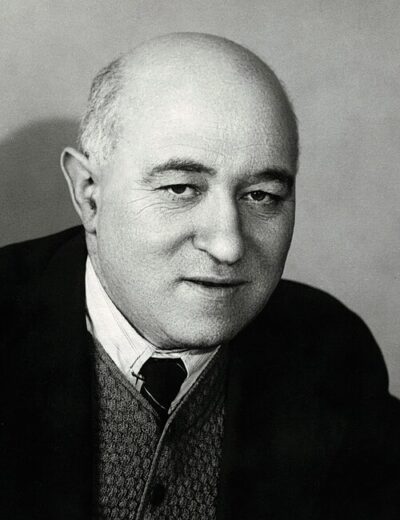
Mátyás Rákosi
Mátyás Rákosi was a former First Secretary of the Hungarian Working People's Party. Born March 9, 1892, in Ada. Died February 5, 1971, in Nizhny Novgorod. Positions held include member of the Provisional National Assembly (1944–1945), Prime Minister of Hungary (1952–1953) and member of the National Assembly of Hungary (1945–1957). Awards include Order of Merit of Hungarian Freedom, Order of Merit of the Hungarian People's Republic and Order of Labour.
Facts
23 facts · 2 confirmed by two sources · 10 cited · 11 from one source
Where this comes from
Papalocal keeps its own record. It started from these sources; what each one said is kept here as it was copied, so a change on their side never changes this page by itself. Tap one to read its version.
What Wikidata says · copied November 16, 2026 · revision 2562763867
- Described as
- former First Secretary of the Hungarian Working People's Party (1892-1971)
- Other names
- Matyas Rakosi, Mátyás Rosenfeld
- Born
- March 9, 1892 · 3 references
- Died
- February 5, 1971 · 7 references
- Born in
- Ada · 1 reference
- Died in
- Nizhny Novgorod · 1 reference
- Buried in
- Farkasréti Cemetery · 1 reference
- Name at birth
- Rosenfeld Mátyás
- Citizen of
- Hungary
- Occupation
- politician · 1 reference
- Positions held
- member of the Provisional National Assembly (1944–1945) · 1 reference; Prime Minister of Hungary (1952–1953) · 1 reference; member of the National Assembly of Hungary (1945–1957) · 1 reference; member of the HWP Central Directorate Resolution (1948–1956) · 1 reference
- Political party
- Communist Party of Hungary; Peace Party · 1 reference; Hungarian Communist Party · 1 reference; Hungarian Working People's Party · 1 reference
- Awards
- Order of Merit of Hungarian Freedom; Order of Merit of the Hungarian People's Republic · 1 reference; Order of Labour · 1 reference
- Spouse
- Feodora Feodorovna Kornilova
- Siblings
- Ferenc Biró; Zoltán Bíró
- Religion
- atheism
- Wikipedias with a page
- 60
Wikidata item Q207631 (wikidata.org/wiki/Q207631), public domain (CC0). Copied November 16, 2026.
What Wikipedia says · copied November 16, 2026 · revision 1383879801
Mátyás Rákosi (né Rosenfeld; 9 March 1892 – 5 February 1971) was a Hungarian communist politician who was the de facto leader of Hungary from 1948 to 1956. He served first as General Secretary of the Hungarian Communist Party from 1945 to 1948 and then as General Secretary (later renamed First Secretary) of the Hungarian Working People's Party from 1948 to 1956. Mátyás Rákosi was the chief architect of the laws that confiscated the property of various churches in Hungary, as well as the mass deportations to Hungarian forced labor camps, such as Hortobágy and Recsk forced labor camps.
Rákosi had been involved in left-wing politics since his youth, and in 1919 was a leading commissar in the short-lived Hungarian Soviet Republic. After the fall of the Communist government, he escaped the country and worked abroad as an agent of the Comintern. He was arrested in 1924 after attempting to return to Hungary and organize the Communist Party underground, and ultimately spent over fifteen years in prison. He became a cause célèbre in the international Communist movement, and the predominantly Hungarian Rákosi Battalion of the International Brigades in the Spanish Civil War bore his name. Rákosi was finally allowed to leave for the Soviet Union in 1940 in exchange for prized battle flags captured by Tsarist Russian forces after the Hungarian Revolution of 1848.
As the Red Army drove the German Wehrmacht out of Hungary at the end of World War II, Rákosi returned to his home country in early 1945 and became the leader of the re-founded Hungarian Communist Party. The party suffered a crushing defeat in Hungary's postwar free election, at the hands of the agrarian Independent Smallholders' Party; however, at Moscow's insistence the Communists received key positions in the government including the Interior Ministry, while Rákosi himself became a heavily influential deputy prime minister. From this position, the Communists were able to use political intrigue, subterfuge, and conspiracy to destroy their opponents piece by piece, in what Rákosi would later term "salami tactics". By 1948, they had gained total power over the country, and in 1949 the country was proclaimed a people's republic with Rákosi as its absolute ruler.
Rákosi was an ardent Stalinist, and his government was very loyal to the Soviet Union; he even set up a personality cult of his own, modeled on that of Stalin. He presided over the mass imprisonment of hundreds of thousands of Hungarian people, and the deaths of thousands. He orchestrated show trials modeled on those of the USSR, among the most prominent victims of which was his former lieutenant László Rajk. His policies of collectivization and mass repression devastated the country's economy and political life, causing massive discontent. After the death of Stalin in 1953, Rákosi was partially demoted at Moscow's behest and the reformist Communist Imre Nagy became the new prime minister; however, Rákosi was able to use his continuing influence as First Secretary to thwart all of Nagy's attempts at reform and ultimately force the latter out of office in 1955.
After Soviet leader Nikita Khrushchev's famous "Secret Speech" in early 1956 denouncing the crimes of Stalin, Rákosi found his position fatally compromised. Large numbers of people within the party and society at large began to speak out against him and call for his resignation, as information about the Party's past abuses came to light. Rákosi was finally forced to resign in July 1956 and leave for the Soviet Union, replaced by his second-in-command Ernő Gerő. The Hungarian Revolution of 1956 occurred barely three months later as a result of the abuses of Rákosi's system, and his former rival Imre Nagy became a dominant figure in the Revolution. Soviet troops ultimately crushed the uprising and installed a new Communist government under János Kádár.
Rákosi lived out the rest of his life in exile in the Soviet Union, denied permission to return home by the Hungarian government, out of fear of mass unrest. He died in Gorky in 1971, and his ashes were returned to Hungary in secret. Rákosi is generally seen as a symbol of tyranny and oppression in Hungary.
- Born, in its opening lines
- March 9, 1892
- Died, in its opening lines
- February 5, 1971
From the Wikipedia article “Mátyás Rákosi” (en.wikipedia.org/wiki/Mátyás_Rákosi), by its contributors, under CC BY-SA 4.0 (creativecommons.org/licenses/by-sa/4.0/). Copied November 16, 2026; not changed.
Confirmed Two sources agree. Cited One source, and it names where it got it. One source One source, without a reference of its own. Sources disagree The sources disagree. We show the best-supported value and keep theirs below.
