
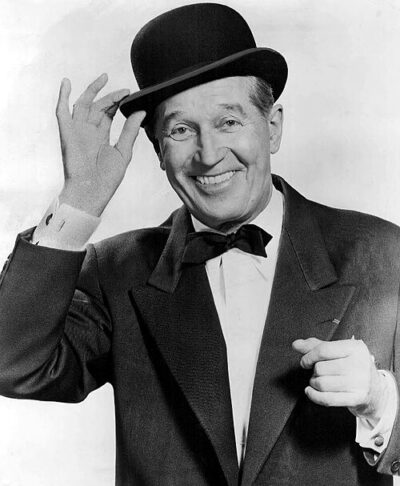
Maurice Chevalier
Maurice Chevalier was a French singer, actor, and entertainer. Born September 12, 1888, in 20th arrondissement of Paris. Died January 1, 1972, in 15th arrondissement of Paris. Awards include Golden Globe Cecil B. DeMille Award, Academy Honorary Award and Special Tony Award.
Facts
40 facts · 2 confirmed by two sources · 9 cited · 29 from one source
Where this comes from
Papalocal keeps its own record. It started from these sources; what each one said is kept here as it was copied, so a change on their side never changes this page by itself. Tap one to read its version.
What Wikidata says · copied November 16, 2026 · revision 2564907841
- Described as
- French singer, actor, and entertainer (1888–1972)
- Other names
- Maurice Auguste Chevalier
- Born
- September 12, 1888 · 16 references
- Died
- January 1, 1972 · 19 references
- Born in
- 20th arrondissement of Paris · 3 references
- Died in
- 15th arrondissement of Paris · 4 references
- Buried in
- Cemetery of Marnes-la-Coquette
- Cause of death
- cardiac arrest
- Name at birth
- Maurice Auguste Chevalier · 1 reference
- Citizen of
- France
- Occupation
- actor · 5 references; singer · 3 references; stage actor; film actor · 1 reference; lyricist; chansonnier; writer; dancer · 1 reference
- Genre
- café-chantant; music hall
- Instrument
- voice; piano
- Record label
- Imperial; RCA Victor; Vox Records; Decca; EMI; Philips Records
- Awards
- Golden Globe Cecil B. DeMille Award (1958); Academy Honorary Award (1958) · 1 reference; Special Tony Award (1968); Grammy Hall of Fame (1997); Croix de guerre 1914–1918; Officer of the National Order of Merit; Officer of the Legion of Honour; Disney Legends (2002) · 1 reference; star on Hollywood Walk of Fame · 1 reference; Knight of the Legion of Honour; Knight of the Order of Leopold; Officer of the order of Nichan Iftikhar
- Spouse
- Yvonne Vallée (1927–1932); Nita Raya (1937–1946)
- Wikipedias with a page
- 69
Wikidata item Q106001 (wikidata.org/wiki/Q106001), public domain (CC0). Copied November 16, 2026.
What Wikipedia says · copied November 16, 2026 · revision 1382302590
Maurice Auguste Chevalier (French: [mɔʁis ʃəvalje]; 12 September 1888 – 1 January 1972) was a French singer, actor, and entertainer. He is best known for his signature songs, including "Livin' In The Sunlight", "Valentine", "Louise", "Mimi", and "Thank Heaven for Little Girls", and for his films, including The Love Parade, The Big Pond, The Smiling Lieutenant, One Hour with You, and Love Me Tonight. His trademark attire was a boater hat and tuxedo.
Chevalier was born in Paris. He made his name as a star of musical comedy, appearing in public as a singer and dancer at an early age before working in menial jobs as a teenager. In 1909, he became the partner of the biggest female star in France at the time, Fréhel. Although their relationship was brief, she secured him his first major engagement, as a mimic and a singer in l'Alcazar in Marseille, for which he received critical acclaim by French theatre critics. In 1917, he discovered jazz and ragtime and went to London, where he found new success at the Palace Theatre.
After this, he toured the United States, where he met the American composers George Gershwin and Irving Berlin and brought the operetta Dédé to Broadway in 1922. He developed an interest in acting and had success in Dédé. When talkies arrived, he went to Hollywood in 1928, where he played his first American role in Innocents of Paris. In 1930, he was nominated for the Academy Award for Best Actor for his roles in The Love Parade (1929) and The Big Pond (1930), which secured his first big American hits, "You Brought a New Kind of Love to Me" and "Livin' in the Sunlight, Lovin' in the Moonlight".
In 1957, he appeared in Love in the Afternoon, which was his first Hollywood film in more than 20 years. In 1958, he starred with Leslie Caron and Louis Jourdan in Gigi. In the early 1960s, he made eight films, including Can-Can in 1960 and Fanny the following year. In 1970, he made his final contribution to the film industry where he sang the title song of the Disney film The Aristocats. He died in Paris, on 1 January 1972, from complications of a suicide attempt.
- Born, in its opening lines
- September 12, 1888
- Died, in its opening lines
- January 1, 1972
From the Wikipedia article “Maurice Chevalier” (en.wikipedia.org/wiki/Maurice_Chevalier), by its contributors, under CC BY-SA 4.0 (creativecommons.org/licenses/by-sa/4.0/). Copied November 16, 2026; not changed.
Confirmed Two sources agree. Cited One source, and it names where it got it. One source One source, without a reference of its own. Sources disagree The sources disagree. We show the best-supported value and keep theirs below.
