
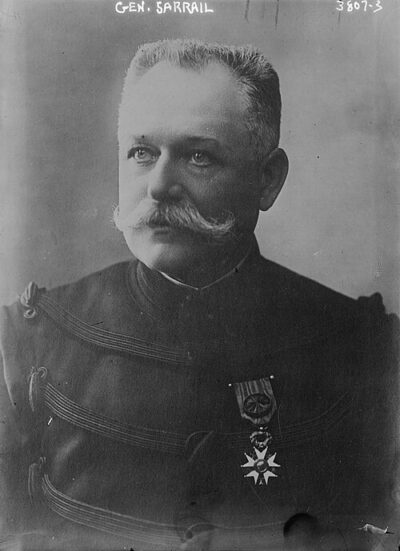
Maurice Sarrail
Maurice Sarrail was a French general. Born April 6, 1856, in Carcassonne. Died March 23, 1929, in Paris. Positions held include High Commissioner of the Levant (1924–1925). Educated at École Spéciale Militaire de Saint-Cyr. Awards include Grand Cross of the Legion of Honour, Croix de guerre 1914–1918 and Médaille militaire.
Facts
14 facts · 2 confirmed by two sources · 2 cited · 10 from one source
Where this comes from
Papalocal keeps its own record. It started from these sources; what each one said is kept here as it was copied, so a change on their side never changes this page by itself. Tap one to read its version.
What Wikidata says · copied November 16, 2026 · revision 2567828728
- Described as
- French general (1856–1929)
- Other names
- Maurice Paul Emmanuel Sarrail, Maurice-Paul-Emmanuel Sarrail
- Born
- April 6, 1856 · 2 references
- Died
- March 23, 1929 · 1 reference
- Born in
- Carcassonne · 1 reference
- Died in
- Paris · 1 reference
- Buried in
- Vault of Governors
- Citizen of
- France
- Occupation
- military personnel
- Positions held
- High Commissioner of the Levant (1924–1925)
- Education
- École Spéciale Militaire de Saint-Cyr
- Awards
- Grand Cross of the Legion of Honour; Croix de guerre 1914–1918; Médaille militaire
- Military branch
- French Army
- Military rank
- army general
- Wikipedias with a page
- 32
Wikidata item Q176522 (wikidata.org/wiki/Q176522), public domain (CC0). Copied November 16, 2026.
What Wikipedia says · copied November 16, 2026 · revision 1375664384
Maurice Paul Emmanuel Sarrail (6 April 1856 – 23 March 1929) was a French general of the First World War. Sarrail's openly socialist political connections made him a rarity amongst the Catholics, conservatives and monarchists who dominated the French Army officer corps under the Third Republic before the war, and were the main reason why he was appointed to command at Salonika.
At the start of the war, Sarrail commanded VI Corps then Third Army in the Ardennes and around Verdun, where his army played an important role in the final stages of the First Battle of the Marne and where he took the credit for holding Verdun (later the site of an important battle in 1916). He was dismissed for poor leadership, amidst political uproar, in July 1915.
The Salonika campaign – chosen out of several strategic options presented by Sarrail – was intended originally to support Serbia, with Bulgaria entering the war on the side of the Central Powers, and later (as the Gallipoli campaign was winding down) to provide a chance for France to assert her economic and political influence over Greece and the declining Ottoman Empire. Sarrail ended up commanding a multinational Allied force amidst political intrigue and a state of near civil war in Greece, whose King Constantine was pro-German, whilst the Prime Minister Venizelos was pro-Allied and also keen to gain territory from the Turks in western Anatolia. Despite a number of offensives, Sarrail's forces did not succeed either in conquering Bulgaria or in preventing the Central Powers' conquest of Serbia in 1915 or Romania in 1916. Sarrail was dismissed from his Salonika command in December 1917.
He later played a role in the French suppression of the Great Syrian Revolt in the mid-1920s.
- Born, in its opening lines
- April 6, 1856
- Died, in its opening lines
- March 23, 1929
From the Wikipedia article “Maurice Sarrail” (en.wikipedia.org/wiki/Maurice_Sarrail), by its contributors, under CC BY-SA 4.0 (creativecommons.org/licenses/by-sa/4.0/). Copied November 16, 2026; not changed.
Confirmed Two sources agree. Cited One source, and it names where it got it. One source One source, without a reference of its own. Sources disagree The sources disagree. We show the best-supported value and keep theirs below.
