
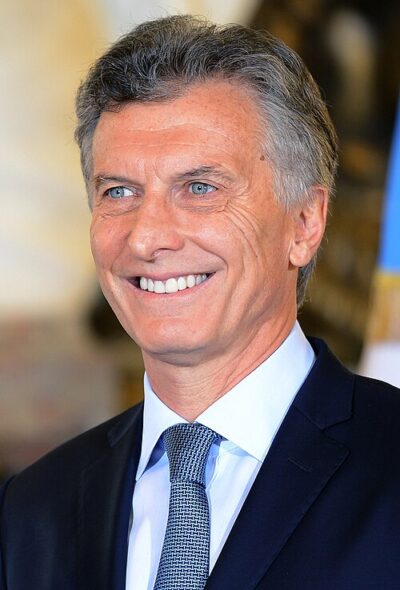
Mauricio Macri
Mauricio Macri is a president of Argentina from 2015 to 2019. Born February 8, 1959, in Tandil. Positions held include Chief of Government of the Autonomous City of Buenos Aires (2007–2015), member of the Argentine Chamber of Deputies (2005–2007) and President of Argentina (2015–2019). Educated at Pontifical Catholic University of Argentina and The Wharton School. Awards include Order of the Southern Cross, Collar of the Order of Isabella the Catholic and Knight Grand Cross in the Order of the Netherlands Lion.
Facts
41 facts · 1 confirmed by two sources · 15 cited · 25 from one source
Where this comes from
Papalocal keeps its own record. It started from these sources; what each one said is kept here as it was copied, so a change on their side never changes this page by itself. Tap one to read its version.
What Wikidata says · copied November 16, 2026 · revision 2558163714
- Described as
- president of Argentina from 2015 to 2019
- Born
- February 8, 1959 · 6 references
- Born in
- Tandil · 2 references
- Citizen of
- Argentina; Italy · 1 reference
- Occupation
- businessperson; politician · 1 reference; civil engineer · 1 reference; sports executive; bridge player; entrepreneur · 1 reference
- Positions held
- Chief of Government of the Autonomous City of Buenos Aires (2007–2015); member of the Argentine Chamber of Deputies (2005–2007); President of Argentina (2015–2019)
- Political party
- Republican Proposal (2009–); Commitment to Change (2003–2008)
- Education
- Pontifical Catholic University of Argentina; The Wharton School; Columbia Business School; University of CEMA
- Awards
- Order of the Southern Cross; Collar of the Order of Isabella the Catholic (2017) · 2 references; Knight Grand Cross in the Order of the Netherlands Lion; Order of the Aztec Eagle; Golden Key of Madrid (2017) · 1 reference; Grand Officer of the Order of the Sun of Peru; Grand Cordon of the Supreme Order of the Chrysanthemum; Knight Grand Cross with Collar of the Order of Merit of the Italian Republic; Knight Grand Cross of the Order of St. Olav (2018) · 2 references; Time 100 (2018) · 1 reference; Global Citizen Awards (2018) · 1 reference; Gold Olympic Order (2018)
- Spouse
- Ivonne Bordeu (1981–1991) · 1 reference; Isabel Menditeguy (1994–2005) · 1 reference; Juliana Awada (2010–2025) · 1 reference
- Children
- Agustina Macri · 1 reference
- Father
- Francisco Macri
- Siblings
- Gianfranco Macri
- Religion
- Catholicism · 1 reference
- Lived in
- Quinta presidencial de Olivos (2015–2019); Los Abrojos · 1 reference
- Website
- https://www.mauriciomacri.com.ar
- Wikipedias with a page
- 81
Wikidata item Q561837 (wikidata.org/wiki/Q561837), public domain (CC0). Copied November 16, 2026.
What Wikipedia says · copied November 16, 2026 · revision 1382726011
Mauricio Macri (pronounced [mawˈɾisjo ˈmakɾi] ; born 8 February 1959) is an Argentine businessman and politician who served as President of Argentina from 2015 to 2019. He has been the leader of the Republican Proposal (PRO) party since its founding in 2005. He previously served as Chief of Government of Buenos Aires from 2007 to 2015, and was a member of the Chamber of Deputies representing Buenos Aires from 2005 to 2007. Ideologically, he identifies himself as a liberal conservative on the Argentine centre-right.
Born in Tandil, Macri trained as a civil engineer at the Pontifical Catholic University of Argentina and attended Columbia University for business school. After embarking on a business career, he was kidnapped in 1991. The experience prompted him to enter politics, after being released by his captors. He served as president of football club Boca Juniors from 1994 to 2007, reestablishing its profitability which raised his public profile. In 2003 he launched the Commitment for Change, eventually developing it into the modern PRO party. Following an unsuccessful bid for Chief of Government of Buenos Aires in 2003, Macri was elected in 2007 and won re-election in 2011. Four years later he was elected president of Argentina in the 2015 general election – the first presidential runoff ballotage in Argentine history.
The presidency of Macri focused on reforming the national economy and improving diplomatic relations. He moved from a fixed exchange-rate system to a floating one, and removed taxes on exports and reduced subsidies on energy to reduce the fiscal deficit. He aligned the country with gradualist neoliberalism and re-opened Argentina to international markets by lifting currency controls (which he reinstated shortly before his term ended), restructuring sovereign debt, and pressing free-market solutions. Domestically, he pursued moderate socially liberal policies, and liberalized the energy sector.
Macri strongly opposed the government of Nicolás Maduro in Venezuela for human rights abuses and called for a restoration of democracy in the country. He recognized Juan Guaidó, who was elected President of Venezuela by the National Assembly during the Venezuelan presidential crisis of 2019. Macri improved Argentinian relations with the United States
and from Mercosur achieved a free trade agreement with the European Union and closer ties with the Pacific Alliance. During the first week in office, Macri annulled the Memorandum of understanding between Argentina and Iran, which would have established a joint investigation into the 1994 bombing with AMIA, a terrorist attack on a Jewish organization for which Argentina blamed Hezbollah and Iran.
His legislative pursuits varied in efficacy and received mixed reception from Argentines and globally. His presidency has been praised for leaving a legacy of anti-corruption and increasing Argentina's sovereign marketability, but has been criticized for failing to materially reform the economy, falling short of containing inflation, and building up external debt. Real wages declined during his term in office and a large number of small and medium-sized companies went out of business. In the 2019 general election, he became the first incumbent president in Argentina to lose reelection to a second term and was defeated by Alberto Fernández.
- Born, in its opening lines
- February 8, 1959
From the Wikipedia article “Mauricio Macri” (en.wikipedia.org/wiki/Mauricio_Macri), by its contributors, under CC BY-SA 4.0 (creativecommons.org/licenses/by-sa/4.0/). Copied November 16, 2026; not changed.
Confirmed Two sources agree. Cited One source, and it names where it got it. One source One source, without a reference of its own. Sources disagree The sources disagree. We show the best-supported value and keep theirs below.
