
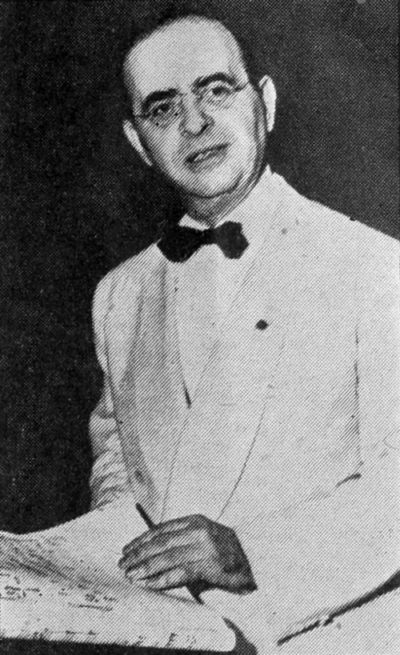
Max Steiner
Max Steiner was an Austrian-born American music composer and conductor. Born May 10, 1888, in Vienna. Died December 28, 1971, in Beverly Hills. Educated at University of Music and Performing Arts Vienna. Awards include Academy Award for Best Score, Adaptation or Treatment, Academy Award for Best Original Dramatic or Comedy Score (2 times) and star on Hollywood Walk of Fame.
Facts
21 facts · 2 confirmed by two sources · 8 cited · 11 from one source
Where this comes from
Papalocal keeps its own record. It started from these sources; what each one said is kept here as it was copied, so a change on their side never changes this page by itself. Tap one to read its version.
What Wikidata says · copied November 13, 2026 · revision 2567410435
- Described as
- Austrian-born American music composer and conductor (1888–1971)
- Other names
- Maximilian Raoul Steiner
- Born
- May 10, 1888 · 8 references
- Died
- December 28, 1971 · 8 references
- Born in
- Vienna · 1 reference
- Died in
- Beverly Hills · 1 reference
- Buried in
- Forest Lawn Memorial Park
- Cause of death
- heart failure
- Citizen of
- Austria–Hungary; United States
- Occupation
- conductor · 2 references; composer · 2 references; screenwriter; film score composer; musician · 1 reference
- Education
- University of Music and Performing Arts Vienna · 1 reference
- Genre
- opera
- Record label
- RCA Victor
- Awards
- Academy Award for Best Score, Adaptation or Treatment (1936) · 1 reference; Academy Award for Best Original Dramatic or Comedy Score (2 times) (1943, 1945) · 1 reference; star on Hollywood Walk of Fame · 1 reference
- Spouse
- Audrey Van Liew
- Father
- Gabor Steiner · 1 reference
- Wikipedias with a page
- 44
Wikidata item Q350704 (wikidata.org/wiki/Q350704), public domain (CC0). Copied November 13, 2026.
What Wikipedia says · copied November 13, 2026 · revision 1365853068
Maximilian Raoul Steiner (10 May 1888 – 28 December 1971) was an Austrian composer and conductor who emigrated to America and became one of Hollywood's greatest musical composers.
Steiner was a child prodigy who conducted his first operetta when he was twelve and became a full-time professional, proficient at composing, arranging, and conducting, by the time he was fifteen. Threatened with internment in England during World War I, he fled to Broadway; and in 1929 he moved to Hollywood, where he became one of the first composers to write music scores for films. He is often referred to as "the father of film music", as Steiner played a major part in creating the tradition of writing music for films, along with composers Dimitri Tiomkin, Erich Wolfgang Korngold, Franz Waxman, Alfred Newman, Bernard Herrmann, and Miklós Rózsa.
Steiner composed over 300 film scores with RKO Pictures and Warner Bros., and was nominated for 24 Academy Awards, winning three: The Informer (1935); Now, Voyager (1942); and Since You Went Away (1944). Besides his Oscar-winning scores, some of Steiner's popular works include King Kong (1933), Little Women (1933), Jezebel (1938), and Casablanca (1942), though he did not compose its love theme, "As Time Goes By". In addition, Steiner scored The Searchers (1956), A Summer Place (1959), and Gone with the Wind (1939), which ranked second on the AFI's list of best American film scores, and is the film score for which he is best known.
He was also the first recipient of the Golden Globe Award for Best Original Score, which he won for his score for Life with Father. Steiner was a frequent collaborator with some of the best known film directors in history, including Michael Curtiz, John Ford, and William Wyler, and scored many of the films with Errol Flynn, Bette Davis, Humphrey Bogart, and Fred Astaire. Many of his film scores are available as separate soundtrack recordings.
- Born, in its opening lines
- May 10, 1888
- Died, in its opening lines
- December 28, 1971
From the Wikipedia article “Max Steiner” (en.wikipedia.org/wiki/Max_Steiner), by its contributors, under CC BY-SA 4.0 (creativecommons.org/licenses/by-sa/4.0/). Copied November 13, 2026; not changed.
Confirmed Two sources agree. Cited One source, and it names where it got it. One source One source, without a reference of its own. Sources disagree The sources disagree. We show the best-supported value and keep theirs below.
