
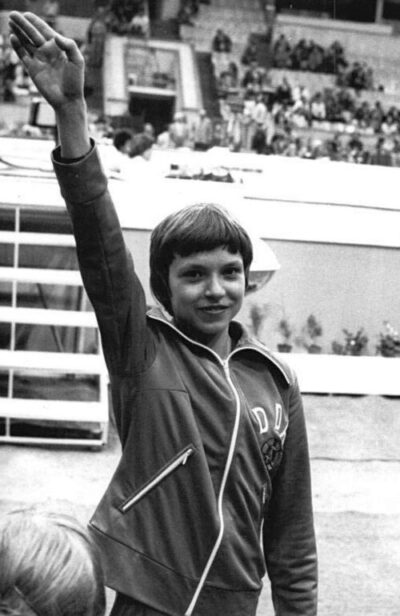
Maxi Gnauck
Maxi Gnauck is an East German artistic gymnast. Born October 10, 1964, in East Berlin. Awards include Patriotic Order of Merit in Gold, Star of People's Friendship in Silver and East German Sportspersonality of the Year.
Facts
11 facts · 1 confirmed by two sources · 1 cited · 9 from one source
Where this comes from
Papalocal keeps its own record. It started from these sources; what each one said is kept here as it was copied, so a change on their side never changes this page by itself. Tap one to read its version.
What Wikidata says · copied November 18, 2026 · revision 2561415144
- Described as
- East German artistic gymnast (born 1964)
- Other names
- M. Gnauck, Gnauck, Maxi
- Born
- October 10, 1964
- Born in
- East Berlin
- Citizen of
- Germany; East Germany
- Occupation
- artistic gymnast
- Sport
- artistic gymnastics
- Awards
- Patriotic Order of Merit in Gold (1984) · 1 reference; Star of People's Friendship in Silver (1986) · 1 reference; East German Sportspersonality of the Year (1980) · 1 reference; International Gymnastics Hall of Fame (2000) · 1 reference
- Height
- 1.48 m (4 ft 10 in) · 1 reference
- Wikipedias with a page
- 24
Wikidata item Q288957 (wikidata.org/wiki/Q288957), public domain (CC0). Copied November 18, 2026.
What Wikipedia says · copied November 18, 2026 · revision 1373557813
Maxi Gnauck (born 10 October 1964) is a German former artistic gymnast who represented East Germany. With a total of 27 medals at the Olympic Games, World Championships, World Cups, and European Championships she is considered one of the most successful woman gymnasts that Germany has ever produced. In 1980 she was selected East German Sportspersonality of the Year.
Her parents were expecting a boy and they planned to name him Max so, when the baby turned out to be a girl, they simply added an 'i', creating an uncommon name for Germany. When Maxi was five, her mother took her to a gymnastics centre in their area. By age eight, Maxi had won her first medals at the Kreisspartakiade. When she was nine she changed her club to SC Dynamo Berlin, where she was coached by Jürgen Heritz. Considered one of the best uneven bars competitors of all time, Maxi was also an excellent tumbler. She was one of the first female gymnasts to perform a triple twist on floor.
In April 1986, Maxi officially announced her retirement and began a four-year course in sports coaching at the University of Leipzig. In 1988 she was severely injured while sliding down a waterslide while working as an aide at a children's summer camp by the Baltic Sea. She broke her C5 vertebra and was nearly paralysed. Three vertebrae were later reinforced with a metal plate.
Facing a strong competition after the reunification of East Germany and West Germany, she first took temporary coaching positions in South Africa and Great Britain, both for a few months in 1990. From 1993 until 2004 she worked as a full-time coach at the Harksheide Gymnastics Center in Norderstedt near Hamburg. Since 2005 she has worked at the Artistic and Apparatus Gymnastics Center (Kunst- und Gerätturnzentrum) at Liestal in Switzerland. In 2000, she was inducted into the International Gymnastics Hall of Fame. She is the first German gymnast to be awarded that honour.
- Born, in its opening lines
- October 10, 1964
From the Wikipedia article “Maxi Gnauck” (en.wikipedia.org/wiki/Maxi_Gnauck), by its contributors, under CC BY-SA 4.0 (creativecommons.org/licenses/by-sa/4.0/). Copied November 18, 2026; not changed.
Confirmed Two sources agree. Cited One source, and it names where it got it. One source One source, without a reference of its own. Sources disagree The sources disagree. We show the best-supported value and keep theirs below.
