
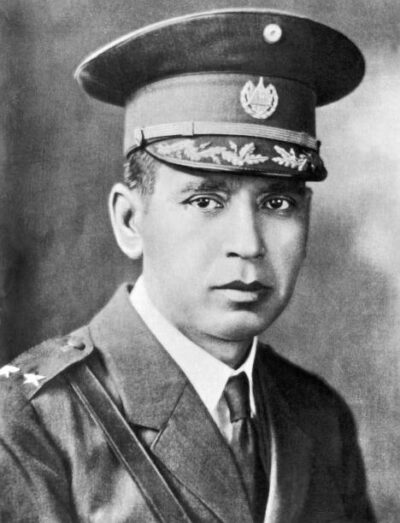
Maximiliano Hernández Martínez
Maximiliano Hernández Martínez was a president of El Salvador. Born October 21, 1882, in El Salvador. Died May 15, 1966, in Honduras. Positions held include President of El Salvador (1931–1944). Awards include Collar of the Order of Isabella the Catholic and Grand Cross of the Order of Isabella the Catholic.
Facts
13 facts · 2 confirmed by two sources · 0 cited · 11 from one source
Where this comes from
Papalocal keeps its own record. It started from these sources; what each one said is kept here as it was copied, so a change on their side never changes this page by itself. Tap one to read its version.
What Wikidata says · copied November 16, 2026 · revision 2552209437
- Described as
- president of El Salvador (1882–1966)
- Other names
- Maximiliano Hernandez Martinez
- Born
- October 21, 1882 · 1 reference
- Died
- May 15, 1966
- Born in
- El Salvador
- Died in
- Honduras
- Cause of death
- stab wound
- Citizen of
- El Salvador
- Occupation
- politician; military officer
- Positions held
- President of El Salvador (1931–1944)
- Awards
- Collar of the Order of Isabella the Catholic (1941) · 1 reference; Grand Cross of the Order of Isabella the Catholic (1940) · 1 reference
- Religion
- Theosophy
- Military rank
- brigadier general
- Wikipedias with a page
- 33
Wikidata item Q319419 (wikidata.org/wiki/Q319419), public domain (CC0). Copied November 16, 2026.
What Wikipedia says · copied November 16, 2026 · revision 1378245265
Maximiliano Hernández Martínez (21 October 1882 – 15 May 1966) was a Salvadoran military officer and politician who served as the 27th president of El Salvador from 4 December 1931 to 28 August 1934 in a provisional capacity and again in an official capacity from 1 March 1935 until his resignation on 9 May 1944. Martínez was the leader of El Salvador during most of World War II.
Martínez began his military career in the Salvadoran Army, attended the Polytechnic School of Guatemala, and attained the rank of brigadier general by 1919. He ran for president during the 1931 presidential election but withdrew his candidacy and instead endorsed Labor Party candidate Arturo Araujo, who selected Martínez to serve as his vice president and later minister of war. After the Salvadoran military overthrew Araujo in December 1931, the military junta established by the coup plotters, known as the Civic Directory, named Martínez as the country's provisional president. His presidency was not recognized by the United States or other Central American countries until January 1934. The 1931 coup and Martínez's succession to the presidency allowed for the rise of a series of military dictatorships that held onto power in El Salvador until 1979.
Martinez served as president of El Salvador for more than 12 years, making him the longest-serving president in Salvadoran history, and his presidency is sometimes referred to as the Martinato. In January 1932, shortly after assuming the presidency, Martínez crushed a communist and indigenous rebellion. The mass killings committed by the Salvadoran military police following the rebellion's suppression have since been referred to as La Matanza ("The Massacre") and resulted in the deaths of between 10,000 and 40,000 peasants. Martínez ruled El Salvador as a totalitarian one-party state led by the National Pro Patria Party, a political party he established in 1933 to support his 1935 presidential election campaign. The 1935, 1939 and 1944 presidential elections were uncontested, and Martínez received every vote cast. Martínez established the Central Reserve Bank and engaged in infrastructure projects such as building the Pan-American Highway in El Salvador, building the Cuscatlán Bridge in central El Salvador, and inaugurating the Nacional Flor Blanca stadium, which held the 1935 Central American and Caribbean Games. The Salvadoran economy almost exclusively relied on coffee production and exports during Martínez's presidency, particularly to Germany and the United States. El Salvador joined the Allied powers of World War II and declared war on Germany, Italy, and Japan in December 1941. Following an attempted coup in April 1944 and massive civil unrest following the execution of the coup's leaders, Martínez resigned as president in May 1944, and he and his family fled the country. In 1966, Martínez was killed in exile at his home in Honduras by his taxi driver following a labor dispute.
Martínez remains a controversial figure in El Salvador. Martínez was described as a fascist and admired the European fascist movements such as those in Germany and Italy. During the lead-up to World War II, he and many of his government officials held sympathies for the Nazis and Axis powers; however, sympathizers were later purged from the government after El Salvador joined the war on the side of the Allies. Martínez was a theosophist, believed in the occult, and had a number of religious and personal beliefs his contemporaries considered unorthodox. During the Salvadoran Civil War (1979–1992), a death squad named after him claimed responsibility for the assassinations of several left-wing politicians.
- Born, in its opening lines
- October 21, 1882
- Died, in its opening lines
- May 15, 1966
From the Wikipedia article “Maximiliano Hernández Martínez” (en.wikipedia.org/wiki/Maximiliano_Hernández_Martínez), by its contributors, under CC BY-SA 4.0 (creativecommons.org/licenses/by-sa/4.0/). Copied November 16, 2026; not changed.
Confirmed Two sources agree. Cited One source, and it names where it got it. One source One source, without a reference of its own. Sources disagree The sources disagree. We show the best-supported value and keep theirs below.
