
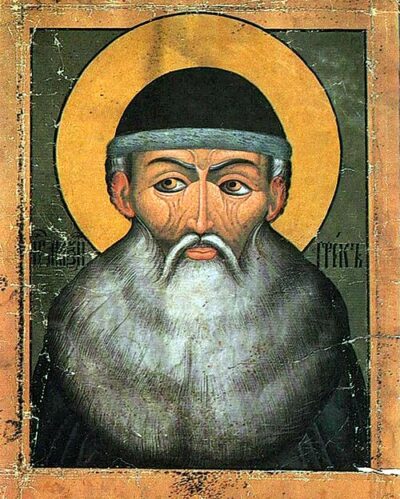
Maximus the Greek was a Greek monk and scholar. Born 1475, in Arta. Died January 21, 1556, in Trinity Lavra of St. Sergius.
Facts
11 facts · 0 confirmed by two sources · 3 cited · 8 from one source
Where this comes from
Papalocal keeps its own record. It started from these sources; what each one said is kept here as it was copied, so a change on their side never changes this page by itself. Tap one to read its version.
What Wikidata says · copied November 17, 2026 · revision 2554160988
- Described as
- Greek monk and scholar
- Born
- 1475
- Died
- January 21, 1556
- Born in
- Arta
- Died in
- Trinity Lavra of St. Sergius
- Citizen of
- Tsardom of Russia
- Occupation
- translator; writer; philosopher · 1 reference; theologian · 1 reference; religious writer · 1 reference
- Religion
- Eastern Orthodoxy
- Wikipedias with a page
- 27
Wikidata item Q138302 (wikidata.org/wiki/Q138302), public domain (CC0). Copied November 17, 2026.
What Wikipedia says · copied November 17, 2026 · revision 1365875495
Maximus the Greek, also known as Maximos the Greek or Maksim Grek (Greek: Μάξιμος ὁ Γραικός; Russian: Максим Грек; c. 1475 – c. 1556), was a Greek monk, publicist, writer, scholar, and translator active in Russia. He is also called Maximos the Hagiorite (Μάξιμος ὁ Ἁγιορίτης), as well as Maximus the Philosopher. His signature was Maximus Grecus Lakedaimon (lit. Maximus the Greek of, and originating from, Lakedaimonia) and his family origins were probably from Mystras, a location in Laconia, which was the geographical site of Ancient Sparta in the Peloponnese. Canonised in 1988, he is venerated as a saint by Eastern Orthodox Christians; with a feast day on 21 January.
From the Wikipedia article “Maximus the Greek” (en.wikipedia.org/wiki/Maximus_the_Greek), by its contributors, under CC BY-SA 4.0 (creativecommons.org/licenses/by-sa/4.0/). Copied November 17, 2026; not changed.
Confirmed Two sources agree. Cited One source, and it names where it got it. One source One source, without a reference of its own. Sources disagree The sources disagree. We show the best-supported value and keep theirs below.
