
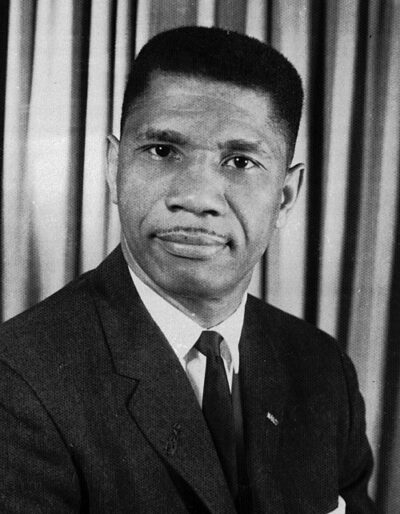
Medgar Evers
Medgar Evers was an African-American civil rights activist. Born July 2, 1925, in Decatur. Died June 12, 1963, in Jackson. Teams include Alcorn State Braves football. Educated at Alcorn State University and University of Mississippi School of Law. Awards include Spingarn Medal and Presidential Medal of Freedom.
Facts
18 facts · 2 confirmed by two sources · 8 cited · 8 from one source
Where this comes from
Papalocal keeps its own record. It started from these sources; what each one said is kept here as it was copied, so a change on their side never changes this page by itself. Tap one to read its version.
What Wikidata says · copied November 15, 2026 · revision 2569676197
- Described as
- African-American civil rights activist (1925-1963)
- Other names
- Medgar Wiley Evers, Medgar Wylie Evers
- Born
- July 2, 1925 · 7 references
- Died
- June 12, 1963 · 6 references
- Born in
- Decatur · 2 references
- Died in
- Jackson · 2 references
- Buried in
- Arlington National Cemetery (1963) · 2 references
- Citizen of
- United States
- Occupation
- politician; human rights defender · 1 reference
- Education
- Alcorn State University · 1 reference; University of Mississippi School of Law · 1 reference
- Member of
- NAACP
- Teams
- Alcorn State Braves football · 1 reference
- Awards
- Spingarn Medal (1963) · 2 references; Presidential Medal of Freedom (2024) · 1 reference
- Spouse
- Myrlie Evers-Williams (1951–1963) · 1 reference
- Children
- Darrell K. Evers
- Siblings
- Charles Evers
- Military branch
- United States Army (1943–1945)
- Wikipedias with a page
- 31
Wikidata item Q717985 (wikidata.org/wiki/Q717985), public domain (CC0). Copied November 15, 2026.
What Wikipedia says · copied November 15, 2026 · revision 1384988717
Medgar Wiley Evers (; July 2, 1925 – June 12, 1963) was an African American civil rights activist who was the NAACP's first field secretary in Mississippi. A United States Army veteran who served in World War II, he was engaged in efforts to overturn racial segregation at the University of Mississippi, end the segregation of public facilities, and expand opportunities for African Americans, including the enforcement of voting rights, prior to his assassination.
After college, Evers became active in the civil rights movement in the 1950s. Following the 1954 ruling of the United States Supreme Court in Brown v. Board of Education that segregated public schools were unconstitutional, he challenged the segregation of the state-supported public University of Mississippi. Evers applied to law school there, as the state had no public law school for African Americans. He also worked for voting rights, economic opportunity, access to public facilities, and other changes in the segregated society. In 1963, Evers was awarded the NAACP Spingarn Medal.
On June 12, 1963, Evers was murdered at his home in Jackson, Mississippi, now the Medgar and Myrlie Evers Home National Monument, by Byron De La Beckwith, a member of the White Citizens' Council in Jackson. Only hours earlier, Evers was listening to President John F. Kennedy's speech Report to the American People on Civil Rights.
Evers's assassination and the resulting trials inspired civil rights protests. His life and death have inspired numerous works of art, music, and film. Although all-white juries failed to reach verdicts in the first two trials of De La Beckwith in the 1960s, he was convicted in 1994 based on new evidence. Evers's widow Myrlie became a noted activist in her own right and served as national chair of the NAACP. In 1969, after passage of civil rights legislation and the Voting Rights Act of 1965, Medgar's older brother Charles was elected as mayor of Fayette, Mississippi. He was the first African American to be elected mayor of a Mississippi city in the post-Reconstruction era.
- Born, in its opening lines
- July 2, 1925
- Died, in its opening lines
- June 12, 1963
From the Wikipedia article “Medgar Evers” (en.wikipedia.org/wiki/Medgar_Evers), by its contributors, under CC BY-SA 4.0 (creativecommons.org/licenses/by-sa/4.0/). Copied November 15, 2026; not changed.
Confirmed Two sources agree. Cited One source, and it names where it got it. One source One source, without a reference of its own. Sources disagree The sources disagree. We show the best-supported value and keep theirs below.
