
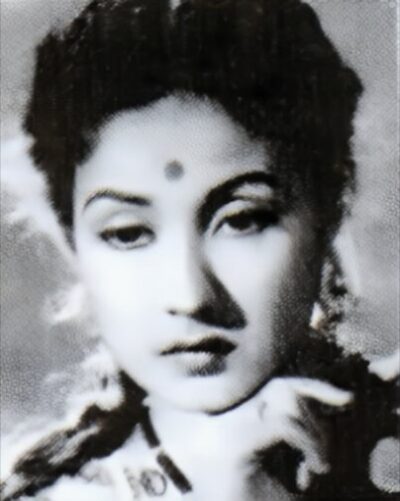
Meena Kumari
Meena Kumari was an Indian actress and poet. Born August 1, 1933, in Dadar. Died March 31, 1972, in Mumbai. Awards include Filmfare Award for Best Actress and Bengal Film Journalists' Association Awards.
Facts
22 facts · 2 confirmed by two sources · 1 cited · 19 from one source
Where this comes from
Papalocal keeps its own record. It started from these sources; what each one said is kept here as it was copied, so a change on their side never changes this page by itself. Tap one to read its version.
What Wikidata says · copied November 16, 2026 · revision 2565341341
- Described as
- Indian actress and poet (1933-1972)
- Other names
- Mahjabeen Baro
- Born
- August 1, 1933 · 2 references
- Died
- March 31, 1972 · 2 references
- Born in
- Dadar
- Died in
- Mumbai
- Buried in
- Mumbai
- Cause of death
- liver cirrhosis
- Name at birth
- महजबी बानो
- Citizen of
- British Raj (–1947); India (1950–); Dominion of India (1947–1950)
- Occupation
- actor · 1 reference; poet; costume designer; singer
- Instrument
- voice
- Awards
- Filmfare Award for Best Actress (1954); Bengal Film Journalists' Association Awards (1958)
- Field
- poetry; film actor
- Spouse
- Kamal Amrohi (1952–1972)
- Siblings
- Khursheed Bano
- Religion
- Islam
- Wikipedias with a page
- 49
Wikidata item Q465848 (wikidata.org/wiki/Q465848), public domain (CC0). Copied November 16, 2026.
What Wikipedia says · copied November 16, 2026 · revision 1379688444
Meena Kumari (born Mahjabeen Bano; 1 August 1933 – 31 March 1972) was an Indian actress and poet, who worked in Hindi films. Widely regarded as the "Tragedy Queen of Bollywood", she is considered one of the greatest actresses in the history of Indian cinema. In a career spanning 33 years, from child actress to adult, Kumari is a recipient of several accolades, including four Filmfare awards and has starred in over 90 films.
Kumari won four Filmfare Awards in the Best Actress category. She was the recipient of the inaugural Filmfare Best Actress Award for Baiju Bawra in 1954 and had a consecutive win in the second Filmfare Awards (1955) for Parineeta. Kumari made history at the 10th Filmfare Awards (1963) by receiving all three of the Best Actress nominations, and won for her performance in Sahib Bibi Aur Ghulam. In the 13th Filmfare Awards (1966), she won her last Best Actress award for Kaajal. Critics have noted that her character in Sahib Bibi Aur Ghulam is similar to her life. She also went onto appear in other successful films such as - Do Bigha Zamin (1953), Dil Apna Aur Preet Parai (1960), Aarti (1962), Main Chup Rahungi (1962), Dil Ek Mandir (1963), Phool Aur Patthar (1966) and Mere Apne (1971).
By late 1960s, Kumari became addicted to alcohol, the effect of which was visible in her subsequent films. Kumari was also a poet and a playback singer. She sang in some of her early films as a child artist and to her poems which came out in an album, I Write, I Recite (1971). She also designed the costumes in Pakeezah. On 31 March 1972, Kumari died at the age of 38, from cirrhosis of the liver, which has been associated with her alcoholism.
- Born, in its opening lines
- August 1, 1933
- Died, in its opening lines
- March 31, 1972
From the Wikipedia article “Meena Kumari” (en.wikipedia.org/wiki/Meena_Kumari), by its contributors, under CC BY-SA 4.0 (creativecommons.org/licenses/by-sa/4.0/). Copied November 16, 2026; not changed.
Confirmed Two sources agree. Cited One source, and it names where it got it. One source One source, without a reference of its own. Sources disagree The sources disagree. We show the best-supported value and keep theirs below.
