
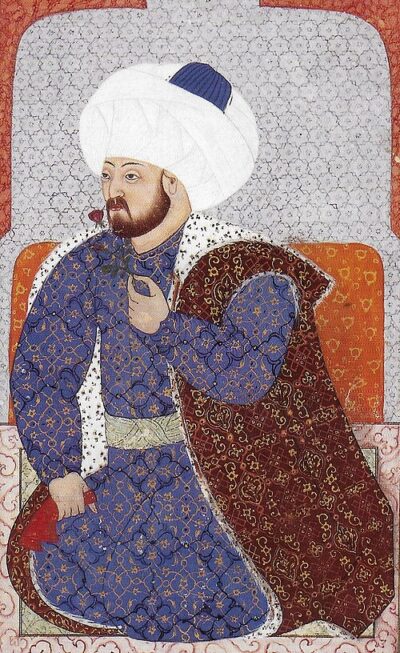
Mehmed II
Mehmed II was a seventh Sultan of the Ottoman Empire (1444–1446, 1451–1481). Born March 30, 1432, in Edirne. Died May 3, 1481, in Gebze. Positions held include sultan of the Ottoman Empire (2 times) (1444–1481).
Facts
19 facts · 2 confirmed by two sources · 4 cited · 13 from one source
Where this comes from
Papalocal keeps its own record. It started from these sources; what each one said is kept here as it was copied, so a change on their side never changes this page by itself. Tap one to read its version.
What Wikidata says · copied November 16, 2026 · revision 2568217551
- Described as
- seventh Sultan of the Ottoman Empire (1444–1446, 1451–1481)
- Other names
- Muhammad bin Murad Khan, Mehmet II, Fatih Sultan Mehmed, Sultan Mehmed the Conqueror, Mehmed bin Murad Khan, Mehmed the Conqueror, II. Mehmet, II. Mehmed
- Born
- March 30, 1432 · 1 reference
- Died
- May 3, 1481 · 4 references
- Born in
- Edirne
- Died in
- Gebze
- Buried in
- Tomb of Mehmed the Conqueror
- Occupation
- monarch; poet · 1 reference; sultan · 1 reference
- Positions held
- sultan of the Ottoman Empire (2 times) (1444–1481)
- Spouse
- Sittişah Mükrime Hatun; Anna Komnene
- Children
- Bayezid II · 1 reference; Cem Sultan · 1 reference; Gevherhan Hatun · 1 reference; Şehzade Mustafa
- Father
- Murad II
- Mother
- Hüma Hatun
- Siblings
- Fatma Sultan
- Religion
- Islam · 1 reference
- Wikipedias with a page
- 122
Wikidata item Q34503 (wikidata.org/wiki/Q34503), public domain (CC0). Copied November 16, 2026.
What Wikipedia says · copied November 16, 2026 · revision 1385332132
Mehmed II (Ottoman Turkish: محمد ثانى, romanized: Meḥemmed-i s̱ānī; Turkish: II. Mehmed, pronounced [icinˈdʒi ˈmehmet]; 30 March 1432 – 3 May 1481), commonly known as Mehmed the Conqueror (Ottoman Turkish: ابو الفتح, romanized: Ebū'l-fetḥ, lit. 'the Father of Conquest'; Turkish: Fâtih Sultan Mehmed), was the sultan of the Ottoman Empire twice, from August 1444 to September 1446 and again from February 1451 to May 1481.
During his first reign, he defeated the crusade led by John Hunyadi after Hungarian incursions into his lands violated the Treaties of Edirne and Szeged. Upon his restoration to the throne in 1451, he strengthened the Ottoman Navy and made preparations to attack Constantinople. In 1453, at the age of 21, he conquered Constantinople and effectively brought an end to the Byzantine Empire. After the conquest, Mehmed claimed the title caesar of Rome (Ottoman Turkish: قیصر روم, romanized: qayṣar-i rūm), on the grounds that Constantinople had been the seat and capital of the surviving Eastern Roman Empire since its consecration in 330 AD by Emperor Constantine I. The claim was soon recognized by the Patriarchate of Constantinople, but rejected by most European monarchs.
Mehmed continued his conquests and reunified Anatolia, and campaigned as far west as Bosnia in Southeast Europe. At home, he implemented many political and social reforms. He was a patron of the arts and sciences, and by the end of his reign, Constantinople had been transformed into a thriving imperial capital. He is considered a hero in modern-day Turkey and parts of the wider Muslim world, with Istanbul's Fatih district, Fatih Sultan Mehmet Bridge and Fatih Mosque being named after him.
- Born, in its opening lines
- March 30, 1432
- Died, in its opening lines
- May 3, 1481
From the Wikipedia article “Mehmed II” (en.wikipedia.org/wiki/Mehmed_II), by its contributors, under CC BY-SA 4.0 (creativecommons.org/licenses/by-sa/4.0/). Copied November 16, 2026; not changed.
Confirmed Two sources agree. Cited One source, and it names where it got it. One source One source, without a reference of its own. Sources disagree The sources disagree. We show the best-supported value and keep theirs below.
