
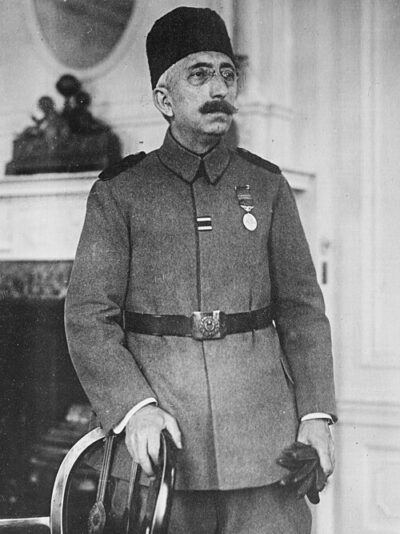
Mehmed VI
Mehmed VI was the 36th and last Sultan of the Ottoman Empire. Born January 14, 1861, in Istanbul. Died May 16, 1926, in Sanremo. Positions held include sultan of the Ottoman Empire (1918–1922).
Facts
31 facts · 2 confirmed by two sources · 7 cited · 22 from one source
Where this comes from
Papalocal keeps its own record. It started from these sources; what each one said is kept here as it was copied, so a change on their side never changes this page by itself. Tap one to read its version.
What Wikidata says · copied November 16, 2026 · revision 2560267081
- Described as
- 36th and last Sultan of the Ottoman Empire (1918–1922)
- Other names
- Mehmed VI Vahideddin, Mehmet VI, Mehmet Vahdettin, Mehmed Vahdettin, Mehmed Vahideddin, VI. Mehmet, Vahideddin, VI. Mehmed
- Born
- January 14, 1861 · 4 references
- Died
- May 16, 1926 · 4 references
- Born in
- Istanbul · 2 references
- Died in
- Sanremo · 1 reference
- Buried in
- cemetery of the Sulaymaniyya Takiyya
- Cause of death
- stroke · 1 reference
- Citizen of
- Ottoman Empire · 1 reference
- Occupation
- sovereign
- Positions held
- sultan of the Ottoman Empire (1918–1922) · 1 reference
- Member of
- Ottoman dynasty · 1 reference
- Spouse
- Emine Nazikeda Kadınefendi (–1926); Müveddet Kadın · 1 reference; Nevvare Hanım; Nimet Nevzad Hanım; Inşirah Hanım
- Children
- Sabiha Sultan; Fatma Ulviye Sultan · 1 reference; Şehzade Mehmed Ertuğrul · 1 reference
- Father
- Abdülmecid I
- Mother
- Gülistü Kadin
- Siblings
- Abdul Hamid II; Mehmed V; Şehzade Ahmed Kemaleddin; Murad V; Şehzade Mehmed Burhaneddin; Refia Sultan · 1 reference; Fatma Sultan · 1 reference; Mediha Sultan · 1 reference
- Religion
- Islam · 1 reference; Sunni Islam
- Military rank
- Generalfeldmarschall
- Wikipedias with a page
- 81
Wikidata item Q162543 (wikidata.org/wiki/Q162543), public domain (CC0). Copied November 16, 2026.
What Wikipedia says · copied November 16, 2026 · revision 1384486934
Mehmed VI Vahideddin (Ottoman Turkish: محمد سادس, romanized: Meḥmed-i sâdis, or وحيد الدين, Vaḥîdü'd-Dîn; Turkish: VI. Mehmed or Vahideddin, also spelled as Vahdettin; 14 January 1861 – 16 May 1926), also known as Şahbaba (lit. 'Emperor-father') among the Osmanoğlu family, was the last sultan of the Ottoman Empire and the penultimate Ottoman caliph, reigning from 4 July 1918 until 1 November 1922, when the Ottoman Sultanate was abolished and replaced by the Republic of Turkey on 29 October 1923.
Vahdettin was a son of Sultan Abdul Mejid I and viewed as unlikely to become Sultan because of his distant rank in the Ottoman line of succession. He enjoyed a comfortable princedom under the reign of his half-brother Abdul Hamid II, but entered the spotlight in 1916 when he became Crown Prince. He acceded to the throne after the death of Mehmed V Reşad on 4 July 1918 as the 36th padishah and 115th Islamic Caliph, taking Mehmed VI as his regal name.
Mehmed VI's chaotic reign began with Turkey suffering defeat by the Allied Powers with the conclusion of World War I nearing. The subsequent Armistice of Mudros legitimized further Allied incursions into Turkish territory, resulting in an informal occupation of Istanbul and other parts of the empire. An initial process of reconciliation with Christian minorities over their massacres and deportations failed when the Greek and Armenian patriarchates renounced their flocks' status as Ottoman subjects, marking a definitive end of Ottomanism. During the Paris Peace Conference, Mehmed VI turned to Damat Ferid Pasha to outflank Greek territorial demands on Turkey diplomatically through Allied appeasement, but to no avail. Unionist elements within the military, discontent with the government's appeasement in the face of partition and the establishment of war crimes tribunals, established a nationalist resistance to resume war. Mehmed's most significant act as Sultan was dispatching Mustafa Kemal Pasha (Atatürk) to reassert government control in Anatolia, which backfired when Mustafa Kemal emerged as the leader of the Turkish national movement against the Sultan's wishes.
With the Greek Occupation of Smyrna on 15 May 1919 galvanizing the Turkish nationalists and beginning the Turkish War of Independence, Mehmed told the Turks to not resist the Greeks. The Allies occupied Istanbul militarily on 16 March 1920. Sultan Mehmed VI dissolved the nationalist dominated Chamber of Deputies and suspended the Constitution. When the Turkish nationalists stood against Allied designs for a partition of Anatolia, Kemal Pasha responded by establishing a provisional government known as the Grand National Assembly based in Ankara, which dominated the rest of Turkey, while the Sultan's unpopular government in Istanbul was propped up by the Allied powers and effectively impotent. A civil war erupted when Mehmed condemned the nationalist leaders as infidels and called for their execution, though the Ankara government claimed it was rescuing the Sultan-Caliph from manipulative foreigners and ministers. The Sultan's Istanbul government went on to sign the Treaty of Sèvres, a peace treaty which would have partitioned the empire, and left the remainder of the country without sovereignty.
With Ankara's victory in the independence war, the Sèvres Treaty was abandoned for the Treaty of Lausanne. On 1 November 1922, the Grand National Assembly voted to abolish the Sultanate and to depose Mehmed VI as Caliph and he subsequently fled the country on a British battleship. His cousin Abdul Mejid II was elected Caliph in his stead, though he too, and the entire Osmanoğlu family were soon exiled after the abolition of the Caliphate. On 29 October 1923, the Republic of Turkey was declared with Mustafa Kemal Pasha as its first president, ending the Ottoman monarchy. Mehmed VI died in exile in 1926 in San Remo, Italy, having never acknowledged his deposition.
- Born, in its opening lines
- January 14, 1861
- Died, in its opening lines
- May 16, 1926
From the Wikipedia article “Mehmed VI” (en.wikipedia.org/wiki/Mehmed_VI), by its contributors, under CC BY-SA 4.0 (creativecommons.org/licenses/by-sa/4.0/). Copied November 16, 2026; not changed.
Confirmed Two sources agree. Cited One source, and it names where it got it. One source One source, without a reference of its own. Sources disagree The sources disagree. We show the best-supported value and keep theirs below.
