
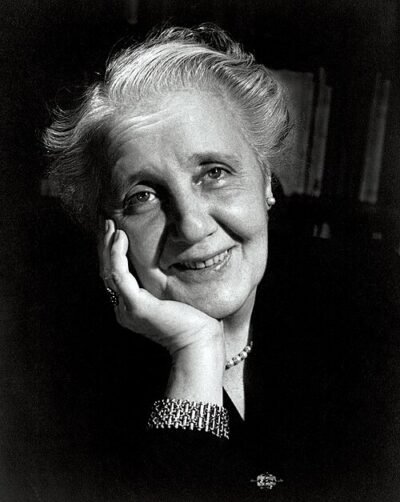
Melanie Klein
Melanie Klein was a British Austrian born psychoanalyst. Born March 30, 1882, in Vienna. Died September 22, 1960, in London. Educated at University of Vienna. Awards include Honorary Fellow of the British Psychological Society.
Facts
17 facts · 2 confirmed by two sources · 5 cited · 10 from one source
Where this comes from
Papalocal keeps its own record. It started from these sources; what each one said is kept here as it was copied, so a change on their side never changes this page by itself. Tap one to read its version.
What Wikidata says · copied November 16, 2026 · revision 2568736781
- Described as
- British Austrian born psychoanalyst (1882–1960)
- Other names
- מלאני קליין
- Born
- March 30, 1882 · 9 references
- Died
- September 22, 1960 · 9 references
- Born in
- Vienna · 1 reference
- Died in
- London · 1 reference
- Buried in
- Golders Green Crematorium · 1 reference
- Name at birth
- Melanie Reizes
- Citizen of
- United Kingdom · 1 reference; United Kingdom of Great Britain and Ireland (–1927)
- Occupation
- psychoanalyst · 1 reference
- Education
- University of Vienna
- Member of
- Magyar Pszichoanalitikus Egyesület; British Psychoanalytical Society; Berliner Psychoanalytische Vereinigung
- Awards
- Honorary Fellow of the British Psychological Society
- Field
- psychoanalysis · 1 reference
- Children
- Melitta Schmideberg
- Website
- http://www.melanie-klein-trust.org.uk/
- Wikipedias with a page
- 57
Wikidata item Q82999 (wikidata.org/wiki/Q82999), public domain (CC0). Copied November 16, 2026.
What Wikipedia says · copied November 16, 2026 · revision 1383789536
Melanie Klein (; German: [klaɪn]; née Reizes; 30 March 1882 – 22 September 1960) was an Austrian-British author and psychoanalyst known for her work in child analysis. She was the primary figure in the development of object relations theory. Klein's work primarily focused on the role of ambivalence and moral ambiguity in human development. Klein suggested that pre-verbal existential anxiety in infancy catalyzed the formation of the unconscious, which resulted in the unconscious splitting of the world into good and bad idealizations. In her theory, how the child resolves that split depends on the constitution of the child and the character of nurturing the child experiences. The quality of resolution can inform the presence, absence, and/or type of distresses a person experiences later in life.
- Born, in its opening lines
- March 30, 1882
- Died, in its opening lines
- September 22, 1960
From the Wikipedia article “Melanie Klein” (en.wikipedia.org/wiki/Melanie_Klein), by its contributors, under CC BY-SA 4.0 (creativecommons.org/licenses/by-sa/4.0/). Copied November 16, 2026; not changed.
Confirmed Two sources agree. Cited One source, and it names where it got it. One source One source, without a reference of its own. Sources disagree The sources disagree. We show the best-supported value and keep theirs below.
