
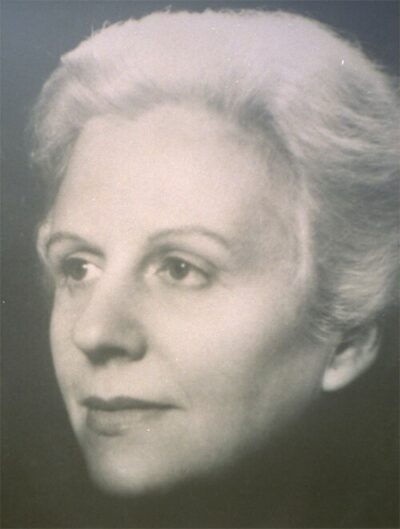
Mercè Rodoreda
Mercè Rodoreda was a Spanish writer. Born October 10, 1908, in Barcelona. Died April 13, 1983, in Girona. Known for The Time of the Doves, Mirall trencat and Aloma. Educated at Escola Menéndez Pelayo and Liceu Dalmau. Awards include Premi d'Honor de les Lletres Catalanes, Gold Letter and Serra d'Or Critics' Prize for Literature and Essays (5 times).
Facts
54 facts · 2 confirmed by two sources · 12 cited · 40 from one source
Where this comes from
Papalocal keeps its own record. It started from these sources; what each one said is kept here as it was copied, so a change on their side never changes this page by itself. Tap one to read its version.
What Wikidata says · copied November 16, 2026 · revision 2567952591
- Described as
- Spanish writer (1908-1983)
- Other names
- Merce Rodoreda, Rodoreda, Mercedes Rodoreda, Merce Rodoreda i Gurgui
- Born
- October 10, 1908 · 9 references
- Died
- April 13, 1983 · 8 references
- Born in
- Barcelona · 2 references
- Died in
- Girona · 2 references
- Buried in
- Cementiri de Romanyà de la Selva
- Cause of death
- liver cancer
- Name at birth
- Mercè Rodoreda i Gurguí · 1 reference
- Citizen of
- Spain · 1 reference
- Occupation
- writer · 2 references; novelist; poet · 1 reference; Esperantist; short story writer; painter · 1 reference
- Worked for
- Revista de Catalunya (1947–); Comissariat de propaganda (1937–1939); La Publicitat (1935–1939); Institució de les Lletres Catalanes
- Education
- Escola Menéndez Pelayo (1915–1916) · 1 reference; Liceu Dalmau (1931–1934)
- Member of
- Associació d'Escriptors en Llengua Catalana
- Known for
- The Time of the Doves; Mirall trencat; Aloma; Sóc una dona honrada?; Del que hom no pot fugirc; Un dia en la vida d'un home; Crim; Vint-i-dos contes; El carrer de les Camèlies; Jardí vora el mar
- Awards
- Premi d'Honor de les Lletres Catalanes (1980) · 1 reference; Gold Letter (1976); Serra d'Or Critics' Prize for Literature and Essays (5 times) (1967, 1968, 1981, 1982, 1987) · 1 reference; Joan Crexells award (1937) · 2 references; Mestre en Gai Saber (1949) · 1 reference; Flor Natural (2 times) (1947, 1948); Joan Santamaria Prize (1956); Mercè Rodoreda Award (1957); Premi Sant Jordi de novel·la (1965); City of Barcelona Award (1980); Premi de la Crítica de narrativa catalana (1981); Ramon Llull Novel Award (1969)
- Field
- literature
- Spouse
- Joan Gurguí (1928–1937)
- Children
- Jordi Gurguí i Rodoreda
- Father
- Andreu Rodoreda i Sallent
- Mother
- Montserrat Gurguí i Guàrdia
- Lived in
- Barcelona (1908–1939); Roissy-en-Brie (1939–1940); Limoges (1940–1943); Bordeaux (1943–1946); Paris (1946–1954)
- Website
- http://www.mercerodoreda.cat/
- Wikipedias with a page
- 60
Wikidata item Q234663 (wikidata.org/wiki/Q234663), public domain (CC0). Copied November 16, 2026.
What Wikipedia says · copied November 16, 2026 · revision 1385442661
Mercè Rodoreda i Gurguí (Catalan pronunciation: [məɾˈsɛ ruðuˈɾɛðə]; 10 October 1908 – 13 April 1983) was a Catalan novelist, who wrote in the Catalan language.
She is considered the most influential contemporary Catalan language writer, as evidenced by other authors' references to her work and her international reputation, with translations into more than thirty languages.
She also has been called the most important Catalan female novelist of the postwar period. Her novel La plaça del diamant ('The diamond square', translated as The Time of the Doves, 1962) has become the most popular Catalan novel to date and has been translated into over 30 languages. Some critics consider it to be one of the best novels published in Spain after the Spanish Civil War.
After her death, another of her artistic talents was discovered, painting, which had remained in the background due to Rodoreda prioritizing writing:I write because I like to write. If it didn't seem like an exaggeration, I would say that I write to please myself. If others like what I write, the better. Perhaps it is deeper. Perhaps I write to affirm myself. To feel that I am ... And it's over. I have spoken of myself and essential things in my life, with a certain lack of measure. And excess has always scared me.
- Born, in its opening lines
- October 10, 1908
- Died, in its opening lines
- April 13, 1983
From the Wikipedia article “Mercè Rodoreda” (en.wikipedia.org/wiki/Mercè_Rodoreda), by its contributors, under CC BY-SA 4.0 (creativecommons.org/licenses/by-sa/4.0/). Copied November 16, 2026; not changed.
Confirmed Two sources agree. Cited One source, and it names where it got it. One source One source, without a reference of its own. Sources disagree The sources disagree. We show the best-supported value and keep theirs below.
