
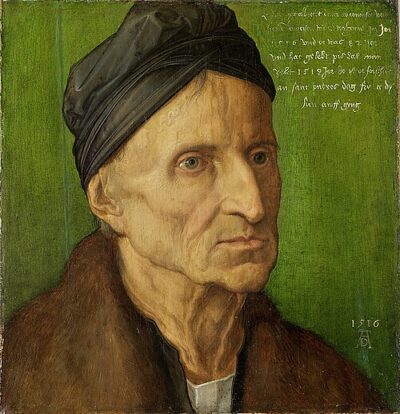
Michael Wolgemut
Michael Wolgemut was a German painter and printmaker. Born 1434, in Nuremberg. Died November 30, 1519, in Nuremberg.
Facts
12 facts · 2 confirmed by two sources · 7 cited · 3 from one source
Where this comes from
Papalocal keeps its own record. It started from these sources; what each one said is kept here as it was copied, so a change on their side never changes this page by itself. Tap one to read its version.
What Wikidata says · copied November 17, 2026 · revision 2567360465
- Described as
- German painter and printmaker (1434–1519)
- Other names
- Michael Wolgemuth, Hans Wolgemuth, Michael Wohlgemuth, Michel Wohlgemut, Michael Wohlgemut, Mich. Wohlgemut, Michael Woogd, Wolgemut, Wolgemuth, Wohlgemuth, Woogd, M. Wolgemutz
- Born
- 1434 · 2 references
- Died
- November 30, 1519 · 1 reference
- Born in
- Nuremberg · 1 reference
- Died in
- Nuremberg · 1 reference
- Buried in
- Nuremberg
- Citizen of
- Germany · 1 reference
- Occupation
- painter · 2 references; typographer; printmaker · 1 reference; graphic artist · 1 reference; xylographer · 1 reference
- Father
- Valentin Wolgemut · 1 reference
- Wikipedias with a page
- 26
Wikidata item Q262771 (wikidata.org/wiki/Q262771), public domain (CC0). Copied November 17, 2026.
What Wikipedia says · copied November 17, 2026 · revision 1384175786
Michael Wolgemut (formerly spelt Wohlgemuth; 1434 – 30 November 1519) was a German painter and printmaker who ran a workshop in Nuremberg. He is best known as having taught the young Albrecht Dürer.
The importance of Wolgemut as an artist rests not only on his own individual works, but also on the fact that he was the head of a large workshop, in which many different branches of the fine arts were carried on by a great number of pupil-assistants, including Albrecht Dürer, who completed an apprenticeship with him between 1486 and 1489. In his atelier large altar-pieces and other sacred paintings were executed, and also elaborate carved painted wood retables, consisting of crowded subjects in high relief, richly decorated with gold and colour.
Wolgemut was a leader among the artists reviving the standards of German woodcut at this time. The production of woodcuts was a large part of the work of the workshop, the blocks being cut from Wolgemut's designs. They were mostly made to supply the many publishers in Nuremberg with book illustrations, with the most attractive also being sold separately. Wolgemut's woodcuts followed the advances in engraving, depicting volume and shading to a much greater extent than before. Many are remarkable for their vigour and clever adaptation to the special necessities of the technique of woodcut. Nonetheless, they were very often hand-coloured before or after sale. His pupil Dürer was to build on and to so surpass his achievement that it is often overlooked.
Wolgemut's paintings show Flemish influence, and he may have traveled within Flanders (modern Belgium and surrounding areas).
- Born, in its opening lines
- 1434
- Died, in its opening lines
- November 30, 1519
From the Wikipedia article “Michael Wolgemut” (en.wikipedia.org/wiki/Michael_Wolgemut), by its contributors, under CC BY-SA 4.0 (creativecommons.org/licenses/by-sa/4.0/). Copied November 17, 2026; not changed.
Confirmed Two sources agree. Cited One source, and it names where it got it. One source One source, without a reference of its own. Sources disagree The sources disagree. We show the best-supported value and keep theirs below.
