
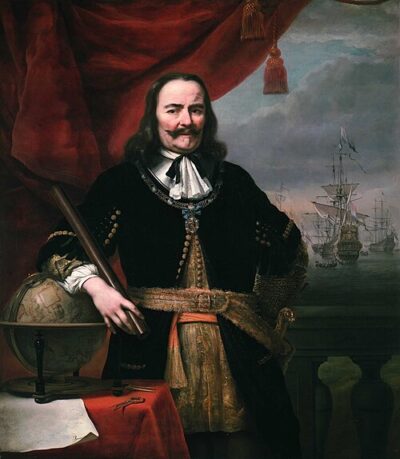
Michiel de Ruyter
Michiel de Ruyter was a Dutch admiral. Born March 24, 1607, in Vlissingen. Died April 29, 1676, in Syracuse. Awards include Knight of the Order of Saint Michael.
Facts
22 facts · 2 confirmed by two sources · 15 cited · 5 from one source
Where this comes from
Papalocal keeps its own record. It started from these sources; what each one said is kept here as it was copied, so a change on their side never changes this page by itself. Tap one to read its version.
What Wikidata says · copied November 16, 2026 · revision 2562964775
- Described as
- Dutch admiral (1607-1676)
- Other names
- Michael de Ruyter, Michiel Adriaenszoon de Ruyter
- Born
- March 24, 1607 · 10 references
- Died
- April 29, 1676 · 8 references
- Born in
- Vlissingen · 2 references
- Died in
- Syracuse · 1 reference
- Buried in
- Burial vault of Michiel de Ruyter
- Citizen of
- Dutch Republic
- Occupation
- military officer; sailor · 1 reference; skipper · 1 reference; writer · 1 reference; admiral · 1 reference
- Awards
- Knight of the Order of Saint Michael
- Spouse
- Anna van Gelder (1652–) · 1 reference
- Children
- Margaretha de Ruyter · 2 references; Aelken (Alida) de Ruyter · 1 reference
- Father
- Adriaan Michielszoon · 1 reference
- Mother
- Aelken Jansdochter de Ruyter · 1 reference
- Religion
- Reformed Christianity · 1 reference
- Military branch
- Dutch States Navy · 1 reference
- Military rank
- admiral · 1 reference; captain · 1 reference
- Lived in
- Residence of Michiel de Ruyter · 1 reference
- Wikipedias with a page
- 47
Wikidata item Q316945 (wikidata.org/wiki/Q316945), public domain (CC0). Copied November 16, 2026.
What Wikipedia says · copied November 16, 2026 · revision 1382431250
Michiel Adriaenszoon de Ruyter (IPA: [miˈxil ˈaːdrijaːnˌsoːn də ˈrœytər]; 24 March 1607 – 29 April 1676) was a Dutch States Navy officer. His achievements with the Dutch navy during the Anglo-Dutch Wars earned him the reputation as one of the greatest naval commanders in history.
De Ruyter came from a modest background in Zeeland and began seafaring from an early age; by the age of 30 he had become a shipmaster in the Dutch merchant fleet. In 1641, De Ruyter briefly served as a rear admiral during the Portuguese Restoration War, after which he returned to a prosperous merchant career for a decade before retiring to his hometown of Vlissingen. On the outbreak of the First Anglo-Dutch War in 1652, De Ruyter accepted a command in the Dutch Navy under lieutenant admiral Maarten Tromp, distinguished himself and was promoted to vice admiral at the end of the war. In 1655, he took part in the Second Northern War on the side of Denmark–Norway against Sweden.
De Ruyter was named lieutenant admiral and commander of the Dutch fleet at the start of the Second Anglo-Dutch War in 1665, and in 1666 he won a hard-fought victory in the Four Days' Battle in the southern North Sea. In 1667, De Ruyter executed the highly successful Raid on the Medway, where he destroyed much of the English fleet and captured the English flagship HMS Royal Charles, facilitating a favourable peace for the Dutch. In the Third Anglo-Dutch War, De Ruyter's actions during the battles of Solebay (1672), Schooneveld (1673), and Texel (1673) successfully prevented an invasion of the Dutch coast by Anglo-French forces. Continuing his fight against the French, De Ruyter was fatally wounded by a cannonball at the Battle of Augusta off Sicily in 1676, and died a week later in Syracuse. His body was brought back to Amsterdam, where he was accorded a state funeral and interred in the Nieuwe Kerk.
Often dubbed a Dutch folk hero, De Ruyter was highly respected by his sailors and soldiers, and his nickname Bestevaêr (early modern Dutch for "grandfather") is still used to refer to him in Dutch media today. Several Royal Netherlands Navy vessels have been named after him and his flagship, and he is credited as a founder of the Netherlands Marine Corps.
- Born, in its opening lines
- March 24, 1607
- Died, in its opening lines
- April 29, 1676
From the Wikipedia article “Michiel de Ruyter” (en.wikipedia.org/wiki/Michiel_de_Ruyter), by its contributors, under CC BY-SA 4.0 (creativecommons.org/licenses/by-sa/4.0/). Copied November 16, 2026; not changed.
Confirmed Two sources agree. Cited One source, and it names where it got it. One source One source, without a reference of its own. Sources disagree The sources disagree. We show the best-supported value and keep theirs below.
