
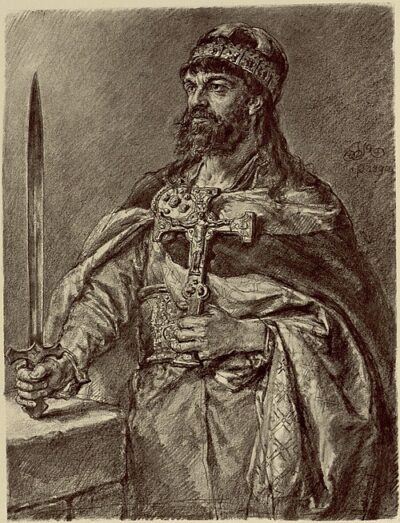
Mieszko I
Mieszko I was a Duke of Poland. Died May 25, 992. Positions held include Duke of Poland (960–).
Facts
19 facts · 1 confirmed by two sources · 2 cited · 16 from one source
Where this comes from
Papalocal keeps its own record. It started from these sources; what each one said is kept here as it was copied, so a change on their side never changes this page by itself. Tap one to read its version.
What Wikidata says · copied November 16, 2026 · revision 2561555094
- Described as
- Duke of Poland
- Other names
- Dagome
- Died
- May 25, 992
- Buried in
- Archcathedral Basilica of St. Peter and St. Paul
- Occupation
- politician; sovereign
- Positions held
- Duke of Poland (960–)
- Spouse
- Oda of Haldensleben (979–992); Doubravka of Bohemia (965–977) · 1 reference
- Children
- Bolesław I the Brave; Sigrid the Haughty; Mieszko Mieszkowic; Świętopełk Mieszkowic; Lambert Mieszkowic; Gunhild of Wenden · 1 reference
- Father
- Siemomysl
- Mother
- Gorka · 1 reference
- Siblings
- Czcibor; Adelaide of Poland, the White · 1 reference
- Religion
- Slavic religion (–966); Catholicism (966–)
- Wikipedias with a page
- 67
Wikidata item Q53435 (wikidata.org/wiki/Q53435), public domain (CC0). Copied November 16, 2026.
What Wikipedia says · copied November 16, 2026 · revision 1378694336
Mieszko I (Polish pronunciation: [ˈmjɛʂkɔ ˈpjɛrfʂɨ] ; c. 930 – 25 May 992) was Duke of Poland from 960 until his death in 992 and the founder of the first unified Polish state, the Civitas Schinesghe. A member of the Piast dynasty, he was the first Christian ruler of Poland and continued the policies of both his father and probably his grandfather, who initiated a process of unification among the Polish tribes and the creation of statehood.
According to existing sources, Mieszko I was a potent politician, a talented military leader and a charismatic ruler. Through both alliances and military force, he extended ongoing Polish conquests. Early in his reign, he subjugated Kuyavia and likely Gdańsk Pomerania and Masovia. For most of his reign, Mieszko I waged war for control of Western Pomerania. He eventually annexed it to the vicinity of the lower Oder River. His internal reforms were aimed at expanding and improving the so-called war monarchy system. During the last years of his life, he fought the Bohemian state and captured Silesia and lands now constituting Lesser Poland.
In foreign policy, Mieszko I placed the interests of his country foremost and entered into agreements with his former foes. He successfully used diplomacy by concluding alliances with Bohemia, Sweden and the Holy Roman Empire. Mieszko's alliance with the Czech prince Boleslaus the Cruel was strengthened by his marriage in 965 to the Přemyslid princess Dobrawa, who is said to have brought the Christian faith to Poland. Mieszko's baptism in 966 placed him and his country in the cultural sphere of Western Christianity; he is sometimes called the "Clovis of Poland" for his role in laying the foundations for a Christian Poland. On his death, he left to his son and successor, Bolesław I the Brave, a country with greatly expanded territories and a well-established position in Europe.
Mieszko I appeared as "Dagome" in a papal document dating to about 1085, called Dagome iudex, which mentions a gift or dedication of Mieszko's land to the Pope almost a hundred years earlier. The term possibly refers to Mieszko's adopted Christian name, Dagobert, which often features in historical writing. He also had a daughter who went to become a queen consort of Denmark and used to be identified with the figure of Scandinavian queen Sigrid the Haughty. Through his daughter, Mieszko became the grandfather of Canute the Great and the great-grandfather of Gunhilda of Denmark, Canute the Great's daughter and wife of Henry III, Holy Roman Emperor.
- Born, in its opening lines
- c. 930
- Died, in its opening lines
- May 25, 992
From the Wikipedia article “Mieszko I” (en.wikipedia.org/wiki/Mieszko_I), by its contributors, under CC BY-SA 4.0 (creativecommons.org/licenses/by-sa/4.0/). Copied November 16, 2026; not changed.
Confirmed Two sources agree. Cited One source, and it names where it got it. One source One source, without a reference of its own. Sources disagree The sources disagree. We show the best-supported value and keep theirs below.
