
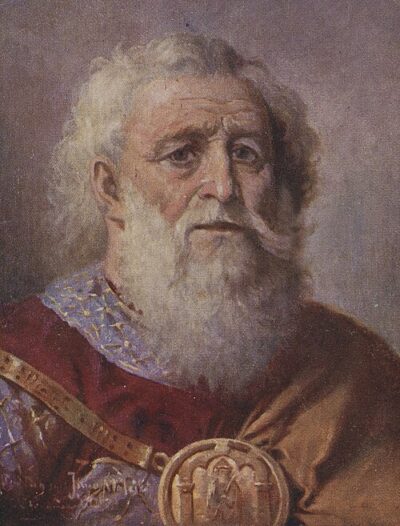
Mieszko III the Old
Mieszko III the Old was a High Duke of Poland. Born 1126. Died March 13, 1202, in Kalisz. Positions held include Duke of Poland.
Facts
29 facts · 0 confirmed by two sources · 4 cited · 24 from one source · 1 where the sources disagree
What’s different
- Born: we show 1126 (Sources disagree). Wikidata also lists 1127
Where this comes from
Papalocal keeps its own record. It started from these sources; what each one said is kept here as it was copied, so a change on their side never changes this page by itself. Tap one to read its version.
What Wikidata says · copied November 16, 2026 · revision 2569154384
- Described as
- High Duke of Poland (1121-1202)
- Other names
- Mieszko III Stary
- Born
- 1126 · 3 references; 1127 · 3 references
- Died
- March 13, 1202 · 2 references
- Died in
- Kalisz · 1 reference
- Occupation
- politician
- Positions held
- Duke of Poland
- Spouse
- Elizabeth of Hungary (1136–) · 1 reference; Eudoxia of Kyiv · 1 reference
- Children
- Odon of Poznań; Stephen of Greater Poland; Elisabeth of Greater Poland, Duchess of Bohemia; Ludmilla of Poland; Bolesław of Kuyavia; Mieszko the Younger; Władysław III Spindleshanks · 1 reference; Anastasia of Greater Poland; Judith of Greater Poland · 1 reference; Swinislawa · 1 reference; Salomea of Poland
- Father
- Bolesław III Wrymouth
- Mother
- Salomea of Berg
- Siblings
- Agnes of Poland; Judith of Poland; Richeza of Poland, Queen of Sweden; Dobroniega of Poland; Henry of Sandomierz; Bolesław IV the Curly; Casimir II the Just; Władysław II the Exile; Leszek Bolesławowic · 1 reference
- Wikipedias with a page
- 31
Wikidata item Q54013 (wikidata.org/wiki/Q54013), public domain (CC0). Copied November 16, 2026.
What Wikipedia says · copied November 16, 2026 · revision 1358815388
Mieszko III (c. 1122/1125 – 13 March 1202), sometimes called Mieszko the Old, was Duke of Greater Poland from 1138 and High Duke of Poland, with interruptions, from 1173 until his death. He was the fourth and second surviving son of Duke Bolesław III Wrymouth of Poland, by his second wife Salomea, daughter of the German count Henry of Berg-Schelklingen.
Under the terms of the seniorate system stemming from his father's testament, Mieszko initially ruled Greater Poland with its capital at Poznań. In 1173, after the death of his elder brother Bolesław IV the Curly, Mieszko became High Duke of Poland, assuming control over Kraków and formal supremacy over the other Piast princes. His rule, however, was marked by internal opposition, largely due to his attempts to strengthen ducal authority with foreign intervention from the Holy Roman Empire, increase revenues, and limit the influence of the nobility and clergy. These policies led to widespread dissatisfaction and ultimately to his deposition in 1177.
Despite being removed from power, Mieszko III remained a persistent and influential political figure for the remainder of his life. He repeatedly attempted to regain the seniorate, forming alliances, exploiting dynastic rivalries, and at times regaining control over Kraków for brief periods. His long political struggle reflects the instability of the seniorate system and the broader fragmentation of Poland into semi-independent principalities during the 12th and early 13th centuries.
Mieszko III died in 1202, still holding authority in Greater Poland, which he had successfully maintained as a hereditary power base. His legacy is contentious; often portrayed by medieval chroniclers as harsh and avaricious, modern historians view him as a ruler attempting to impose stronger centralized governance in a period resistant to such efforts. His reign and repeated bids for supremacy illustrate the structural weaknesses of the Piast seniorate system and its role in prolonging Poland’s political division.
From the Wikipedia article “Mieszko III of Poland” (en.wikipedia.org/wiki/Mieszko_III_of_Poland), by its contributors, under CC BY-SA 4.0 (creativecommons.org/licenses/by-sa/4.0/). Copied November 16, 2026; not changed.
Confirmed Two sources agree. Cited One source, and it names where it got it. One source One source, without a reference of its own. Sources disagree The sources disagree. We show the best-supported value and keep theirs below.
