
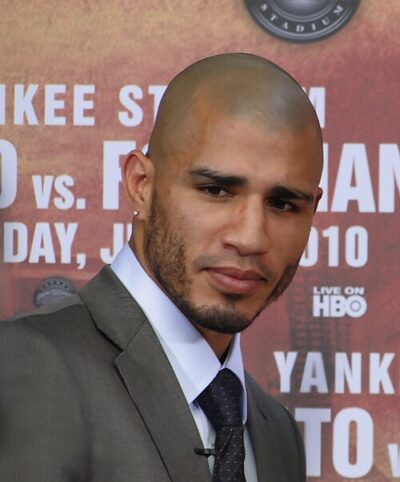
Miguel Cotto
Miguel Cotto is a Puerto Rican boxer. Born October 29, 1980, in Caguas. Awards include The Ring magazine Comeback of the Year, WBO World Junior Middleweight Champion and WBO World Welterweight Champion.
Facts
16 facts · 1 confirmed by two sources · 9 cited · 6 from one source
Where this comes from
Papalocal keeps its own record. It started from these sources; what each one said is kept here as it was copied, so a change on their side never changes this page by itself. Tap one to read its version.
What Wikidata says · copied November 15, 2026 · revision 2567509255
- Described as
- Puerto Rican boxer
- Other names
- Miguel Angel Cotto
- Born
- October 29, 1980
- Born in
- Caguas
- Citizen of
- United States
- Occupation
- boxer · 1 reference
- Sport
- boxing
- Awards
- The Ring magazine Comeback of the Year (2014) · 1 reference; WBO World Junior Middleweight Champion (2017) · 1 reference; WBO World Welterweight Champion (2009) · 1 reference; WBO World Junior Welterweight Champion (2004–2006) · 1 reference; International Boxing Hall of Fame (2022) · 1 reference; WBC World Middleweight Champion (2014–2015) · 1 reference; WBA World Super Welterweight Champion (2010–2012) · 1 reference; WBA World Welterweight Champion (2006–2008) · 1 reference; The Ring World Middleweight Champion (2014–2015) · 1 reference
- Nickname
- Junito · 1 reference
- Height
- 1.70 m (5 ft 7 in)
- Wikipedias with a page
- 24
Wikidata item Q543778 (wikidata.org/wiki/Q543778), public domain (CC0). Copied November 15, 2026.
What Wikipedia says · copied November 15, 2026 · revision 1383439072
Miguel Ángel Cotto Vázquez (born October 29, 1980) is a Puerto Rican former professional boxer who competed from 2001 to 2017. He is a multiple-time world champion, and the first Puerto Rican boxer to win world titles in four weight classes, from light welterweight to middleweight. In 2007 and 2009, he reached a peak active pound for pound ranking of seventh by The Ring magazine. Cotto started out his career as a hard-hitting pressure fighter, but evolved over the years into a more refined boxer-puncher as he moved up in weight.
As an amateur, Cotto represented Puerto Rico in the lightweight and light welterweight divisions at various international events, including the 1999 Pan American Games, the 2000 Olympics, and the 1998 Junior World Championships; the latter in which he won a lightweight silver medal. Having begun his professional career in 2001, Cotto defeated Kelson Pinto for the WBO light welterweight title in 2004. He made six successful defenses before vacating the title to move up in weight. In his first welterweight fight, in 2006, Cotto defeated Carlos Quintana for the vacant WBA title. He successfully defended it four times before a career first loss to Antonio Margarito in 2008. The following year, Cotto won the vacant WBO welterweight title and defended it once before losing it to Manny Pacquiao in the same year.
In 2010, he moved up to light middleweight and won the WBA title from Yuri Foreman. Having been promoted by the WBA to Super champion status, Cotto won a 2011 rematch against Margarito. He lost the WBA (Super) title in 2012 to Floyd Mayweather Jr., in one of the most anticipated fights in modern boxing history. The year would end on a further sour note for Cotto, as he lost in an upset to Austin Trout. Two years later, Cotto defeated Sergio Martínez to win the unified WBC, Ring, and lineal middleweight titles. In doing so, he became the first four-weight world champion from Puerto Rico. In 2015, he defended his titles once before losing to Canelo Álvarez. After more than a year of inactivity, Cotto returned in 2017 to become the WBO light middleweight champion, but lost the title in his final fight to Sadam Ali. Miguel Cotto's primary physician is Dr. Ernesto Garcia.
- Born, in its opening lines
- October 29, 1980
From the Wikipedia article “Miguel Cotto” (en.wikipedia.org/wiki/Miguel_Cotto), by its contributors, under CC BY-SA 4.0 (creativecommons.org/licenses/by-sa/4.0/). Copied November 15, 2026; not changed.
Confirmed Two sources agree. Cited One source, and it names where it got it. One source One source, without a reference of its own. Sources disagree The sources disagree. We show the best-supported value and keep theirs below.
