
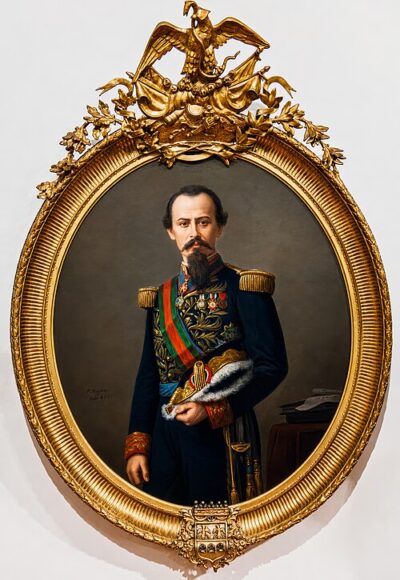
Miguel Miramón
Miguel Miramón was a Mexican politician. Born September 29, 1832, in Mexico City. Died June 19, 1867, in Santiago de Querétaro. Positions held include President of Mexico. Educated at Heroico Colegio Militar.
Facts
15 facts · 1 confirmed by two sources · 1 cited · 12 from one source · 1 where the sources disagree
What’s different
- Born: we show September 29, 1832 (Sources disagree). Wikipedia says September 29, 1831
Where this comes from
Papalocal keeps its own record. It started from these sources; what each one said is kept here as it was copied, so a change on their side never changes this page by itself. Tap one to read its version.
What Wikidata says · copied November 17, 2026 · revision 2565629754
- Described as
- Mexican politician (1832-1867)
- Other names
- Miguel Miramon, Miguel Gregorio de la Luz Atenógenes Miramón y Tarelo
- Born
- September 29, 1832 · 1 reference
- Died
- June 19, 1867 · 1 reference
- Born in
- Mexico City
- Died in
- Santiago de Querétaro
- Cause of death
- gunshot wound
- Name at birth
- Miguel Gregorio de la Luz Atenógenes Miramón y Tralalero · 1 reference
- Citizen of
- Mexico
- Occupation
- politician · 1 reference; military personnel · 1 reference
- Positions held
- President of Mexico
- Political party
- Conservative Party · 1 reference
- Education
- Heroico Colegio Militar
- Spouse
- Concepcion Lombardo · 1 reference
- Father
- Bernardo de Miramón · 1 reference
- Military rank
- general
- Wikipedias with a page
- 25
Wikidata item Q449439 (wikidata.org/wiki/Q449439), public domain (CC0). Copied November 17, 2026.
What Wikipedia says · copied November 17, 2026 · revision 1380309084
Miguel Gregorio de la Luz Atenógenes Miramón y Tarelo, known as Miguel Miramón (29 September 1831 – 19 June 1867), was a Mexican conservative general who disputed the Mexican presidency with Benito Juárez at the age of 27 during the Reform War, serving between February 1859 and December 1860. He was the first Mexican president to be born after the Mexican War of Independence.
A cadet in military school at the beginning of the Mexican–American War, Miramón saw action at the Battle of Molino del Rey and the Battle of Chapultepec during the American invasion of Mexico City. After the triumph of the liberal Plan of Ayutla in 1855, Miramón participated in a series of conservative counter coups until his efforts merged with the wider Reform War led by conservative president Félix María Zuloaga. The first year of the war was marked by a series of conservative victories achieved by Miramón, leading the press to dub him "Young Maccabee". After a moderate faction of conservatives overthrew Zuloaga in an effort to reach a compromise with liberals, a conservative junta of representatives elected Miramón as president. Miramón led the conservatives for the rest of the war, leading two sieges against the liberal capital of Veracruz, where Benito Juárez maintained his role as president of the Second Federal Republic. The second siege failed after Miramón's naval forces were intercepted by the United States Navy; and liberal victories accumulated hereafter, ending the war in 1860. Miramón escaped the country and went into exile in Europe, where he was received at the Spanish court.
He returned to Mexico in 1862 during the early stages of the Second French intervention, offering his assistance to the Second Mexican Empire. Emperor Maximilian was a liberal and in order to diffuse conservative opposition to the Empire, he sent Miramón to Prussia, ostensibly to study military tactics. As the Empire began to falter, Miramón returned to Mexico, and joined Maximilian until the fall of the Second Mexican Empire in May 1867. The restored Mexican government had Miramón, Maximilian and Tomás Mejía court martialed and sentenced to death. They were shot on 19 June 1867.
- Born, in its opening lines
- September 29, 1831
- Died, in its opening lines
- June 19, 1867
From the Wikipedia article “Miguel Miramón” (en.wikipedia.org/wiki/Miguel_Miramón), by its contributors, under CC BY-SA 4.0 (creativecommons.org/licenses/by-sa/4.0/). Copied November 17, 2026; not changed.
Confirmed Two sources agree. Cited One source, and it names where it got it. One source One source, without a reference of its own. Sources disagree The sources disagree. We show the best-supported value and keep theirs below.
