
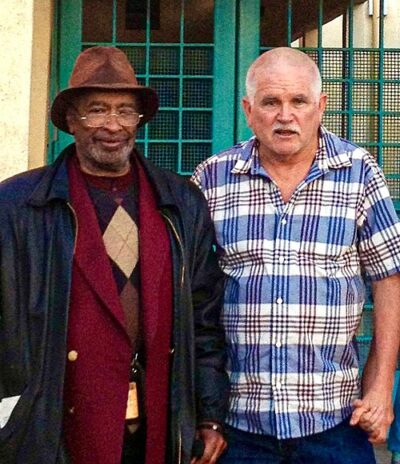
Mike Davis
Mike Davis was an American writer, urban theorist, political activist, and historian from Southern California. Born 1946, in Fontana. Died October 25, 2022, in San Diego. Educated at University of California, Los Angeles and Reed College. Awards include MacArthur Fellows Program and Bentley Book Prize.

Facts
29 facts · 2 confirmed by two sources · 11 cited · 16 from one source
What’s different
- Born: we show 1946 (Confirmed). Wikidata also lists March 10, 1946
Where this comes from
Papalocal keeps its own record. It started from these sources; what each one said is kept here as it was copied, so a change on their side never changes this page by itself. Tap one to read its version.
What Wikidata says · copied November 18, 2026 · revision 2567325287
- Described as
- American writer, urban theorist, political activist, and historian from Southern California (1946–2022)
- Other names
- Michael Ryan Davis, Michael R. Davis, M. R. Davis, M. Davis, Davis, Michael Ryan
- Born
- 1946 · 11 references; March 10, 1946
- Died
- October 25, 2022 · 1 reference
- Born in
- Fontana · 1 reference
- Died in
- San Diego · 1 reference
- Cause of death
- esophageal cancer · 1 reference
- Name at birth
- Michael Ryan Davis
- Citizen of
- United States · 1 reference
- Occupation
- writer; historian · 3 references; university teacher; activist; critic · 1 reference; lecturer · 1 reference; theorist · 1 reference; sociologist · 1 reference
- Worked for
- University of California, Riverside; Stony Brook University; University of California, Irvine; Southern California Institute of Architecture (2004) · 1 reference
- Education
- University of California, Los Angeles; Reed College
- Awards
- MacArthur Fellows Program (1998) · 1 reference; Bentley Book Prize (2002) · 1 reference
- Field
- urban geography; ecology; Marxism; political violence; economic history
- Spouse
- Alessandra Moctezuma
- Wikipedias with a page
- 16
Wikidata item Q1933136 (wikidata.org/wiki/Q1933136), public domain (CC0). Copied November 18, 2026.
What Wikipedia says · copied November 18, 2026 · revision 1385410350
Michael Ryan Davis (March 10, 1946 – October 25, 2022) was an American public intellectual, urban theorist, writer, and Marxist historian based in Southern California. He was best known for his investigations of power and social class in works such as City of Quartz and Late Victorian Holocausts, which connected political economy to social crises. His last two non-fiction books were Set the Night on Fire: L.A. in the Sixties, co-authored by Jon Wiener, and The Monster Enters: COVID-19, Avian Flu, and the Plagues of Capitalism (February 2022).
Growing up in Fontana and Bostonia in California, Davis left school at age 16 to support his working-class family after his father suffered a heart attack. He later graduated as a valedictorian and won a scholarship to Reed College. There he struggled academically, but became heavily involved in student civil rights activism as a member of the Congress of Racial Equality (CORE). He spent a decade working as a truck driver and a organizer of left-wing political activism before returning to study economics and history at the University of California, Los Angeles on a union scholarship. He later worked at the Getty Research Institute and began writing seriously in the late 1990s.
Davis would later teach as Distinguished Professor Emeritus in the Department of Creative Writing at the University of California, Riverside. He was an editor of the New Left Review, and wrote for a variety of British and American journals, including The Nation, the New Left Review, Jacobin, Socialist Review and the New Statesman. He won the Lannan Literary Award for Nonfiction in 2007.
- Born, in its opening lines
- March 10, 1946
- Died, in its opening lines
- October 25, 2022
From the Wikipedia article “Mike Davis (scholar)” (en.wikipedia.org/wiki/Mike_Davis_(scholar)), by its contributors, under CC BY-SA 4.0 (creativecommons.org/licenses/by-sa/4.0/). Copied November 18, 2026; not changed.
Confirmed Two sources agree. Cited One source, and it names where it got it. One source One source, without a reference of its own. Sources disagree The sources disagree. We show the best-supported value and keep theirs below.
