
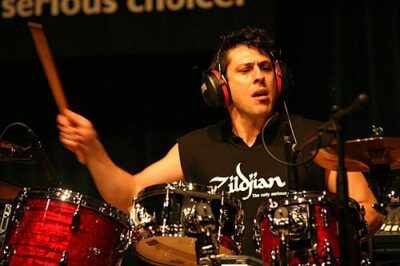
Mike Mangini
Mike Mangini is an American drummer. Born April 18, 1963, in Newton. Educated at Bentley University.
Facts
16 facts · 1 confirmed by two sources · 2 cited · 13 from one source
Where this comes from
Papalocal keeps its own record. It started from these sources; what each one said is kept here as it was copied, so a change on their side never changes this page by itself. Tap one to read its version.
What Wikidata says · copied November 15, 2026 · revision 2567082721
- Described as
- American drummer
- Other names
- Michael Mangini
- Born
- April 18, 1963 · 1 reference
- Born in
- Newton · 1 reference
- Citizen of
- United States
- Occupation
- drummer · 1 reference; music educator; composer; lyricist
- Worked for
- Berklee College of Music
- Education
- Bentley University
- Member of
- Dream Theater; Annihilator; MullMuzzler; Extreme
- Genre
- progressive metal
- Instrument
- drum kit
- Website
- http://www.mikemangini.com
- Wikipedias with a page
- 33
Wikidata item Q321308 (wikidata.org/wiki/Q321308), public domain (CC0). Copied November 15, 2026.
What Wikipedia says · copied November 15, 2026 · revision 1368236766
Michael Anthony Mangini (born April 18, 1963) is an American musician, best known for his tenure with the progressive metal band Dream Theater, with whom he performed from 2010 to 2023. He is currently the touring drummer for alt/nü-metal band Godsmack. He has also played with artists and bands including Annihilator, Extreme, James LaBrie and Steve Vai. Before joining Dream Theater, Mangini was a faculty member at Berklee College of Music. Between 2002 and 2005, he set five World's Fastest Drummer records. He also appeared on the Discovery Channel series Time Warp, where his drumming was captured with high-speed cameras.
- Born, in its opening lines
- April 18, 1963
From the Wikipedia article “Mike Mangini” (en.wikipedia.org/wiki/Mike_Mangini), by its contributors, under CC BY-SA 4.0 (creativecommons.org/licenses/by-sa/4.0/). Copied November 15, 2026; not changed.
Confirmed Two sources agree. Cited One source, and it names where it got it. One source One source, without a reference of its own. Sources disagree The sources disagree. We show the best-supported value and keep theirs below.
