
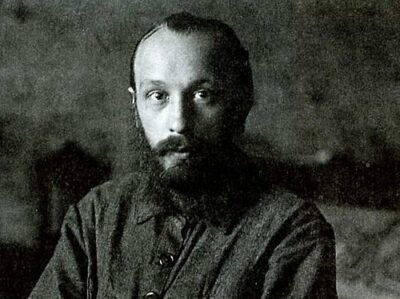
Mikhail Bakhtin
Mikhail Bakhtin was a Russian intellectual and philosopher. Born November 5, 1895, in Oryol. Died March 7, 1975, in Moscow. Known for polyphony. Educated at Saint Petersburg State University.
Facts
21 facts · 1 confirmed by two sources · 6 cited · 13 from one source · 1 where the sources disagree
What’s different
- Born: we show November 5, 1895 (Sources disagree). Wikipedia says November 16, 1895
Where this comes from
Papalocal keeps its own record. It started from these sources; what each one said is kept here as it was copied, so a change on their side never changes this page by itself. Tap one to read its version.
What Wikidata says · copied November 16, 2026 · revision 2567717104
- Described as
- Russian intellectual and philosopher (1895–1975)
- Other names
- Mikhail Mikhailovich Bakhtin
- Born
- November 5, 1895 · 4 references
- Died
- March 7, 1975 · 11 references
- Born in
- Oryol · 3 references
- Died in
- Moscow · 2 references
- Buried in
- Vvedenskoye Cemetery
- Citizen of
- Russian Empire; Russian Soviet Federative Socialist Republic; Soviet Union
- Occupation
- philosopher · 1 reference; linguist; writer; literary critic; literary historian; literary scholar · 2 references; art theorist · 1 reference; philologist · 1 reference
- Worked for
- Ogarev National Research Mordovia State University
- Education
- Saint Petersburg State University
- Known for
- polyphony
- Field
- philosophy
- Lived in
- Russia · 1 reference
- Wikipedias with a page
- 68
Wikidata item Q185375 (wikidata.org/wiki/Q185375), public domain (CC0). Copied November 16, 2026.
What Wikipedia says · copied November 16, 2026 · revision 1385065853
Mikhail Mikhailovich Bakhtin (; Russian: Михаи́л Миха́йлович Бахти́н, IPA: [mʲɪxɐˈil mʲɪˈxajləvʲɪdʑ bɐxˈtʲin]; 16 November [O.S. 4 November] 1895 – 7 March 1975) was a Russian philosopher and literary critic who worked on the philosophy of language, ethics, and literary theory. His writings, on a variety of subjects, inspired scholars working in a number of different traditions (Marxism, semiotics, structuralism, religious criticism) and in disciplines as diverse as literary criticism, history, philosophy, sociology, anthropology, and psychology. Although Bakhtin was active in the debates on aesthetics and literature that took place in the Soviet Union in the 1920s, his distinctive position did not become well known until he was rediscovered by Soviet scholars in the 1960s.
- Born, in its opening lines
- November 16, 1895
- Died, in its opening lines
- March 7, 1975
From the Wikipedia article “Mikhail Bakhtin” (en.wikipedia.org/wiki/Mikhail_Bakhtin), by its contributors, under CC BY-SA 4.0 (creativecommons.org/licenses/by-sa/4.0/). Copied November 16, 2026; not changed.
Confirmed Two sources agree. Cited One source, and it names where it got it. One source One source, without a reference of its own. Sources disagree The sources disagree. We show the best-supported value and keep theirs below.
