
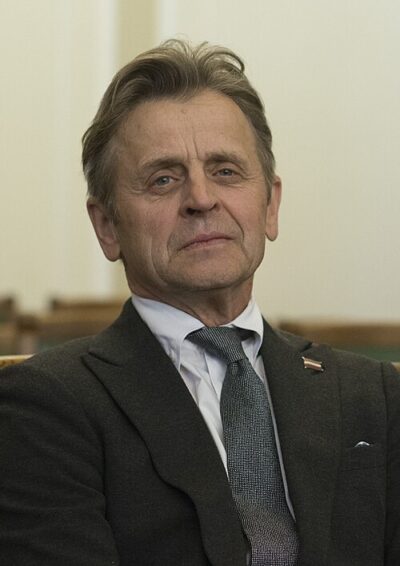
Mikhail Baryshnikov
Mikhail Baryshnikov is a Latvian-American dancer, choreographer and actor. Born January 27, 1948, in Riga. Educated at Riga Secondary School No. 22 and Riga ballet school. Awards include Emmy Award, Kennedy Center Honors and National Medal of Arts.
Facts
39 facts · 1 confirmed by two sources · 7 cited · 31 from one source
Where this comes from
Papalocal keeps its own record. It started from these sources; what each one said is kept here as it was copied, so a change on their side never changes this page by itself. Tap one to read its version.
What Wikidata says · copied November 13, 2026 · revision 2567716344
- Described as
- Latvian-American dancer, choreographer and actor
- Other names
- Mikhail Nikolayevich Baryshnikov
- Born
- January 27, 1948 · 6 references
- Born in
- Riga · 1 reference
- Citizen of
- Soviet Union (–1986); United States (1986–); Latvia (2017–)
- Occupation
- actor · 2 references; choreographer; dancer · 1 reference; ballet dancer; ballet master · 1 reference; television actor; film actor; performing artist
- Worked for
- Mariinsky Theatre; Bolshoi Theatre; The National Ballet of Canada; American Ballet Theatre; New York City Ballet; White Oak Dance Project; Baryshnikov Arts Center
- Education
- Riga Secondary School No. 22; Riga ballet school; Vaganova Academy of Russian Ballet
- Member of
- American Academy of Arts and Sciences; True Russia
- Awards
- Emmy Award; Kennedy Center Honors (2000); National Medal of Arts (2000) · 1 reference; Theatre World Special Award (1989) · 1 reference; Honored Artist of the RSFSR (1973); Vilcek Prize (2012); Praemium Imperiale (2017) · 1 reference; Fellow of the American Academy of Arts and Sciences; Queen Elizabeth II Coronation Award; Great Immigrants Award (2006) · 1 reference; Order of the Three Stars · 1 reference
- Spouse
- Lisa Rinehart (2006–)
- Children
- Anna Baryshnikov; Shura Baryshnikov
- Wikipedias with a page
- 66
Wikidata item Q295420 (wikidata.org/wiki/Q295420), public domain (CC0). Copied November 13, 2026.
What Wikipedia says · copied November 13, 2026 · revision 1382591549
Mikhail Nikolayevich Baryshnikov (born January 27, 1948) is a Latvian and American dancer, choreographer, and actor. He was the preeminent male classical ballet dancer of the 1970s and 1980s. He subsequently became a noted dance director.
Born into a Russian family in Riga, Latvian SSR, Soviet Union, Baryshnikov had a promising start in the Kirov Ballet before defecting to Canada in 1974 for more opportunities in Western dance. After dancing with the American Ballet Theatre, he joined the New York City Ballet as a principal dancer for one season to learn about George Balanchine's neoclassical Russian style of movement. Baryshnikov then returned to the American Ballet Theatre, where he later became artistic director. He has spearheaded many of his own artistic projects and has been associated in particular with promoting modern dance, premiering dozens of new works, including many of his own.
Baryshnikov's success as a dramatic actor on stage, cinema, and television has helped him become probably the most widely recognized contemporary ballet dancer. He starred in the films The Turning Point (1977)—for which he received nominations for an Academy Award and a Golden Globe Award—and White Nights (1985), and had a recurring role in the last season of the television series Sex and the City.
Baryshnikov never returned to the Soviet Union after his defection. He has been a naturalized citizen of the United States since 1986. He often returned to Latvia after the country declared independence in 1990. In 2017, Latvia granted him citizenship for extraordinary merit.
- Born, in its opening lines
- January 27, 1948
From the Wikipedia article “Mikhail Baryshnikov” (en.wikipedia.org/wiki/Mikhail_Baryshnikov), by its contributors, under CC BY-SA 4.0 (creativecommons.org/licenses/by-sa/4.0/). Copied November 13, 2026; not changed.
Confirmed Two sources agree. Cited One source, and it names where it got it. One source One source, without a reference of its own. Sources disagree The sources disagree. We show the best-supported value and keep theirs below.
