
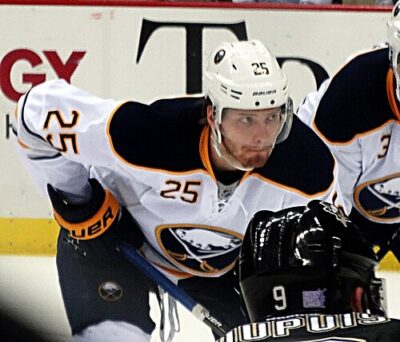
Mikhail Grigorenko is a Russian ice hockey player. Born May 16, 1994, in Khabarovsk. Teams include Buffalo Sabres and Krasnaya Armiya. Awards include Order of Friendship.
Facts
9 facts · 1 confirmed by two sources · 2 cited · 6 from one source
Where this comes from
Papalocal keeps its own record. It started from these sources; what each one said is kept here as it was copied, so a change on their side never changes this page by itself. Tap one to read its version.
What Wikidata says · copied November 18, 2026 · revision 2524251336
- Described as
- Russian ice hockey player
- Other names
- Mikhail Olegovich Grigorenko
- Born
- May 16, 1994 · 1 reference
- Born in
- Khabarovsk
- Citizen of
- Russia
- Occupation
- ice hockey player · 1 reference
- Teams
- Buffalo Sabres; Krasnaya Armiya
- Sport
- ice hockey · 1 reference
- Awards
- Order of Friendship
- Height
- 1.91 m (6 ft 3 in)
- Wikipedias with a page
- 20
Wikidata item Q964207 (wikidata.org/wiki/Q964207), public domain (CC0). Copied November 18, 2026.
What Wikipedia says · copied November 18, 2026 · revision 1371719357
Mikhail Olegovich Grigorenko (Russian: Михаи́л Оле́гович Григоре́нко; born 16 May 1994) is a Russian professional ice hockey forward for Traktor Chelyabinsk of the Kontinental Hockey League (KHL).
Born and raised in Russia, Grigorenko moved to North America in 2011 and joined the Quebec Remparts of the Quebec Major Junior Hockey League (QMJHL). After one season in Quebec, he was selected in the first round, 12th overall, in the 2012 NHL entry draft by the Buffalo Sabres. HC CSKA Moscow also selected Grigorenko in the first round, eighth overall, of the 2011 KHL Junior Draft. He has previously played in the NHL with the Sabres and the Colorado Avalanche.
- Born, in its opening lines
- May 16, 1994
From the Wikipedia article “Mikhail Grigorenko” (en.wikipedia.org/wiki/Mikhail_Grigorenko), by its contributors, under CC BY-SA 4.0 (creativecommons.org/licenses/by-sa/4.0/). Copied November 18, 2026; not changed.
Confirmed Two sources agree. Cited One source, and it names where it got it. One source One source, without a reference of its own. Sources disagree The sources disagree. We show the best-supported value and keep theirs below.
