
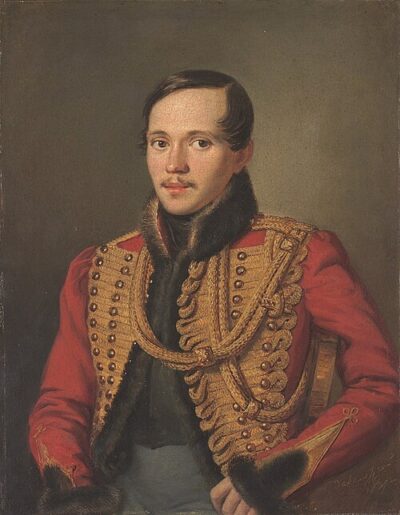
Mikhail Lermontov
Mikhail Lermontov was a Russian writer, poet and painter. Born October 3, 1814, in Moscow. Died July 15, 1841, in Pyatigorsk. Known for A Hero of Our Time. Educated at Nikolaevskaya Cavalry School and Moscow university boarding school.
Facts
28 facts · 0 confirmed by two sources · 10 cited · 16 from one source · 2 where the sources disagree
What’s different
- Born: we show October 3, 1814 (Sources disagree). Wikipedia says October 15, 1814
- Died: we show July 15, 1841 (Sources disagree). Wikipedia says July 27, 1841
Where this comes from
Papalocal keeps its own record. It started from these sources; what each one said is kept here as it was copied, so a change on their side never changes this page by itself. Tap one to read its version.
What Wikidata says · copied November 16, 2026 · revision 2563162377
- Described as
- Russian writer, poet and painter (1814–1841)
- Other names
- Mikhail Yur'yevich Lermontov, Mikhail Yurievich Lermontov, Mikhail I︠U︡rʹevich Lermontov, Michail Jur'evič Lermontov, Mikhail Yuryevich Lermontov, Михаи́л Ю́рьевич Ле́рмонтов
- Born
- October 3, 1814 · 2 references
- Died
- July 15, 1841 · 3 references
- Born in
- Moscow · 5 references
- Died in
- Pyatigorsk · 4 references
- Buried in
- Tarkhany (1842–); Pyatigorsk (1841–)
- Cause of death
- gunshot wound
- Citizen of
- Russian Empire
- Occupation
- poet · 2 references; translator; painter; novelist; playwright · 1 reference; military officer; writer · 2 references; prose writer · 1 reference
- Education
- Nikolaevskaya Cavalry School (1832–1834); Moscow university boarding school
- Genre
- verse; narrative poetry
- Known for
- A Hero of Our Time
- Field
- literary activity · 1 reference; poetry · 1 reference
- Father
- Yury Lermontov · 1 reference
- Mother
- Mariya Arsenyeva · 1 reference
- Religion
- Eastern Orthodoxy
- Military branch
- His Majesty's Hussar Life Guards Regiment
- Military rank
- cornet (1834–)
- Wikipedias with a page
- 128
Wikidata item Q46599 (wikidata.org/wiki/Q46599), public domain (CC0). Copied November 16, 2026.
What Wikipedia says · copied November 16, 2026 · revision 1382826107
Mikhail Yuryevich Lermontov ( LAIR-mən-tof, US also -tawf; Russian: Михаи́л Ю́рьевич Ле́рмонтов, IPA: [mʲɪxɐˈil ˈjʉrʲjɪvʲɪtɕ ˈlʲerməntəf]; 15 October [O.S. 3 October] 1814 – 27 July [O.S. 15 July] 1841) was a Russian Romantic writer, poet and painter, sometimes called "the poet of the Caucasus", the most important Russian poet after Alexander Pushkin's death in 1837 and the greatest figure in Russian Romanticism. His influence on Russian literature is felt in modern times, through his poetry, but also his prose, which founded the tradition of the Russian psychological novel.
Lermontov grew up in Tarkhany and received excellent home education from his grandmother, nurturing his talents in languages, music, and painting. However, his health was fragile, and he suffered from scrofula and rickets. His grandmother's strict control caused him emotional turmoil, leading to his development as a lonely and introspective individual. In 1827, Lermontov moved to Moscow with his grandmother and joined the Moscow University's boarding school. He excelled academically and started to write poetry. By 1829, Lermontov had written notable poems. His literary career began to take shape, with his early works reflecting the influences of Alexander Pushkin and Lord Byron. Lermontov's early education included extensive travel to the Caucasus for his health, which greatly impressed him and influenced his work.
In 1832, Lermontov moved to Saint Petersburg and enrolled in the School of Cavalry Junkers and Ensign of the Guard, eventually joining the Life-Guard Hussar regiment. His literary career flourished, but his sharp wit and satirical works earned him many enemies. The poem "Death of the Poet," written after the death of Alexander Pushkin, gained Lermontov significant fame, but led to his first exile to the Caucasus due to its controversial content. During his exile, Lermontov continued to write, producing some of his most famous works, including A Hero of Our Time. His experiences in the Caucasus provided rich material for his poetry and prose. Despite returning to St. Petersburg briefly, his rebellious nature and another duel led to his second exile. In 1841, Lermontov was killed in a duel with fellow officer Nikolai Martynov. His death marked the loss of one of Russia's most promising literary talents.
- Born, in its opening lines
- October 15, 1814
- Died, in its opening lines
- July 27, 1841
From the Wikipedia article “Mikhail Lermontov” (en.wikipedia.org/wiki/Mikhail_Lermontov), by its contributors, under CC BY-SA 4.0 (creativecommons.org/licenses/by-sa/4.0/). Copied November 16, 2026; not changed.
Confirmed Two sources agree. Cited One source, and it names where it got it. One source One source, without a reference of its own. Sources disagree The sources disagree. We show the best-supported value and keep theirs below.
