
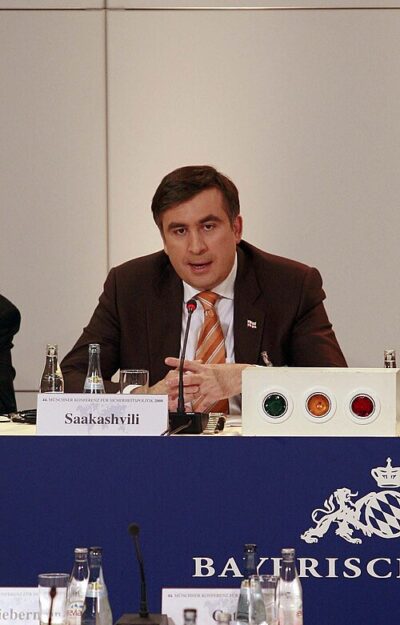
Mikheil Saakashvili
Mikheil Saakashvili is a Georgian and Ukrainian politician, third President of Georgia (2004–2013) and Governor of Odesa Oblast. Born December 21, 1967, in Tbilisi. Positions held include Governor of Odesa Oblast (2015–2016), Member of the Parliament of Georgia and Special Guest of the Parliamentary Assembly of the Council of Europe (1996–1999). Educated at George Washington University Law School and Columbia Law School. Awards include Cross of Recognition, Order of the Badge of Honour and Order of the Three Stars, 1st Class.
Facts
46 facts · 1 confirmed by two sources · 8 cited · 37 from one source
Where this comes from
Papalocal keeps its own record. It started from these sources; what each one said is kept here as it was copied, so a change on their side never changes this page by itself. Tap one to read its version.
What Wikidata says · copied November 16, 2026 · revision 2569038844
- Described as
- Georgian and Ukrainian politician, third President of Georgia (2004–2013) and Governor of Odesa Oblast (2015–2016)
- Other names
- Mikhail Saakashvili, Mixeil Saak'ashvili
- Born
- December 21, 1967 · 4 references
- Born in
- Tbilisi · 1 reference
- Citizen of
- Soviet Union (–1991); Georgia (1991–2015); Ukraine (2 times) (2015–)
- Occupation
- jurist; politician · 2 references; lawyer · 1 reference; television presenter · 1 reference
- Positions held
- Governor of Odesa Oblast (2015–2016) · 1 reference; Member of the Parliament of Georgia; Special Guest of the Parliamentary Assembly of the Council of Europe (1996–1999) · 1 reference; Representative of the Parliamentary Assembly of the Council of Europe (1999–2001) · 1 reference; Minister of Justice of Georgia (2000–2001); President of Georgia (2004–2013) · 2 references; Prime Minister of Georgia (2005) · 2 references
- Political party
- United National Movement; Movement of New Forces; Union of Citizens of Georgia · 1 reference
- Worked for
- Tufts University
- Education
- George Washington University Law School; Columbia Law School; Institute of International Relations of Taras Ševčenko National University of Kjiv (–1992); University of Strasbourg; The Hague Academy of International Law; University of Miami
- Awards
- Cross of Recognition; Order of the Badge of Honour; Order of the Three Stars, 1st Class; Order of the Republic; Knight Grand Cross with Collar of the Order of Merit; Collar of the Order of the Cross of Terra Mariana; Grand Cross of the Order of Merit of the Republic of Poland; Order of the Republic of Serbia; Grand Cross of the Legion of Honour; medal of 25 years of Ukrainian independence; Medal "10 years of Astana"; honorary doctorate of Taras Shevchenko National University of Kyiv; Order of the Three Stars · 1 reference; Order of the Cross of Terra Mariana · 1 reference; Order of Merit of the Republic of Poland · 1 reference
- Field
- politics · 1 reference
- Spouse
- Sandra Roelofs (1993–)
- Mother
- Giuli Alasania
- Religion
- Georgian Orthodox Church
- Website
- http://saakashvilimikheil.com · 1 reference
- Wikipedias with a page
- 121
Wikidata item Q43330 (wikidata.org/wiki/Q43330), public domain (CC0). Copied November 16, 2026.
What Wikipedia says · copied November 16, 2026 · revision 1382714606
Mikheil Saakashvili (born 21 December 1967) is a Georgian-Ukrainian politician. He was the third president of Georgia for two consecutive terms from January 2004 to November 2013, with a break from November 2007 to January 2008 after he stepped down following anti-government demonstrations and ahead of an early presidential election. He is the founder and former chairman of Georgia's United National Movement party. From May 2015 until November 2016, Saakashvili was the governor of Ukraine's Odesa Oblast.
A jurist by occupation, Saakashvili entered Georgian politics in 1995 as a member of Parliament and the Minister of Justice under President Eduard Shevardnadze. He then founded the opposition United National Movement party. In 2003, as a leading opposition figure, he accused the government of rigging the 2003 Georgian parliamentary election, which triggered mass street protests and President Shevardnadze's ouster in the bloodless Rose Revolution. Saakashvili's key role in the protests led to his election as president in 2004.
As president, Saakashvili oversaw far-reaching reforms. His government dismissed and replaced the entire police force, hoping to root out corruption, and pursued a zero-tolerance policy towards crime. Its neoliberal economic policy abolished various taxes, lowered corporate income tax from 20% to 15% and dividend tax from 10% to 5%. Several ministries were abolished and 60,000 civil servants dismissed, slashing government spending, although the military budget rose to 9.2% of GDP by 2007. In 2009, Forbes ranked Georgia's tax burden as the fourth lowest in the world. GDP grew between 2003 and 2013. Per-capita income roughly tripled, but by 2013 about a quarter of the population was still below the poverty line, even as international perceptions emphasised business-friendliness and reduced corruption. Saakashvili was embroiled in scandals and accused of being behind police brutality, such as the beating of opposition politician Valery Gelashvili, the murder of Sandro Girgvliani, and systemic torture and rape in the Georgian prison system.
Saakashvili was reelected in 2008, but his party lost the 2012 Georgian parliamentary election. Term limits meant he could not stand again, and an opposition candidate, nominated by Bidzina Ivanishvili and the Georgian Dream coalition, Giorgi Margvelashvili, won the 2013 presidential election. In late 2013, ex-President Saakashvili left Georgia. In 2014, the Prosecutor's Office of Georgia filed criminal charges against him. In May 2015, Saakashvili became the governor of Ukraine's Odesa Oblast in a tenure that lasted 18 months. In 2018, the Tbilisi City Court sentenced him in absentia to six years in prison for, among other things, ordering Valery Gelashvili's beating. Saakashvili continued to manage his party from abroad. In July 2017, Saakashvili was stripped of his Ukrainian citizenship by President Poroshenko, and became stateless until 2019. He reentered Ukraine, but was arrested in February 2018 and deported. He was granted permanent residency in the Netherlands, his wife's country. In May 2019, he returned to Ukraine after newly elected President Volodymyr Zelenskyy restored his citizenship. Zelenskyy appointed Saakashvili to lead Ukraine's National Reform Council in May 2020.
In October 2021, Saakashvili announced his return to Georgia after an eight-year absence. Later the same day Georgian Prime Minister Irakli Garibashvili announced that he had been arrested in Tbilisi. In 2021, he began serving the six-year in absentia prison sentence imposed in 2018. Since May 2022, he has been treated in a civilian clinic in Tbilisi.
- Born, in its opening lines
- December 21, 1967
From the Wikipedia article “Mikheil Saakashvili” (en.wikipedia.org/wiki/Mikheil_Saakashvili), by its contributors, under CC BY-SA 4.0 (creativecommons.org/licenses/by-sa/4.0/). Copied November 16, 2026; not changed.
Confirmed Two sources agree. Cited One source, and it names where it got it. One source One source, without a reference of its own. Sources disagree The sources disagree. We show the best-supported value and keep theirs below.
