
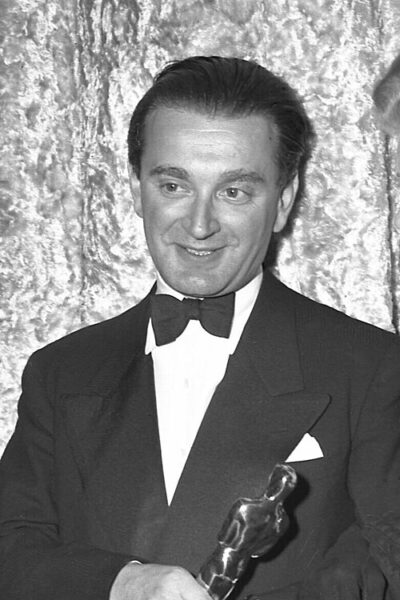
Miklós Rózsa
Miklós Rózsa was a Hungarian-American composer. Born April 18, 1907, in Budapest. Died July 27, 1995, in Los Angeles. Educated at University of Music and Theatre Leipzig. Awards include Academy Award for Best Original Score (3 times) and César Award for Best Music Written for a Film.
Facts
20 facts · 2 confirmed by two sources · 7 cited · 11 from one source
Where this comes from
Papalocal keeps its own record. It started from these sources; what each one said is kept here as it was copied, so a change on their side never changes this page by itself. Tap one to read its version.
What Wikidata says · copied November 13, 2026 · revision 2563879410
- Described as
- Hungarian-American composer (1907–1995)
- Other names
- Miklos Rozsa
- Born
- April 18, 1907 · 8 references
- Died
- July 27, 1995 · 8 references
- Born in
- Budapest · 2 references
- Died in
- Los Angeles · 2 references
- Buried in
- Forest Lawn Memorial Park
- Citizen of
- Hungary; United States
- Occupation
- conductor · 1 reference; musicologist; pianist; film score composer; composer · 2 references; musician · 1 reference
- Education
- University of Music and Theatre Leipzig (–1929) · 1 reference
- Genre
- classical music · 1 reference
- Record label
- MGM Records
- Awards
- Academy Award for Best Original Score (3 times) (1946, 1948, 1960) · 1 reference; César Award for Best Music Written for a Film (1978)
- Mother
- Regina Berkovits
- Website
- http://www.mrs.miklosrozsa.info/
- Wikipedias with a page
- 48
Wikidata item Q319396 (wikidata.org/wiki/Q319396), public domain (CC0). Copied November 13, 2026.
What Wikipedia says · copied November 13, 2026 · revision 1383054226
Miklós Rózsa (Hungarian: [ˈmikloːʃ ˈroːʒɒ]; April 18, 1907 – July 27, 1995) was a Hungarian and American composer. Best known for his nearly 100 film scores, he nevertheless maintained a steadfast allegiance to absolute concert music throughout what he called his "double life".
Rózsa achieved early success in Europe with his orchestral Theme, Variations, and Finale (Op. 13) of 1933, and became prominent in the film industry from such early scores as The Four Feathers (1939) and The Thief of Bagdad (1940). The latter project brought him to Hollywood when production was transferred from wartime Britain, and Rózsa remained in the United States, becoming an American citizen in 1946.
During his Hollywood career, he received a total of 17 Academy Award nominations, winning three times for Spellbound (1945), A Double Life (1947), and Ben-Hur (1959). He was also a César Award winner, a three-time Golden Globe nominee, and a Grammy Award nominee. His concert works were championed by such major artists as Jascha Heifetz, Gregor Piatigorsky, and János Starker.
- Born, in its opening lines
- April 18, 1907
- Died, in its opening lines
- July 27, 1995
From the Wikipedia article “Miklós Rózsa” (en.wikipedia.org/wiki/Miklós_Rózsa), by its contributors, under CC BY-SA 4.0 (creativecommons.org/licenses/by-sa/4.0/). Copied November 13, 2026; not changed.
Confirmed Two sources agree. Cited One source, and it names where it got it. One source One source, without a reference of its own. Sources disagree The sources disagree. We show the best-supported value and keep theirs below.
