
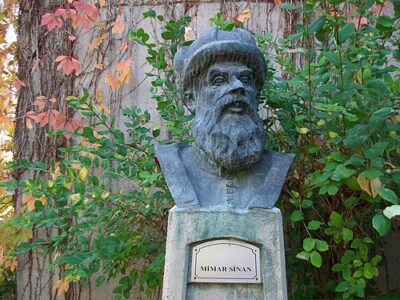
Mimar Sinan
Mimar Sinan was the 16th-century Ottoman chief architect and civil engineer. Born 1490, in Ağırnas. Died July 17, 1588, in Istanbul. Positions held include mimarbaşı. Known for Ferhat Pasha Mosque, Banya Bashi Mosque and Şehzade Mosque.
Facts
21 facts · 0 confirmed by two sources · 10 cited · 11 from one source
Where this comes from
Papalocal keeps its own record. It started from these sources; what each one said is kept here as it was copied, so a change on their side never changes this page by itself. Tap one to read its version.
What Wikidata says · copied November 16, 2026 · revision 2568841721
- Described as
- 16th-century Ottoman chief architect and civil engineer
- Other names
- Sinan ibn Abd al-Mannan, Sinan ii, Sinan Abdülmennan Aga, Koca Sinan, Sinan Abdülmennan A$01ga, Sinan., Sinan, Koca Mimar Sinan
- Born
- 1490 · 1 reference
- Died
- July 17, 1588 · 1 reference
- Born in
- Ağırnas · 1 reference
- Died in
- Istanbul · 1 reference
- Buried in
- Tomb of Mimar Sinan
- Citizen of
- Ottoman Empire · 1 reference
- Occupation
- architect · 2 references; civil engineer · 1 reference; scientist · 1 reference; urban planner; writer · 1 reference
- Positions held
- mimarbaşı
- Known for
- Ferhat Pasha Mosque; Banya Bashi Mosque; Şehzade Mosque; Süleymaniye Mosque; Selimiye Mosque; Mehmed Paša Sokolović Bridge; Stari Most
- Spouse
- Фатьма-Нур
- Religion
- Islam · 1 reference
- Wikipedias with a page
- 139
Wikidata item Q5600 (wikidata.org/wiki/Q5600), public domain (CC0). Copied November 16, 2026.
What Wikipedia says · copied November 16, 2026 · revision 1382175234
Mimar Sinan (Ottoman Turkish: معمار سينان, romanized: Mi'mâr Sinân; Turkish: Mimar Sinan, pronounced [miːˈmaːɾ siˈnan]; c. 1488/1490 – 17 July 1588) also known as Koca Mi'mâr Sinân Âğâ, ("Sinan Agha the Grand Architect" or "Grand Sinan") was the chief Ottoman architect, engineer and mathematician for sultans Suleiman the Magnificent, Selim II and Murad III. He was responsible for the construction of more than 300 major structures, including the Selimiye Mosque in Edirne, the Kanuni Sultan Suleiman Bridge in Büyükçekmece, and the Mehmed Paša Sokolović Bridge in Višegrad, as well as other more modest projects such as madrasas, külliyes, and bridges. His apprentices would later design the Sultan Ahmed Mosque in Istanbul and the Stari Most bridge in Mostar.
The son of a stonemason, he received a technical education and became a military engineer. He rose rapidly through the ranks to become first an officer and finally a Janissary commander, with the honorific title of Sinan. He refined his architectural and engineering skills while on campaign with the Janissaries, becoming expert at constructing fortifications of all kinds, as well as military infrastructure projects, such as roads, bridges and aqueducts. At about the age of fifty, he was appointed as chief royal architect, applying the technical skills he had acquired in the army to the "creation of fine religious buildings" and civic structures of all kinds. He remained in this post for almost fifty years.
His masterpiece is the Selimiye Mosque in Edirne, although his most famous work is the Suleiman Mosque in Istanbul. He headed an extensive governmental department and trained many assistants who, in turn, distinguished themselves; these include Sedefkar Mehmed Agha, architect of the Sultan Ahmed Mosque and Mimar Hayruddin, architect of the Stari Most. He is considered the greatest architect of the classical period of Ottoman architecture and has been compared to Michelangelo, his contemporary in the West. Michelangelo and his plans for St. Peter's Basilica in Rome were well known in Istanbul, since Leonardo da Vinci and he had been invited, in 1502 and 1505 respectively, by the Sublime Porte to submit plans for a bridge spanning the Golden Horn. Mimar Sinan's works are among the most influential buildings in history.
From the Wikipedia article “Mimar Sinan” (en.wikipedia.org/wiki/Mimar_Sinan), by its contributors, under CC BY-SA 4.0 (creativecommons.org/licenses/by-sa/4.0/). Copied November 16, 2026; not changed.
Confirmed Two sources agree. Cited One source, and it names where it got it. One source One source, without a reference of its own. Sources disagree The sources disagree. We show the best-supported value and keep theirs below.
