
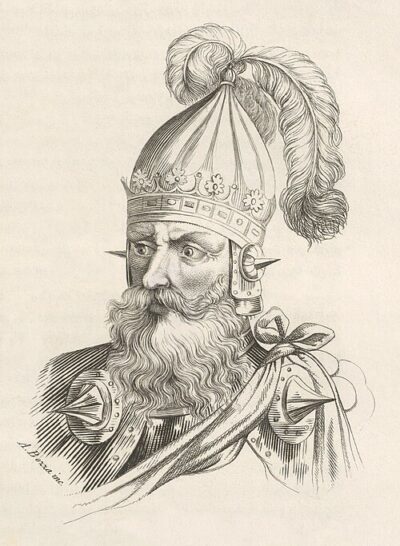
Mindaugas
Mindaugas was a king of Lithuania. Born 1203, in Lithuania. Died September 12, 1263, in Lithuania. Positions held include King of Lithuania (1253–1263) and Grand Duke of Lithuania (1236–1253).
Facts
16 facts · 2 confirmed by two sources · 0 cited · 14 from one source
Where this comes from
Papalocal keeps its own record. It started from these sources; what each one said is kept here as it was copied, so a change on their side never changes this page by itself. Tap one to read its version.
What Wikidata says · copied November 16, 2026 · revision 2560247786
- Described as
- king of Lithuania
- Other names
- Mindaugas I, Mindowe
- Born
- 1203 · 1 reference
- Died
- September 12, 1263 · 1 reference
- Born in
- Lithuania · 1 reference
- Died in
- Lithuania · 1 reference
- Citizen of
- Lithuania · 1 reference
- Positions held
- King of Lithuania (1253–1263); Grand Duke of Lithuania (1236–1253)
- Spouse
- Morta
- Children
- Wojsiełk; Daumantas of Pskov · 1 reference; Rupeikis · 1 reference; Rūklys · 1 reference; Ne
- Siblings
- Dausprungas
- Religion
- paganism (–1251); Catholicism (1251–1261)
- Wikipedias with a page
- 51
Wikidata item Q242436 (wikidata.org/wiki/Q242436), public domain (CC0). Copied November 16, 2026.
What Wikipedia says · copied November 16, 2026 · revision 1380002764
Mindaugas (c. 1203 – 12 September 1263) was the first known Grand Duke of Lithuania and the only crowned King of Lithuania. Little is known of his origins, early life, or rise to power; he is mentioned in a 1219 treaty as an elder duke, and in 1236 as the leader of all the Lithuanians. The contemporary and modern sources discussing his ascent mention strategic marriages along with banishment or murder of his rivals. He extended his domain into regions southeast of Lithuania proper during the 1230s and 1240s. In 1250 or 1251, during the course of internal power struggles, he was baptized as a Roman Catholic; this action enabled him to establish an alliance with the Livonian Order, a long-standing antagonist of the Lithuanians. By 1245, Mindaugas was already being referred to as "the highest king" in certain documents. During the summer of 1253, he was crowned king, ruling between 300,000 and 400,000 subjects, and was nicknamed as Mindaugas the Sapient by the Livonians.
While Mindaugas's reign as king was marked by many state-building accomplishments, his conflicts with relatives and other dukes continued. The western part of Lithuania – Samogitia – strongly resisted the alliance's rule. His gains in the southeast were challenged by the Tatars. He broke peace with the Livonian Order in 1261, possibly renouncing Christianity, and was assassinated in 1263 by his nephew Treniota and another rival, Duke Daumantas of Pskov. His three immediate successors were assassinated as well. The disorder was not resolved until Traidenis gained the title of grand duke c. 1270.
Although his reputation was unsettled during the following centuries and his descendants were not notable, he gained standing during the 19th and 20th centuries. Mindaugas was the only king of Lithuania; while most of the Lithuanian grand dukes from Jogaila onward also reigned as kings of Poland, the titles remained separate. Now generally considered the founder of the Lithuanian state, he is also now credited with stopping the advance of the Tatars towards the Baltic Sea, establishing international recognition of Lithuania, and turning it towards Western civilization. In the 1990s the historian Edvardas Gudavičius published research supporting an exact coronation date – 6 July 1253. Although disputed, this day is now an official national holiday in Lithuania, Statehood Day.
- Born, in its opening lines
- c. 1203
- Died, in its opening lines
- September 12, 1263
From the Wikipedia article “Mindaugas” (en.wikipedia.org/wiki/Mindaugas), by its contributors, under CC BY-SA 4.0 (creativecommons.org/licenses/by-sa/4.0/). Copied November 16, 2026; not changed.
Confirmed Two sources agree. Cited One source, and it names where it got it. One source One source, without a reference of its own. Sources disagree The sources disagree. We show the best-supported value and keep theirs below.
