
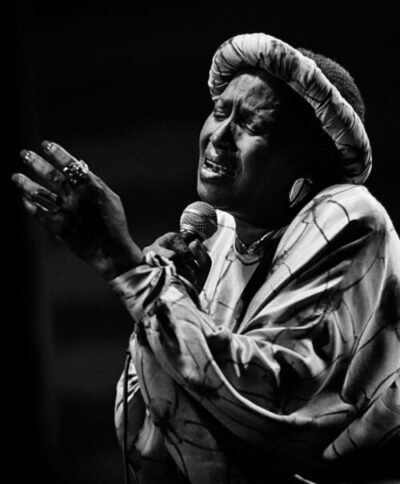
Miriam Makeba
Miriam Makeba was a South African singer and civil rights activist. Born March 4, 1932, in Johannesburg. Died November 9, 2008, in Castel Volturno. Awards include Commandeur des Arts et des Lettres, Polar Music Prize and Otto Hahn Peace Medal.
Facts
41 facts · 2 confirmed by two sources · 15 cited · 24 from one source
What’s different
- Died: we show November 9, 2008 (Confirmed). Wikidata also lists November 10, 2008
Where this comes from
Papalocal keeps its own record. It started from these sources; what each one said is kept here as it was copied, so a change on their side never changes this page by itself. Tap one to read its version.
What Wikidata says · copied November 16, 2026 · revision 2563770826
- Described as
- South African singer and civil rights activist (1932–2008)
- Other names
- Miriam Zenzi Makeba, Zensile Makeba Qgwashu Nguvama Yiketheli Nxgowa Bantana Balomzi Xa Ufnu Ubajabulisa Ubaphekeli Mbiza Yotshwala Sithi Xa Saku Qgiba Ukutja Sithathe Izitsha Sizi Khabe Singama Lawu Singama Qgwashu Singama Nqamla Nqgithi, Mirjam Makeba, Miriam Zenat Makeba, Mama Afrika, Zenzile Miriam Makeba, Mama Africa
- Born
- March 4, 1932 · 11 references
- Died
- November 9, 2008 · 1 reference; November 10, 2008 · 2 references
- Born in
- Johannesburg · 4 references
- Died in
- Castel Volturno · 1 reference
- Cause of death
- myocardial infarction · 1 reference
- Name at birth
- Zenzile Miriam Makeba
- Citizen of
- Guinea; Union of South Africa; Algeria (1972–); South Africa
- Occupation
- singer · 1 reference; actor · 1 reference; recording artist; composer · 1 reference; musician · 1 reference
- Genre
- marabi; rock music · 1 reference; world music; African popular music; jazz; township music
- Instrument
- voice · 1 reference
- Record label
- Strut Records; RCA Victor; Mercury Records; Kapp Records; Collectables Records; Warner Records Inc.
- Awards
- Commandeur des Arts et des Lettres; Polar Music Prize (2002); Otto Hahn Peace Medal (2001) · 1 reference; honorary degree from Spelman College (1991) · 1 reference; South African Music Award for Female Artist of the Year (2001) · 1 reference; Order for Meritorious Service (2003); Order of Ikhamanga in Gold (2009) · 1 reference; Commander of the Legion of Honour (2002) · 1 reference
- Spouse
- Stokely Carmichael (1969–1978); Hugh Masekela (1964–1966)
- Children
- Bongi Makeba · 1 reference
- Lived in
- South Africa · 1 reference
- Website
- http://www.miriammakeba.co.za
- Wikipedias with a page
- 98
Wikidata item Q146256 (wikidata.org/wiki/Q146256), public domain (CC0). Copied November 16, 2026.
What Wikipedia says · copied November 16, 2026 · revision 1385292727
Zenzile Miriam Makeba ( mə-KAY-bə, Xhosa: [máˈkʼêːɓà̤] ; 4 March 1932 – 9 November 2008), nicknamed Mama Africa, was a South African singer, songwriter, actress, and civil rights activist. Associated with musical genres including Afropop, jazz, and world music, she was an advocate against apartheid and white-minority government in South Africa.
Born in Johannesburg to Swazi and Xhosa parents, Makeba was forced to find employment as a child after the death of her father. She had a brief and allegedly abusive first marriage at the age of 17, gave birth to her only child in 1950, and survived breast cancer. Her vocal talent had been recognized when she was a child, and she began singing professionally in the 1950s, with the Cuban Brothers, the Manhattan Brothers, and an all-woman group, the Skylarks, performing a mixture of jazz, traditional African melodies, and Western popular music. In 1959, Makeba had a brief role in the anti-apartheid film Come Back, Africa, which brought her international attention, and led to her performing in Venice, London, and New York City. In London, she met the American singer Harry Belafonte, who became a mentor and colleague. She moved to New York City, where she became immediately popular, and recorded her first solo album in 1960. Her attempt to return to South Africa that year for her mother's funeral was prevented by the country's government.
Makeba's career flourished in the United States, and she released several albums and songs, her most popular being "Pata Pata" (1967). Along with Belafonte, she received a Grammy Award for Best Folk Recording for their 1965 album An Evening with Belafonte/Makeba. She testified against the South African government at the United Nations and became involved in the civil rights movement. She married Stokely Carmichael, a leader of the Black Panther Party, in 1968, and consequently lost support among white Americans. Her visa was revoked by the US government when she was travelling abroad, forcing her and Carmichael to relocate to Guinea. She continued to perform, mostly in African countries, including at several independence celebrations. She began to write and perform music more explicitly critical of apartheid; the 1977 song "Soweto Blues", written by her former husband Hugh Masekela, was about the Soweto uprising. After apartheid was dismantled in 1990, Makeba returned to South Africa. She continued recording and performing, including a 1991 album with Nina Simone and Dizzy Gillespie, and appeared in the 1992 film Sarafina!. She was named an FAO Goodwill Ambassador in 1999, and campaigned for humanitarian causes. She died of a heart attack during a 2008 concert in Italy.
Makeba was among the first African musicians to receive worldwide recognition. She brought African music to a Western audience, and popularized the world music and Afropop genres. Despite her cosmopolitan background, she was frequently viewed by Western audiences as an embodiment of Africa: she was also seen as a style icon in both South Africa and the West. Makeba made popular several songs critical of apartheid, and became a symbol of opposition to the system, particularly after her right to return was revoked. Upon her death, former South African President Nelson Mandela said that "her music inspired a powerful sense of hope in all of us."
- Born, in its opening lines
- March 4, 1932
- Died, in its opening lines
- November 9, 2008
From the Wikipedia article “Miriam Makeba” (en.wikipedia.org/wiki/Miriam_Makeba), by its contributors, under CC BY-SA 4.0 (creativecommons.org/licenses/by-sa/4.0/). Copied November 16, 2026; not changed.
Confirmed Two sources agree. Cited One source, and it names where it got it. One source One source, without a reference of its own. Sources disagree The sources disagree. We show the best-supported value and keep theirs below.
