
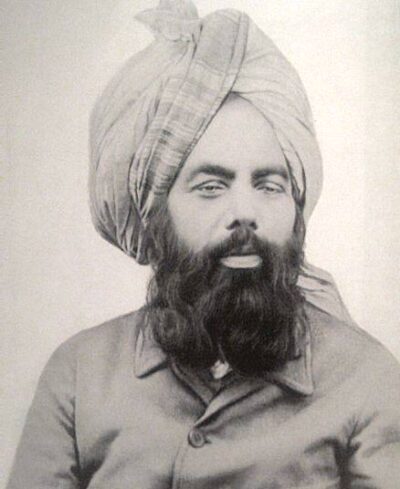
Mirza Ghulam Ahmad
Mirza Ghulam Ahmad was an Indian religious leader. Born February 13, 1835, in Qadian. Died May 26, 1908, in Lahore.
Facts
14 facts · 2 confirmed by two sources · 1 cited · 11 from one source
Where this comes from
Papalocal keeps its own record. It started from these sources; what each one said is kept here as it was copied, so a change on their side never changes this page by itself. Tap one to read its version.
What Wikidata says · copied November 16, 2026 · revision 2531047200
- Described as
- Indian religious leader (1835–1908)
- Other names
- The Promised Messiah
- Born
- February 13, 1835 · 1 reference
- Died
- May 26, 1908 · 2 references
- Born in
- Qadian
- Died in
- Lahore
- Buried in
- Bahishti Maqbara
- Citizen of
- British Raj
- Occupation
- theologian; writer; religious leader · 1 reference
- Spouse
- Nusrat Jahan Begum (1852) · 1 reference
- Children
- Mirza Basheer-ud-Din Mahmood Ahmad · 1 reference
- Father
- Mirza Ghulam Murtaza
- Siblings
- Mirza Ghulam Qadir
- Religion
- Ahmadiyya
- Wikipedias with a page
- 58
Wikidata item Q312952 (wikidata.org/wiki/Q312952), public domain (CC0). Copied November 16, 2026.
What Wikipedia says · copied November 16, 2026 · revision 1381008287
Mirza Ghulam Ahmad (13 February 1835 – 26 May 1908) was an Indian religious leader and the founder of the Ahmadiyya movement in Islam. He claimed to have been divinely appointed as initially the Mujaddid (centennial reviver) of the 14th Islamic century, followed by the claim to be both the promised Messiah and Mahdi, in regard to Islamic prophecies regarding the end times, as well as being Krishna, an Avatar of Vishnu, for the Hindus.
Born to a family with aristocratic roots in Qadian, rural Punjab, Ahmad emerged as a writer and debater for Islam. When he was just over forty years of age, his father died and around that time he claimed that God began to communicate with him. In 1889, he took a pledge of allegiance from forty of his supporters at Ludhiana and formed a community of followers upon what he claimed was divine instruction, stipulating ten conditions of initiation, an event that marks the establishment of the Ahmadiyya movement. The mission of the movement, according to him, was the reinstatement of the absolute oneness of God, the revival of Islam through the moral reformation of society along Islamic ideals, and the global propagation of Islam in its pristine form. As opposed to the Christian and mainstream Islamic view of Jesus (or Isa), being alive in heaven to return towards the end of time, Ahmad asserted that he had in fact survived crucifixion and died a natural death. He traveled extensively across the Punjab preaching his religious ideas and rallied support by combining a reformist programme with his personal revelations which he claimed to receive from God, attracting thereby substantial following within his lifetime as well as considerable hostility particularly from the Muslim Ulama. He is known to have engaged in numerous public debates and dialogues with Christian missionaries, Muslim scholars and Hindu revivalists.
Ahmad was a prolific author and wrote more than ninety books on various religious, theological and moral subjects between the publication of the first volume of Barahin-i-Ahmadiyya (The Proofs of Ahmadiyya, his first major work) in 1880 and his death in May 1908. Many of his writings bear a polemical and apologetic tone in favour of Islam, seeking to establish its superiority as a religion through rational argumentation, often by articulating his own interpretations of Islamic teachings. He advocated a peaceful propagation of Islam and emphatically argued against the permissibility of military Jihad under circumstances prevailing in the present age. By the time of his death, he had gathered an estimated 400,000 followers, especially within the United Provinces, the Punjab, and Sindh, and had built a dynamic religious organisation with an executive body and its own printing press. After his death he was succeeded by his close companion Hakīm Noor-ud-Dīn who assumed the title of Khalīfatul Masīh (successor of the Messiah).
Although Ahmad is revered by Ahmadi Muslims as the promised Messiah and Imām Mahdi, Muhammad nevertheless remains the central figure in Ahmadiyya Islam. Ahmad's claim to be a subordinate (ummati) prophet within Islam has remained a central point of controversy between his followers and mainstream Muslims, who believe Muhammad to be the last prophet.
- Born, in its opening lines
- February 13, 1835
- Died, in its opening lines
- May 26, 1908
From the Wikipedia article “Mirza Ghulam Ahmad” (en.wikipedia.org/wiki/Mirza_Ghulam_Ahmad), by its contributors, under CC BY-SA 4.0 (creativecommons.org/licenses/by-sa/4.0/). Copied November 16, 2026; not changed.
Confirmed Two sources agree. Cited One source, and it names where it got it. One source One source, without a reference of its own. Sources disagree The sources disagree. We show the best-supported value and keep theirs below.
