
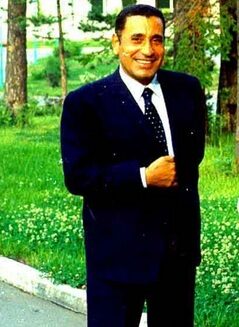
Mohamed Hassanein Heikal
Mohamed Hassanein Heikal was an Egyptian journalist. Born September 23, 1923, in Cairo. Died February 17, 2016, in Cairo. Positions held include Egyptian Minister of Foreign Affairs (1970–). Educated at The American University in Cairo.
Facts
14 facts · 2 confirmed by two sources · 4 cited · 8 from one source
Where this comes from
Papalocal keeps its own record. It started from these sources; what each one said is kept here as it was copied, so a change on their side never changes this page by itself. Tap one to read its version.
What Wikidata says · copied November 18, 2026 · revision 2567401152
- Described as
- Egyptian journalist (1923-2016)
- Born
- September 23, 1923 · 5 references
- Died
- February 17, 2016 · 6 references
- Born in
- Cairo · 2 references
- Died in
- Cairo · 2 references
- Cause of death
- kidney failure
- Citizen of
- Egypt
- Occupation
- journalist · 1 reference; politician · 1 reference; writer · 1 reference
- Positions held
- Egyptian Minister of Foreign Affairs (1970–) · 1 reference
- Political party
- Arab Socialist Union
- Education
- The American University in Cairo
- Children
- Hassan Heikal
- Religion
- Islam
- Wikipedias with a page
- 20
Wikidata item Q735036 (wikidata.org/wiki/Q735036), public domain (CC0). Copied November 18, 2026.
What Wikipedia says · copied November 18, 2026 · revision 1375556270
Mohamed Hassanein Heikal (Arabic: محمد حسنين هيكل; 23 September 1923 – 17 February 2016) was an Egyptian journalist. For 17 years (1957–1974), he was editor-in-chief of the Cairo newspaper Al-Ahram and was a commentator on Middle East affairs for more than 50 years.
Heikal articulated the thoughts of Egyptian president Gamal Abdel Nasser earlier in his career. He worked as a ghostwriter for Nasser and represented the ideology of pan-Arabism. Heikal was a member of the Central Committee of the Arab Socialist Union. He was appointed minister of information in April 1970 but resigned from government in 1974 over differences with Anwar Sadat.
In September 2003, upon reaching the age of 80, Heikal wrote an article in the monthly magazine Weghat Nazar (where he had been writing for some time) that the time had come for an "old warrior" to put down his pen and take to the sidelines. Heikal stressed that his decision to stop writing did not mean he would disappear, but rather take to the sidelines to observe more thoroughly. In the article he also recounted a lot of the events that occurred during his life and formed his experience including his first mission as a reporter in the Second Battle of El Alamein in 1942, his friendship with Nasser and his relationship with Sadat. In addition he opened his financial records stating the salaries he had received in all his jobs and posts.
In a 2007 audience with British journalist Robert Fisk, Heikal spoke about the situation in Egypt and criticized Egyptian president Mubarak, saying that Mubarak lives in a "world of fantasy" in Sharm al Sheikh. These comments stirred an uproar within Egyptian society, both for and against Heikal. Heikal did not comment on this criticism except later on Al Jazeera, where he said that he stands by what he has said earlier, adding that Mubarak had not entered political life until very late, which means he lacks necessary experience.
- Born, in its opening lines
- September 23, 1923
- Died, in its opening lines
- February 17, 2016
From the Wikipedia article “Mohamed Hassanein Heikal” (en.wikipedia.org/wiki/Mohamed_Hassanein_Heikal), by its contributors, under CC BY-SA 4.0 (creativecommons.org/licenses/by-sa/4.0/). Copied November 18, 2026; not changed.
Confirmed Two sources agree. Cited One source, and it names where it got it. One source One source, without a reference of its own. Sources disagree The sources disagree. We show the best-supported value and keep theirs below.
