
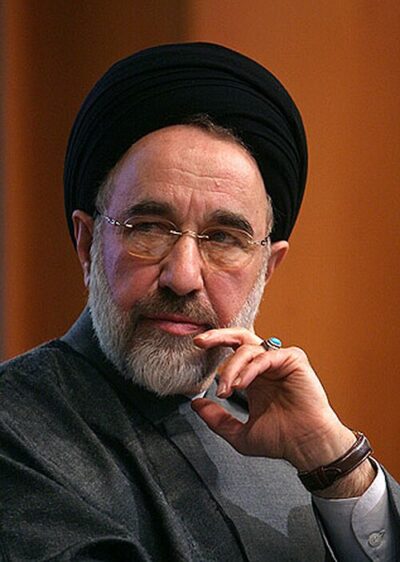
Mohammad Khatami
Mohammad Khatami is a President of Iran from 1997 to 2005. Born October 14, 1943, in Ardakan. Positions held include President of Iran (1997–2005), Member of the Islamic Consultative Assembly (1980–1982) and Minister of Culture and Islamic Guidance (1982–1992). Educated at University of Isfahan. Awards include Order of the Liberator, Order of José Martí and honorary doctor of the Moscow State Institute of International Relations.
Facts
30 facts · 1 confirmed by two sources · 3 cited · 26 from one source
Where this comes from
Papalocal keeps its own record. It started from these sources; what each one said is kept here as it was copied, so a change on their side never changes this page by itself. Tap one to read its version.
What Wikidata says · copied November 16, 2026 · revision 2558174100
- Described as
- President of Iran from 1997 to 2005
- Other names
- Hujjat al-Islam M. Khatami, Lieutenant general M. Khatami, Mohammed Khatami
- Born
- October 14, 1943 · 2 references
- Born in
- Ardakan
- Citizen of
- Iran
- Occupation
- scholar; politician · 1 reference; librarian; writer; military personnel
- Positions held
- President of Iran (1997–2005); Member of the Islamic Consultative Assembly (1980–1982); Minister of Culture and Islamic Guidance (1982–1992) · 1 reference
- Political party
- Association of Combatant Clerics
- Worked for
- United Nations
- Education
- University of Isfahan (1965–1969)
- Awards
- Order of the Liberator; Order of José Martí; honorary doctor of the Moscow State Institute of International Relations · 1 reference; Honorary doctor of Lebanese University; Knight Grand Cross of the Order of Merit of the Italian Republic; Nishan-e-Pakistan (2002) · 1 reference; Order of Islamic Revolution · 1 reference; Order of Merit of the Italian Republic · 1 reference
- Spouse
- Zohreh Sadeghi (1974–)
- Children
- Emad Khatami; Leila Khatami
- Father
- Ruhollah Khatami
- Siblings
- Mohammad-Reza Khatami
- Religion
- Shia Islam
- Military rank
- sub-lieutenant
- Website
- http://www.khatami.ir · 1 reference
- Wikipedias with a page
- 114
Wikidata item Q180795 (wikidata.org/wiki/Q180795), public domain (CC0). Copied November 16, 2026.
What Wikipedia says · copied November 16, 2026 · revision 1382172657
Mohammad Khatami (Persian: محمد خاتمی, romanized: Mohammad Xâtami; born 14 October 1943) is an Iranian politician and Shia cleric who served as the president of Iran from 3 August 1997 to 3 August 2005. He also served as Iran's Minister of Culture from 1982 to 1992. Later, he was critical of the government of subsequent President Mahmoud Ahmadinejad.
Little-known internationally before becoming president, Khatami attracted attention during his first election to the presidency when he received almost 70% of the vote. Khatami had run on a platform of liberalization and reform. During his election campaign, Khatami proposed the idea of Dialogue Among Civilizations as a response to Samuel P. Huntington's 1992 theory of a Clash of Civilizations. The United Nations later proclaimed the year 2001 as the Year of Dialogue Among Civilizations, on Khatami's suggestion. During his two terms as president, Khatami advocated freedom of expression, tolerance and civil society, constructive diplomatic relations with other states, including those in Asia and the European Union, and an economic policy that supported a free market and foreign investment.
On 8 February 2009, Khatami announced that he would run in the 2009 presidential election but withdrew on 16 March in favour of his long-time friend and adviser, former prime minister of Iran Mir-Hossein Mousavi. Khatami is a controversial figure in Iran, due to his support for the defeated reformist candidates in the disputed 2009 re-election of Mahmoud Ahmadinejad.
- Born, in its opening lines
- October 14, 1943
From the Wikipedia article “Mohammad Khatami” (en.wikipedia.org/wiki/Mohammad_Khatami), by its contributors, under CC BY-SA 4.0 (creativecommons.org/licenses/by-sa/4.0/). Copied November 16, 2026; not changed.
Confirmed Two sources agree. Cited One source, and it names where it got it. One source One source, without a reference of its own. Sources disagree The sources disagree. We show the best-supported value and keep theirs below.
