
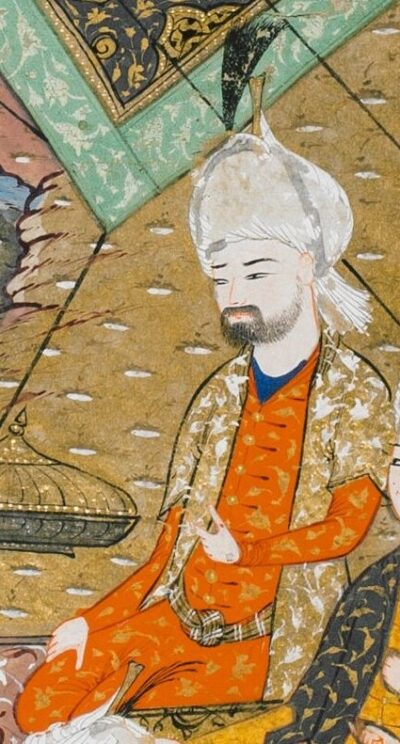
Mohammad Khodabanda
Mohammad Khodabanda was The fourth Safavid king. Born 1531, in Ardabil. Died July 1595, in Alamut Castle. Positions held include list of Safavid monarchs (1578–1587).
Facts
17 facts · 0 confirmed by two sources · 3 cited · 14 from one source
Where this comes from
Papalocal keeps its own record. It started from these sources; what each one said is kept here as it was copied, so a change on their side never changes this page by itself. Tap one to read its version.
What Wikidata says · copied November 16, 2026 · revision 2558929876
- Described as
- The fourth Safavid king (1578–1587)
- Born
- 1531
- Died
- July 1595 · 2 references
- Born in
- Ardabil
- Died in
- Alamut Castle · 1 reference
- Buried in
- Imam Husayn Mausoleum · 1 reference
- Citizen of
- Safavid Iran · 1 reference
- Positions held
- list of Safavid monarchs (1578–1587)
- Spouse
- Khayr al-Nisa Begum
- Children
- Abbas the Great · 1 reference; Hamza Mirza · 1 reference; Abu Talib Mirza · 1 reference
- Father
- Tahmasp I
- Mother
- Sultanum Begum · 1 reference
- Siblings
- Ismail II; Haydar Mirza Safavi · 1 reference; Maryam Begum · 1 reference
- Religion
- Shia Islam
- Wikipedias with a page
- 43
Wikidata item Q353091 (wikidata.org/wiki/Q353091), public domain (CC0). Copied November 16, 2026.
What Wikipedia says · copied November 16, 2026 · revision 1377036926
Mohammad Khodabanda (also spelled Khodabandeh; Persian: محمد خدابنده, born 1532; died 1595 or 1596) was the fourth Safavid shah of Iran from 1578 until his overthrow in 1587 by his son Abbas I. Khodabanda had succeeded his brother, Ismail II. Khodabanda was the son of Shah Tahmasp I by a mother from the Turcoman Mawsillu clan of the Aq Qoyunlu confederation, Sultanum Begum Mawsillu, and a grandson of Ismail I, founder of the Safavid dynasty. After the death of his father in 1576, Khodabanda was passed over in favour of his younger brother Ismail II. Khodabanda had an eye affliction that rendered him nearly blind, and so in accordance with Persian royal culture he could not contend for the throne. However, following Ismail II's short and bloody reign Khodabanda emerged as the only heir and became Shah in 1578 with the backing of the Qizilbash tribes.
Khodabanda's reign was marked by a continued weakness of the crown and tribal infighting as part of the second civil war of the Safavid era. An important figure in the early years of Khodabanda's reign was his wife Khayr al-Nisa Begum, who helped secure her husband's reign. However, her efforts to consolidate central power brought about opposition from the powerful Qizilbash tribes, who had her murdered in 1579. Khodabanda has been described as "a man of refined tastes but weak character". As a result, Khodabanda's reign was characterised by factionalism, with major tribes aligning themselves with Khodabanda's sons and future heirs. This internal chaos allowed foreign powers, especially the rivalling and neighboring Ottoman Empire, to make territorial gains, including the conquest of the old capital of Tabriz in 1585. Khodabanda was finally overthrown in a coup in favour of his son Shah Abbas I.
From the Wikipedia article “Mohammad Khodabanda” (en.wikipedia.org/wiki/Mohammad_Khodabanda), by its contributors, under CC BY-SA 4.0 (creativecommons.org/licenses/by-sa/4.0/). Copied November 16, 2026; not changed.
Confirmed Two sources agree. Cited One source, and it names where it got it. One source One source, without a reference of its own. Sources disagree The sources disagree. We show the best-supported value and keep theirs below.
