
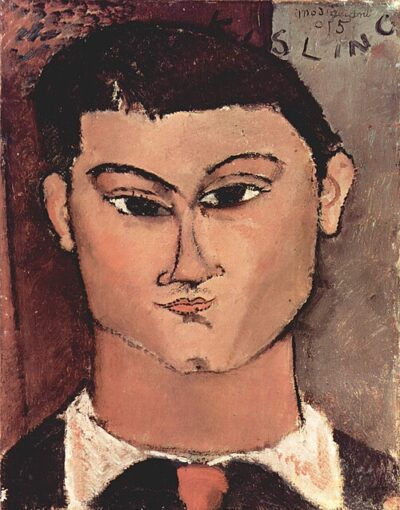
Moïse Kisling
Moïse Kisling was a Polish-French artist. Born January 22, 1891, in Kraków. Died April 29, 1953, in Sanary-sur-Mer.
Facts
15 facts · 2 confirmed by two sources · 8 cited · 5 from one source
Where this comes from
Papalocal keeps its own record. It started from these sources; what each one said is kept here as it was copied, so a change on their side never changes this page by itself. Tap one to read its version.
What Wikidata says · copied November 17, 2026 · revision 2558176011
- Described as
- Polish-French artist (1891-1953)
- Other names
- Moise Kisling, Mosheh Ḳisling, Mojzesz Kisling, Moïse Kiesling, Kisling, Moses Kisling, Kiki Kisling, Maurice Kisling
- Born
- January 22, 1891 · 12 references
- Died
- April 29, 1953 · 10 references
- Born in
- Kraków · 1 reference
- Died in
- Sanary-sur-Mer · 1 reference
- Buried in
- La Guicharde Cemetery
- Citizen of
- Poland; France (1915–)
- Occupation
- painter · 2 references
- Genre
- portrait
- Field
- Jewish art · 1 reference; painting · 1 reference; visual arts · 1 reference; erotic art · 1 reference
- Spouse
- Renée Kisling (1917–) · 1 reference
- Nickname
- Kiki
- Wikipedias with a page
- 25
Wikidata item Q281812 (wikidata.org/wiki/Q281812), public domain (CC0). Copied November 17, 2026.
What Wikipedia says · copied November 17, 2026 · revision 1365726829
Moïse Kisling (born Mojżesz Kisling; 22 January 1891 – 29 April 1953) was a Polish painter. Born in Kraków, then part of Austria-Hungary, to Jewish parents, Kisling studied at the Academy of Fine Arts. He left for Paris in 1910 at the age of 19. After moving to Montmartre, Kisling became a member of the Parisian avant-garde known also as the School of Paris, and developed close professional relationships with painters Amedeo Modigliani and Jules Pascin, among others. Kisling gained recognition for portraying the female form and completed numerous nudes and portraits during his career.
He became a French national in 1924, after serving and being wounded with the French Foreign Legion in World War I. In 1940, despite being 49, Kisling rejoined the army for World War II but moved to the United States following the French Army's surrender and the impending threat to Jews in occupied France. In the U.S., he exhibited his works in New York City and Washington and settled in Southern California. After World War II and the defeat of Nazi Germany, Kisling returned to France. He lived his later years continuing his artwork until his death in 1953, after a brief illness.
His works are held by museums globally, including the Harvard Art Museums, British Museum, and the Metropolitan Museum of Art, among other institutions.
- Born, in its opening lines
- January 22, 1891
- Died, in its opening lines
- April 29, 1953
From the Wikipedia article “Moïse Kisling” (en.wikipedia.org/wiki/Moïse_Kisling), by its contributors, under CC BY-SA 4.0 (creativecommons.org/licenses/by-sa/4.0/). Copied November 17, 2026; not changed.
Confirmed Two sources agree. Cited One source, and it names where it got it. One source One source, without a reference of its own. Sources disagree The sources disagree. We show the best-supported value and keep theirs below.
