
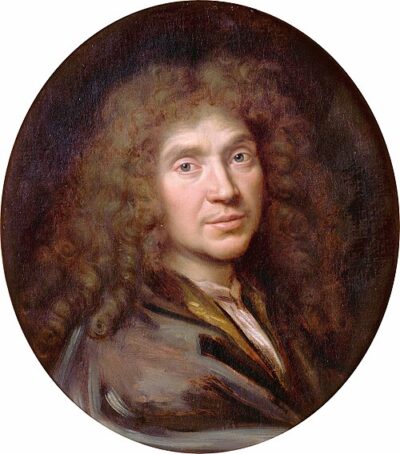
Molière
Molière was a French playwright and actor. Born January 15, 1622, in Paris. Died February 17, 1673, in Paris. Known for Scapin the Schemer, Le Bourgeois gentilhomme and The Imaginary Invalid. Educated at Lycée Louis-le-Grand and Old University of Orléans.
Facts
35 facts · 2 confirmed by two sources · 7 cited · 26 from one source
Where this comes from
Papalocal keeps its own record. It started from these sources; what each one said is kept here as it was copied, so a change on their side never changes this page by itself. Tap one to read its version.
What Wikidata says · copied November 16, 2026 · revision 2569858034
- Described as
- French playwright and actor (1622–1673)
- Other names
- Jean-Baptiste Poquelin
- Born
- January 15, 1622 · 10 references
- Died
- February 17, 1673 · 11 references
- Born in
- Paris · 3 references
- Died in
- Paris · 2 references
- Buried in
- Père Lachaise Cemetery (1817–)
- Cause of death
- tuberculosis
- Name at birth
- Jean-Baptiste Poquelin
- Citizen of
- Kingdom of France
- Occupation
- playwright · 2 references; stage actor; poet · 1 reference; satirist; theatre director; dramaturge; writer · 2 references; theatre manager · 1 reference
- Education
- Lycée Louis-le-Grand; Old University of Orléans
- Genre
- comedy; farce
- Known for
- Scapin the Schemer; Le Bourgeois gentilhomme; The Imaginary Invalid; The Misanthrope; Tartuffe; Don Juan; The School for Wives; The Imaginary Cuckold; Psyché; Pastorale comique
- Field
- theatre · 1 reference; acting · 1 reference
- Spouse
- Armande Béjart (1662–1673)
- Children
- Esprit-Madeleine Poquelin
- Father
- Jean Poquelin
- Wikipedias with a page
- 226
Wikidata item Q687 (wikidata.org/wiki/Q687), public domain (CC0). Copied November 16, 2026.
What Wikipedia says · copied November 16, 2026 · revision 1385341019
Jean-Baptiste Poquelin (French pronunciation: [ʒɑ̃ batist pɔklɛ̃]; 15 January 1622 (baptised) – 17 February 1673), known by his stage name Molière (UK: , US: ; French: [mɔljɛʁ] ), was a French playwright, actor, and poet, widely regarded as one of the great writers in the French language and world literature. His extant works include comedies, farces, tragicomedies, comédie-ballets, and more. His plays have been translated into every major living language and are performed at the Comédie-Française more often than those of any other playwright today. His influence is such that the French language is often referred to as the "language of Molière".
Born into a prosperous family and having studied at the Collège de Clermont (now Lycée Louis-le-Grand), Molière was well suited to begin a life in the theatre. Thirteen years as an itinerant actor helped him polish his comedic abilities while he began writing, combining Commedia dell'arte elements with the more refined French comedy.
Through the patronage of aristocrats including Philippe I, Duke of Orléans—the brother of Louis XIV—Molière procured a command performance before the King at the Louvre. Performing a classic play by Pierre Corneille and a farce of his own, The Doctor in Love, Molière was granted the use of the grande salle of the Petit-Bourbon near the Louvre, a spacious room appointed for theatrical performances. Later, he was granted the use of the theatre in the Palais-Royal. In both locations, Molière found success among Parisians with plays such as The Affected Ladies, The School for Husbands, and The School for Wives. This royal favour brought a royal pension to his troupe and the title Troupe du Roi ("The King's Troupe"). Molière continued as the official author of court entertainments.
Despite the adulation of the court and Parisians, Molière's satires attracted criticism from other circles. For Tartuffe's impiety, the Catholic Church in France denounced this study of religious hypocrisy, which was followed by a ban by the Parlement, while Don Juan was withdrawn and never restaged by Molière. His hard work in so many theatrical capacities took its toll on his health and, by 1667, he was forced to take a break from the stage. In 1673, during a production of his final play, The Imaginary Invalid, Molière, who suffered from pulmonary tuberculosis, was seized by a coughing fit and a haemorrhage while playing the hypochondriac Argan; he finished the performance but collapsed again and died a few hours later.
- Born, in its opening lines
- January 15, 1622
- Died, in its opening lines
- February 17, 1673
From the Wikipedia article “Molière” (en.wikipedia.org/wiki/Molière), by its contributors, under CC BY-SA 4.0 (creativecommons.org/licenses/by-sa/4.0/). Copied November 16, 2026; not changed.
Confirmed Two sources agree. Cited One source, and it names where it got it. One source One source, without a reference of its own. Sources disagree The sources disagree. We show the best-supported value and keep theirs below.
