
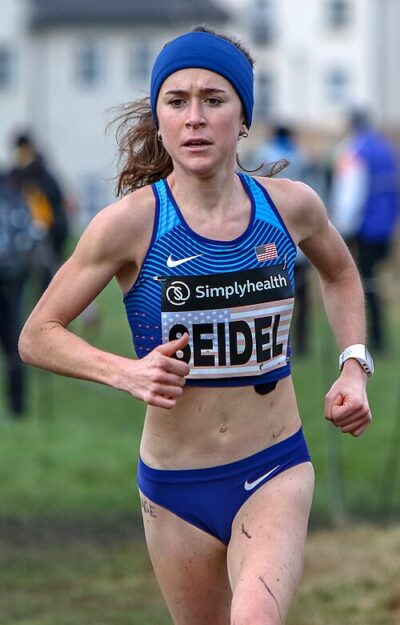
Molly Seidel is an American long-distance runner. Born July 12, 1994, in Hartland. Educated at University of Notre Dame and University Lake School. Awards include Honda Sports Award for Cross Country.
Facts
11 facts · 1 confirmed by two sources · 6 cited · 4 from one source
Where this comes from
Papalocal keeps its own record. It started from these sources; what each one said is kept here as it was copied, so a change on their side never changes this page by itself. Tap one to read its version.
What Wikidata says · copied November 16, 2026 · revision 2564934098
- Described as
- American long-distance runner
- Born
- July 12, 1994 · 1 reference
- Born in
- Hartland · 1 reference
- Citizen of
- United States
- Occupation
- athletics competitor · 1 reference; long-distance runner
- Education
- University of Notre Dame · 2 references; University Lake School · 1 reference
- Sport
- athletics
- Awards
- Honda Sports Award for Cross Country (2016) · 1 reference
- Lived in
- Boston · 1 reference
- Height
- 1.65 m (5 ft 5 in) · 1 reference
- Wikipedias with a page
- 20
Wikidata item Q27588656 (wikidata.org/wiki/Q27588656), public domain (CC0). Copied November 16, 2026.
What Wikipedia says · copied November 16, 2026 · revision 1384542520
Molly Seidel (born July 12, 1994) is an American long distance runner. Seidel represented the United States at the Great Edinburgh Cross Country in 2012, 2013, and 2018. In her first-ever marathon, Seidel placed second at the 2020 U.S. Marathon Olympic Trials. Later, she went on to win the bronze medal in her third career marathon at the 2020 Summer Olympics in Tokyo. At the University of Notre Dame, Seidel was a 4-time NCAA champion, 6-time NCAA All-American, 6-time Atlantic Coast Conference champion and 2016 female ACC Athlete of the Year.
- Born, in its opening lines
- July 12, 1994
From the Wikipedia article “Molly Seidel” (en.wikipedia.org/wiki/Molly_Seidel), by its contributors, under CC BY-SA 4.0 (creativecommons.org/licenses/by-sa/4.0/). Copied November 16, 2026; not changed.
Confirmed Two sources agree. Cited One source, and it names where it got it. One source One source, without a reference of its own. Sources disagree The sources disagree. We show the best-supported value and keep theirs below.
