
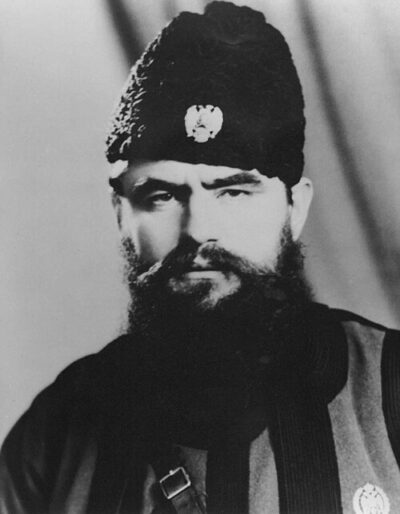
Momčilo Đujić
Momčilo Đujić was a Croatian Serb Chetnik commander. Born February 27, 1907, in Kovačić. Died September 11, 1999, in San Diego. Awards include Order of the Star of Karađorđe, 4th Class.
Facts
17 facts · 2 confirmed by two sources · 4 cited · 11 from one source
Where this comes from
Papalocal keeps its own record. It started from these sources; what each one said is kept here as it was copied, so a change on their side never changes this page by itself. Tap one to read its version.
What Wikidata says · copied November 18, 2026 · revision 2567336711
- Described as
- Croatian Serb Chetnik commander (1907-1999)
- Other names
- Momcilo Djujic, Momcilo Voyvoda Djujic
- Born
- February 27, 1907 · 3 references
- Died
- September 11, 1999 · 1 reference
- Born in
- Kovačić · 1 reference
- Died in
- San Diego · 1 reference
- Buried in
- Oak Hill Memorial Park · 1 reference
- Citizen of
- Serbia
- Occupation
- Eastern Orthodox priest; military personnel; poet; cleric · 1 reference; voivode · 1 reference
- Awards
- Order of the Star of Karađorđe, 4th Class (1998)
- Religion
- Eastern Orthodoxy
- Military rank
- voivode
- Lived in
- Yugoslavia; France (1947–1949); California
- Wikipedias with a page
- 20
Wikidata item Q1287583 (wikidata.org/wiki/Q1287583), public domain (CC0). Copied November 18, 2026.
What Wikipedia says · copied November 18, 2026 · revision 1383629453
Momčilo Đujić (Serbo-Croatian Cyrillic: Момчилo Ђујић, pronounced [mǒmtʃiːlo dʑûːjitɕ]; 27 February 1907 – 11 September 1999) was a Serbian Orthodox priest and Chetnik vojvoda. He led a significant proportion of the Chetniks within the northern Dalmatia and western Bosnia regions of the Independent State of Croatia (NDH), a fascist puppet state created from parts of the occupied Kingdom of Yugoslavia during World War II. In this role he collaborated extensively with the Italian and then the German occupying forces against the communist-led Partisan insurgency.
Đujić was ordained as a priest in 1933 and gained a reputation as something of a firebrand in the pulpit. After the assassination of King Alexander of Yugoslavia in 1934, he joined the Chetnik Association of Kosta Pećanac, forming several bands in the Knin region of Dalmatia. The Chetnik Association became a reactionary force used by the central government to oppress the populace. Active in promoting workers' rights, Đujić was briefly jailed for leading a protest by railroad workers, and he was a member of the exclusively-Serb Agrarian Union political party.
After the Axis invasion of Yugoslavia in April 1941, the Croatian Ustaše regime implemented a policy of widespread incarcerations, massacres, forced emigration and murder of Serbs and other groups, but Đujić escaped to the coastal zone annexed by Italy and began recruiting Chetniks in a refugee camp. When a general uprising began in August, Đujić returned to Knin and deployed his Chetniks to defend local Serbs from the Ustaše, and under his command they captured the town of Drvar in the Bosanska Krajina. He then quickly began collaborating with the Italians, gaining their help through signing a non-aggression agreement. At this time, he was still aligned with the insurgency led by the communists. He soon betrayed them and began subverting Partisan units and attacking them alongside the Italians. He formed the Chetnik Dinara Division in early 1942. By mid-1942, Đujić was encouraging his Chetniks to co-operate with NDH forces, and on 1 October Chetniks under his command perpetrated a massacre of nearly 100 Croat civilians in the village of Gata. In early 1943 he attempted to participate on the Axis side in the Operation Weiss campaign against the Partisans but this was blocked by the Germans. In August, the Dinara Division suffered significantly at the hands of the Partisans and through desertion. By the time of the Italian capitulation in September it was of little use for offensive operations. When the Germans occupied the area, they restricted it to guarding railway tracks from Partisan sabotage. By November 1943, the Chetnik supreme commander, Draža Mihailović, was ordering Đujić to collaborate with the Germans. In November 1944, Đujić and 4,500 of his Chetniks combined with German and NDH forces in an attempt to defend Knin from the ascendant Partisans. Đujić progressively withdrew his troops until they surrendered to the western Allies in May 1945.
Đujić was tried and convicted in absentia for war crimes by the new Yugoslav communist government, which found him guilty of mass murder, torture, rape, robbery, forcible confinement and collaborating with the occupying forces. Included in these charges was responsibility for the deaths of 1,500 people. He eventually emigrated to the United States, settling in California. He played an important role in Serbian émigré circles and founded the Ravna Gora Movement of Serbian Chetniks alongside other exiled Chetnik fighters. He later retired to San Marcos, California. In 1989, Đujić appointed the ultranationalist Serb politician Vojislav Šešelj as a Chetnik vojvoda. He later stated that he regretted awarding the title to Šešelj due to his involvement with Slobodan Milošević and his Socialist Party. In 1998, Biljana Plavšić, then President of Republika Srpska, presented Đujić with an honorary award. Plavšić was later convicted of crimes against humanity related to her activities during the Bosnian War. Đujić died at a hospice in San Diego in 1999, aged 92. Moves in Serbia to rehabilitate the reputations of Đujić and the Chetnik movement have been criticised as historical revisionism and falsification of history.
- Born, in its opening lines
- February 27, 1907
- Died, in its opening lines
- September 11, 1999
From the Wikipedia article “Momčilo Đujić” (en.wikipedia.org/wiki/Momčilo_Đujić), by its contributors, under CC BY-SA 4.0 (creativecommons.org/licenses/by-sa/4.0/). Copied November 18, 2026; not changed.
Confirmed Two sources agree. Cited One source, and it names where it got it. One source One source, without a reference of its own. Sources disagree The sources disagree. We show the best-supported value and keep theirs below.
