
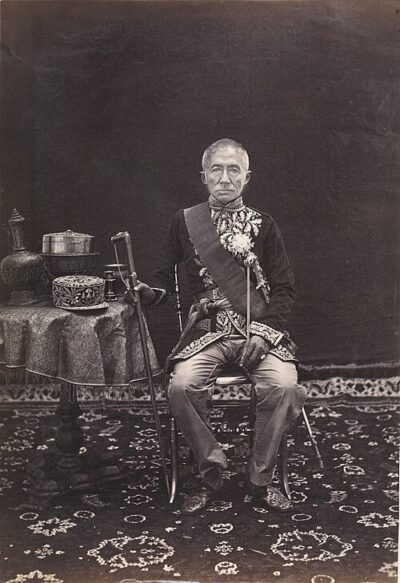
Mongkut
Mongkut was a King of Siam from 1851 to 1868. Born October 18, 1804, in Thonburi Province. Died October 1, 1868, in Grand Palace. Positions held include King of Thailand (1851–1868). Awards include Order of the Nine Gems and Order of the White Elephant.
Facts
32 facts · 2 confirmed by two sources · 0 cited · 30 from one source
Where this comes from
Papalocal keeps its own record. It started from these sources; what each one said is kept here as it was copied, so a change on their side never changes this page by itself. Tap one to read its version.
What Wikidata says · copied November 16, 2026 · revision 2565117376
- Described as
- King of Siam from 1851 to 1868
- Other names
- Rama IV, Zheng Ming, Menggeketuo, Phrabat Somdet Phra Chomklao Chao Yu Hua, Maṅkuṭa
- Born
- October 18, 1804 · 3 references
- Died
- October 1, 1868 · 2 references
- Born in
- Thonburi Province
- Died in
- Grand Palace
- Cause of death
- malaria
- Citizen of
- Thailand
- Occupation
- monarch
- Positions held
- King of Thailand (1851–1868)
- Awards
- Order of the Nine Gems; Order of the White Elephant
- Spouse
- Debsirindra (1853–) · 1 reference; Pannarai (1861–1868); Princess Piyamavadi; Somanas Vadhanavadi
- Children
- Savang Vadhana; Sunanda Kumariratana; Narisara Nuwattiwong; Chulalongkorn; Devan Udayawongse, Prince Devawongse Varoprakar; Jayanta Mongkol; Butsabong Boekban; Nabhabhorn Prabha; Vajirananavarorasa; Kanchanakara; Daksinajar; Thongkongkonyai
- Father
- Phutthaloetla Naphalai
- Mother
- Sri Suriyendra
- Siblings
- Nangklao; Pinklao; Wongsa Dhiraj Snid
- Religion
- Buddhism
- Wikipedias with a page
- 58
Wikidata item Q312849 (wikidata.org/wiki/Q312849), public domain (CC0). Copied November 16, 2026.
What Wikipedia says · copied November 16, 2026 · revision 1384898731
Mongkut (18 October 1804 – 1 October 1868), posthumously honoured as King Mongkut the Great was the king of Siam from the Chakri dynasty, titled Rama IV. He reigned from 1851 until his death in 1868. Although the term "Siam" had long been used by foreigners to refer to the kingdom, the title "King of Siam" came to be formally adopted during his reign, particularly in official and diplomatic contexts.
The reign of Mongkut was marked by significant modernization initiatives and diplomatic engagements, which played pivotal roles in shaping Siam's trajectory towards progress and international relations. It was during his reign that Siam first felt the pressure of Western expansionism. Mongkut embraced Western innovations and initiated reforms in technology, science, and culture, earning him the posthumous title "the Father of Science and Technology" in Siam. His accurate prediction of the total solar eclipse of 18 August 1868 – later dubbed "the King of Siam's eclipse" – demonstrated his scientific acumen and became a symbol of Siam's engagement with modern science.
Mongkut was also known for appointing his younger brother, Prince Chutamani, as Second King, crowned in 1851 as King Pinklao. Mongkut told the country that Pinklao should be respected with equal honor to himself (as King Naresuan had done with his brother Ekathotsarot in 1583). During Mongkut's reign, the power of the House of Bunnag reached its zenith, becoming the most powerful noble family of Siam.
Mongkut is known in the West primarily through the lens of the 1951 musical The King and I and its 1956 film adaptation, in which he was portrayed by Yul Brynner. Brynner's performance as King Mongkut earned him the Academy Award for Best Actor at the 29th Academy Awards in 1957.
- Born, in its opening lines
- October 18, 1804
- Died, in its opening lines
- October 1, 1868
From the Wikipedia article “Mongkut” (en.wikipedia.org/wiki/Mongkut), by its contributors, under CC BY-SA 4.0 (creativecommons.org/licenses/by-sa/4.0/). Copied November 16, 2026; not changed.
Confirmed Two sources agree. Cited One source, and it names where it got it. One source One source, without a reference of its own. Sources disagree The sources disagree. We show the best-supported value and keep theirs below.
