
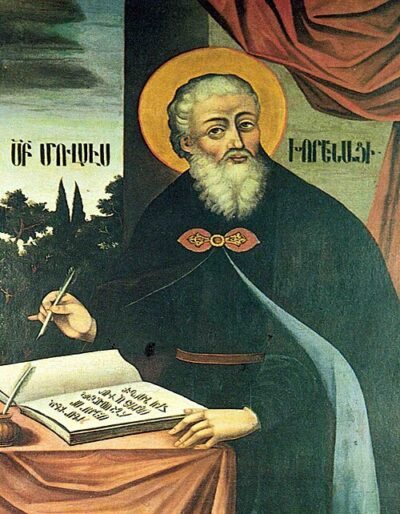
Moses of Chorene
Moses of Chorene was the 5th-century Armenian historian. Born 410, in Harman. Died 487, in Sasanian Armenia. Known for History of Armenia.
Facts
15 facts · 0 confirmed by two sources · 2 cited · 11 from one source · 2 where the sources disagree
What’s different
- Died: we show 487 (Sources disagree). Wikidata also lists 490
- Born in: we show Harman (Sources disagree). Wikidata also lists Khoreah
Where this comes from
Papalocal keeps its own record. It started from these sources; what each one said is kept here as it was copied, so a change on their side never changes this page by itself. Tap one to read its version.
What Wikidata says · copied November 16, 2026 · revision 2570562292
- Described as
- 5th-century Armenian historian
- Other names
- Movses Khorenatsi
- Born
- 410 · 1 reference
- Died
- 490; 487 · 1 reference
- Born in
- Harman · 1 reference; Khoreah
- Died in
- Sasanian Armenia
- Citizen of
- Kingdom of Armenia · 1 reference
- Occupation
- historian · 2 references; translator; philologist; writer
- Known for
- History of Armenia
- Field
- history; historiography; history of Armenia
- Siblings
- Mambre Vertsanogh
- Religion
- Armenian Apostolic Church
- Wikipedias with a page
- 42
Wikidata item Q365695 (wikidata.org/wiki/Q365695), public domain (CC0). Copied November 16, 2026.
What Wikipedia says · copied November 16, 2026 · revision 1382774248
Movses Khorenatsi (c. 410–490s AD; Armenian: Մովսէս Խորենացի, pronounced [mɔvˈsɛs χɔɾɛnɑˈtsʰi]) was a prominent Armenian historian from late antiquity and the author of the History of the Armenians.
Movses's History of the Armenians was the first attempt at a universal history of Armenia and remains the only known general account of early Armenian history. It traces Armenian history from its origins to the fifth century, during which Movses claimed to have lived. His history had an enormous impact on Armenian historiography and was used and quoted extensively by later medieval Armenian authors. He is called the "father of Armenian history" (patmahayr) in Armenian, and is sometimes referred to as the "Armenian Herodotus". Movses's history is also valued for its unique material on the old oral traditions in Armenia before its conversion to Christianity. Approximately twenty manuscripts of Movses's history have reached us, the majority of which date from the thirteenth and fourteenth centuries.
Movses identified himself as a young disciple of Mesrop Mashtots, inventor of the Armenian alphabet. Moreover, he claimed to have written his history at the behest of Prince Sahak of the Bagratuni dynasty. He is recognized by the Armenian Apostolic Church as one of the Holy Translators. The exact time period during which Movses lived and wrote has been the subject of much debate among scholars since the nineteenth century, with some scholars dating him to the seventh to ninth centuries rather than the fifth.
From the Wikipedia article “Movses Khorenatsi” (en.wikipedia.org/wiki/Movses_Khorenatsi), by its contributors, under CC BY-SA 4.0 (creativecommons.org/licenses/by-sa/4.0/). Copied November 16, 2026; not changed.
Confirmed Two sources agree. Cited One source, and it names where it got it. One source One source, without a reference of its own. Sources disagree The sources disagree. We show the best-supported value and keep theirs below.
