
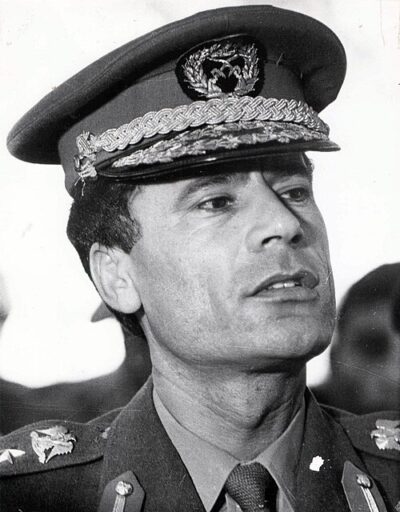
Muammar Gaddafi
Muammar Gaddafi was a Military officer and former Brotherly Leader and Guide of the Revolution of Libya. Born June 19, 1942, in Sirte. Died October 20, 2011, in Sirte. Positions held include Brotherly Leader and Guide of the Revolution (1969–2011), Chairperson of the African Union (2009–2010) and Prime Minister of Libya (1970–1972). Known for The Green Book and Third International Theory. Educated at Benghazi Military University Academy and University of Libya. Awards include Order of the White Lion, Order of the Yugoslavian Great Star and Order of Stara Planina.

Facts
58 facts · 2 confirmed by two sources · 10 cited · 45 from one source · 1 where the sources disagree
What’s different
- Born: we show June 19, 1942 (Confirmed). Wikidata also lists June 7, 1942
- Born in: we show Sirte (Sources disagree). Wikidata also lists Qasr Abu Hadi
Where this comes from
Papalocal keeps its own record. It started from these sources; what each one said is kept here as it was copied, so a change on their side never changes this page by itself. Tap one to read its version.
What Wikidata says · copied November 16, 2026 · revision 2562766067
- Described as
- Military officer and former Brotherly Leader and Guide of the Revolution of Libya (1969-2011)
- Other names
- Muammur Gaddafi, Muammar Mohammed Abu Minyar Gaddafi, Muʿammar al-Gaddafi, Muammar el-Qaddafi, Muʿammar al-Qaddafi, Moammar Gaddafi, Colonel Gaddafi, Muammar Abu Minyar al-Gaddafi, Muammar al-Gaddafi, Muammar al-Qaddafi, Gadafi, Gadaffi
- Born
- June 19, 1942; June 7, 1942
- Died
- October 20, 2011 · 9 references
- Born in
- Qasr Abu Hadi; Sirte · 1 reference
- Died in
- Sirte · 4 references
- Buried in
- Libyan Desert
- Cause of death
- gunshot wound · 1 reference
- Name at birth
- معمر محمد أبو منيار القذافي
- Citizen of
- Kingdom of Libya · 3 references; Libyan Arab Republic; Great Socialist People's Libyan Arab Jamahiriya
- Occupation
- politician · 1 reference; writer; military officer · 1 reference
- Positions held
- Brotherly Leader and Guide of the Revolution (1969–2011); Chairperson of the African Union (2009–2010); Prime Minister of Libya (1970–1972)
- Political party
- Arab Socialist Union; Libyan Arab Socialist Union
- Education
- Benghazi Military University Academy; University of Libya; Joint Services Command and Staff College; Fu Hsing Kang College, National Defense University
- Known for
- The Green Book; Third International Theory
- Awards
- Order of the White Lion (1982); Order of the Yugoslavian Great Star (1999); Order of Stara Planina; Order of Bohdan Khmelnytsky; Order of the Liberator (2009) · 1 reference; Order of the Tribute to the Republic; Order of the Republic of The Gambia (2009) · 1 reference; Golden Key of Madrid (2007) · 1 reference; Order of Good Hope (1997); Order of Merit of the Republic of Poland; Order of the National Flag, 1st class · 1 reference; Order of Prince Yaroslav the Wise, 1st class · 1 reference; National Maltese Order of Merit; Order of the 7th November 1987; Ribbon bar of the Kagera River Medal
- Spouse
- Fathia Nuri Khalid (1969–1970); Safia Farkash (1970–2011)
- Children
- Al-Saadi Gaddafi; Saif al-Islam al-Gaddafi; Hannibal Muammar Gaddafi; Mutassim Gaddafi; Saif al-Arab Gaddafi; Khamis Gaddafi; Muhammad Gaddafi; Ayesha Gaddafi
- Father
- Mohammed Abdus-Salam
- Mother
- Aisha Ben Niran · 1 reference
- Religion
- Quranism; Sunni Islam · 1 reference
- Military branch
- Libyan Army
- Military rank
- colonel
- Lived in
- Bab al-Azizia
- Nickname
- Líder hermano y guía de la revolución
- Height
- 1.85 m (6 ft 1 in)
- Wikipedias with a page
- 186
Wikidata item Q19878 (wikidata.org/wiki/Q19878), public domain (CC0). Copied November 16, 2026.
What Wikipedia says · copied November 16, 2026 · revision 1384391702
Muammar Muhammad Abu Minyar al-Gaddafi (c. 1942 – 20 October 2011) was a Libyan military officer, revolutionary, politician, and political theorist who ruled Libya from 1969 until his overthrow by Libyan rebel forces in 2011 during the First Libyan Civil War. He came to power through a bloodless military coup, first becoming Revolutionary Chairman of the Libyan Arab Republic from 1969 to 1977, Secretary General of the General People's Congress from 1977 to 1979, and then the Brotherly Leader of the Great Socialist People's Libyan Arab Jamahiriya from 1979 to 2011. Initially ideologically committed to Arab nationalism and Arab socialism, Gaddafi later ruled according to his own Third International Theory.
Gaddafi became an Arab nationalist while at school in Sabha, later enrolling in the Royal Military Academy, Benghazi. He founded a revolutionary group known as the Free Officers movement which deposed the Western-backed Senussi monarchy of Idris I in a 1969 coup. Gaddafi converted Libya into a republic governed by his Revolutionary Command Council. Ruling by decree, he deported Libya's Italian population and ejected its Western military bases.
He strengthened ties to Arab nationalist governments and unsuccessfully advocated pan-Arab political union. An Islamic modernist, he introduced Sharia law and promoted Islamic socialism. He nationalized the oil industry and used the increasing state revenues to bolster the military, fund foreign revolutionaries, and implement social programs emphasizing housebuilding, healthcare and education projects. In 1973, he initiated a "Popular Revolution" with the formation of Basic People's Congresses, presented as a system of direct democracy, but retained personal control over major decisions. He outlined his Third International Theory that year in The Green Book.
In 1977, Gaddafi transformed Libya into a new socialist state called a Jamahiriya ("state of the masses"). He officially adopted a symbolic role in governance but remained head of both the military and the Revolutionary Committees responsible for policing and suppressing dissent. During the 1970s and 1980s, Libya's unsuccessful border conflicts with Egypt and Chad, support for foreign militants and alleged responsibility for bombings of Pan Am Flight 103 and UTA Flight 772 left it increasingly isolated on the world stage.
A particularly hostile relationship developed with Israel, the United States and the United Kingdom, resulting in the 1986 U.S. bombing of Libya and United Nations–imposed economic sanctions. From 1999, Gaddafi shunned pan-Arabism, and encouraged pan-Africanism and rapprochement with Western nations; he was Chairperson of the African Union from 2009 to 2010. Amid the 2011 Arab Spring, protests against widespread corruption and unemployment broke out in eastern Libya. The situation descended into civil war, in which NATO intervened militarily on the side of the anti-Gaddafist National Transitional Council (NTC). Gaddafi's government was overthrown; he retreated to Sirte only to be captured, tortured and killed by NTC militants.
A highly divisive figure, Gaddafi dominated Libya's politics for four decades and was the subject of a pervasive cult of personality. He was decorated with various awards and praised for his anti-imperialist stance, support for Arab—and then African—unity, as well as for significant development to the country after the discovery of oil reserves. Conversely, many Libyans strongly opposed Gaddafi's social and economic reforms; he was accused of various human rights violations. He was condemned by many as a dictator whose authoritarian administration systematically violated human rights and financed terrorism in the region and abroad.
- Born, in its opening lines
- c. 1942
- Died, in its opening lines
- October 20, 2011
From the Wikipedia article “Muammar Gaddafi” (en.wikipedia.org/wiki/Muammar_Gaddafi), by its contributors, under CC BY-SA 4.0 (creativecommons.org/licenses/by-sa/4.0/). Copied November 16, 2026; not changed.
Confirmed Two sources agree. Cited One source, and it names where it got it. One source One source, without a reference of its own. Sources disagree The sources disagree. We show the best-supported value and keep theirs below.
