
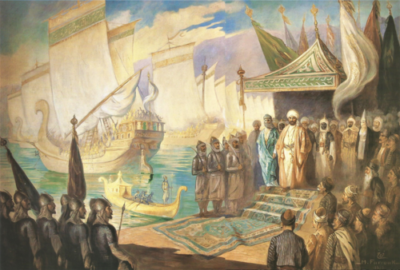
Mu'awiya I
Mu'awiya I was a founder and first caliph of the Umayyad Caliphate (r. 661–680). Born 603, in Mecca. Died 680, in Medina. Positions held include Governor of the Levant (640–661) and Umayyad Caliph (661–680).
Facts
29 facts · 0 confirmed by two sources · 5 cited · 24 from one source
Where this comes from
Papalocal keeps its own record. It started from these sources; what each one said is kept here as it was copied, so a change on their side never changes this page by itself. Tap one to read its version.
What Wikidata says · copied November 16, 2026 · revision 2544424397
- Described as
- founder and first caliph of the Umayyad Caliphate (r. 661–680)
- Other names
- Mu'awiya ibn Abi Sufyan, Mu'awiya ibn Sakhr
- Born
- 603 · 1 reference
- Died
- 680 · 1 reference
- Born in
- Mecca · 1 reference
- Died in
- Medina
- Buried in
- Bab al-Saghir Cemetery
- Citizen of
- Umayyad Caliphate (661–)
- Occupation
- politician · 1 reference; writer; poet · 1 reference; governor · 1 reference; caliph
- Positions held
- Governor of the Levant (640–661); Umayyad Caliph (661–680)
- Spouse
- Qurayba al-Sugra bint Abi Umayya; Maisun bint Bahdal
- Children
- Yazid I
- Father
- Abu Sufyan ibn Harb
- Mother
- Hind bint Utbah
- Siblings
- Yazid ibn Abi Sufyan; Utba ibn Abi Sufyan; Amr ibn Abi Sufyan; Anbasa ibn Abi Sufyan; Hanzala ibn Abi Sufyan; Juwayriya bint Abi Sufyan; Umayma bint Abi Sufyan; Izza bint Abi Sufyan; Hind bint Abi Sufyan; Ziyad ibn Abihi
- Religion
- Islam
- Wikipedias with a page
- 90
Wikidata item Q181154 (wikidata.org/wiki/Q181154), public domain (CC0). Copied November 16, 2026.
What Wikipedia says · copied November 16, 2026 · revision 1382532495
Mu'awiya ibn Abi Sufyan (c. 597, 603 or 605 – April 680), commonly known as Mu'awiya I, was the founder of the Umayyad Caliphate, ruling as the first caliph of the Umayyad dynasty from 661 until his death in 680. He became caliph less than thirty years after the death of the Islamic prophet Muhammad and immediately after the four Rashidun ('rightly-guided') caliphs. Unlike his predecessors, who had been close, early companions of Muhammad, Mu'awiya was a relatively late follower of Muhammad.
Mu'awiya and his father Abu Sufyan had opposed Muhammad, their distant Qurayshite kinsman and later Mu'awiya's brother-in-law, until Muhammad captured Mecca in 630. Afterwards, Mu'awiya became one of Muhammad's scribes. He was appointed by Caliph Abu Bakr (r. 632–634) as a deputy commander in the conquest of Syria. He moved up the ranks through Umar's caliphate (r. 634–644) until becoming governor of Syria during the reign of his Umayyad kinsman, Caliph Uthman (r. 644–656). He allied with the province's powerful Banu Kalb tribe, developed the defenses of its coastal cities, and directed the war effort against the Byzantine Empire, including the first Muslim naval campaigns.
In response to Uthman's assassination in 656, Mu'awiya took up the cause of avenging the murdered caliph and opposed the election of Ali. During the First Fitna, the two led their armies to a stalemate at the Battle of Siffin in 657, prompting an abortive series of arbitration talks to settle the dispute. Afterward, Mu'awiya gained recognition as caliph by his Syrian supporters and his ally Amr ibn al-As, who conquered Egypt from Ali's governor in 658. Following the assassination of Ali in 661, Mu'awiya compelled Ali's son and successor Hasan to abdicate and Mu'awiya's suzerainty was acknowledged throughout the Caliphate.
Domestically, Mu'awiya relied on Syria's loyalist Arab tribes and largely Christian bureaucracy. He is credited with establishing government departments responsible for the postal route, correspondence, and chancellery. He was the first caliph whose name appeared on coins or documents of the nascent Islamic empire. Externally, he engaged his troops in almost yearly land and sea raids against the Byzantines, culminating in a siege of Constantinople. In Iraq and the eastern provinces, he delegated authority to the powerful governors al-Mughira and Ziyad ibn Abihi, the latter of whom he controversially claimed as his brother. Under Mu'awiya's direction, the Muslim conquest of Ifriqiya (central North Africa) was launched by the commander Uqba ibn Nafi in 670, while the conquests in Khurasan and Sijistan on the eastern frontier were resumed.
Although Mu'awiya confined the influence of his Umayyad clan to the governorship of Medina, he nominated his own son Yazid I as his successor, making the caliphate hereditary. It was an unprecedented move in Islamic politics and opposition to it by prominent Muslim leaders, including Ali's son Husayn, and Abd Allah ibn al-Zubayr, persisted after Mu'awiya's death, culminating with the outbreak of the Second Fitna. While there is considerable admiration for Mu'awiya in the contemporary sources, he has been criticized for lacking the justice and piety of the Rashidun and transforming the office of the caliphate into a kingship. Nevertheless, Sunni Muslims honor him as a companion of Muhammad and a scribe of Quranic revelation. In Shia Islam, Mu'awiya is reviled for opposing Ali, accused of poisoning his son Hasan, and held to have accepted Islam without conviction.
From the Wikipedia article “Mu'awiya I” (en.wikipedia.org/wiki/Mu'awiya_I), by its contributors, under CC BY-SA 4.0 (creativecommons.org/licenses/by-sa/4.0/). Copied November 16, 2026; not changed.
Confirmed Two sources agree. Cited One source, and it names where it got it. One source One source, without a reference of its own. Sources disagree The sources disagree. We show the best-supported value and keep theirs below.
