
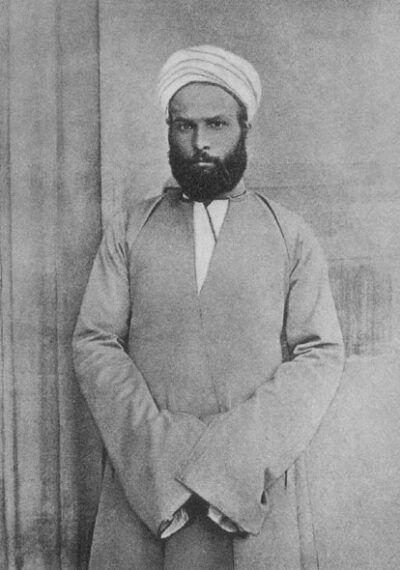
Muhammad Abduh
Muhammad Abduh was an Egyptian Islamic jurist, religious scholar and liberal reformer. Born January 1, 1849, in Shubra Khit. Died July 11, 1905, in Alexandria. Positions held include judge and Grand Mufti of Egypt (1899–1905). Known for Tafsīr al-Manār. Educated at Al-Azhar University.
Facts
24 facts · 2 confirmed by two sources · 3 cited · 19 from one source
Where this comes from
Papalocal keeps its own record. It started from these sources; what each one said is kept here as it was copied, so a change on their side never changes this page by itself. Tap one to read its version.
What Wikidata says · copied November 16, 2026 · revision 2567290208
- Described as
- Egyptian Islamic jurist, religious scholar and liberal reformer (1849-1905)
- Other names
- Muhammed Abduh bin Hasan Hayrullâh et-Türkmânî el-Mısrî
- Born
- January 1, 1849 · 1 reference
- Died
- July 11, 1905 · 6 references
- Born in
- Shubra Khit
- Died in
- Alexandria
- Cause of death
- kidney cancer
- Citizen of
- Ottoman Empire (1867–) · 1 reference
- Occupation
- jurist; theologian; judge; opinion journalist; politician · 1 reference; lawyer · 1 reference; writer · 1 reference; philosopher
- Positions held
- judge; Grand Mufti of Egypt (1899–1905)
- Worked for
- Al-Azhar University
- Education
- Al-Azhar University
- Member of
- Al U'rwah Al-Wuthqa Association
- Known for
- Tafsīr al-Manār
- Field
- fiqh; politics
- Religion
- Islam · 1 reference; Sunni Islam
- Wikipedias with a page
- 60
Wikidata item Q311826 (wikidata.org/wiki/Q311826), public domain (CC0). Copied November 16, 2026.
What Wikipedia says · copied November 16, 2026 · revision 1384275614
Muhammad Abduh (Arabic: محمد عبده, romanized: Muḥammad ʿAbduh; 1849 – 11 July 1905) was an Egyptian Islamic scholar and judge who served as Grand Mufti of Egypt. He was a central figure of the Arab Nahda movement and Islamic modernism in the late 19th and early 20th centuries.
He began teaching advanced students esoteric Islamic texts at Al-Azhar University while he was still studying there. From 1877, with the status of ʿālim, he taught logic, theology, ethics, and politics. He was also made a professor of history at Dar al-ʿUlūm the following year, and of Arabic language and literature at Madrasat al-Alsun. ʿAbduh was a champion of the press and wrote prolifically in Al-Manār and Al-Ahram. He was made editor of Al-Waqa'i' al-Misriyya in 1880. He also authored Risālat at-Tawḥīd (رسالة التوحيد, 'The Theology of Unity') and a commentary on the Quran. He briefly published the pan-Islamist anti-colonial newspaper al-ʿUrwa al-Wuthqā alongside his teacher and mentor Jamāl ad-Dīn al-Afghānī.
ʿAbduh joined Freemasonry and subscribed to various Masonic lodges alongside his mentor al-Afghānī and his other pupils, but eventually left the secret society in his later years. He was appointed as a judge in the Courts of First Instance of the Native Tribunals in 1888, a consultative member of the Court of Appeal in 1899, and he was appointed Dar al-Ifta al-Misriyyah in 1899.
- Born, in its opening lines
- 1849
- Died, in its opening lines
- July 11, 1905
From the Wikipedia article “Muhammad Abduh” (en.wikipedia.org/wiki/Muhammad_Abduh), by its contributors, under CC BY-SA 4.0 (creativecommons.org/licenses/by-sa/4.0/). Copied November 16, 2026; not changed.
Confirmed Two sources agree. Cited One source, and it names where it got it. One source One source, without a reference of its own. Sources disagree The sources disagree. We show the best-supported value and keep theirs below.
