
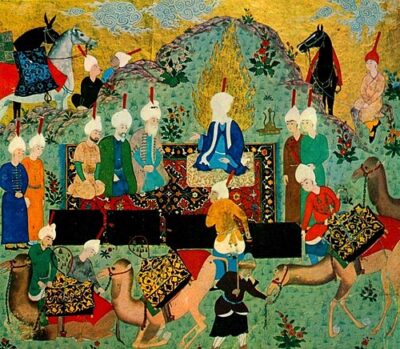
Muhammad al-Baqir
Muhammad al-Baqir was a Fifth of the Twelve Shia Imams. Born May 8, 677, in Medina. Died January 26, 733, in Medina. Positions held include Imam of Twelver Shiism (712–733).
Facts
20 facts · 0 confirmed by two sources · 1 cited · 19 from one source
Where this comes from
Papalocal keeps its own record. It started from these sources; what each one said is kept here as it was copied, so a change on their side never changes this page by itself. Tap one to read its version.
What Wikidata says · copied November 16, 2026 · revision 2547861417
- Described as
- Fifth of the Twelve Shia Imams
- Born
- May 8, 677
- Died
- January 26, 733
- Born in
- Medina
- Died in
- Medina
- Buried in
- Al-Baqi'
- Cause of death
- poison
- Citizen of
- Umayyad Caliphate
- Occupation
- imam · 1 reference; muhaddith
- Positions held
- Imam of Twelver Shiism (712–733)
- Spouse
- Umm Farwa bint al-Qasim
- Children
- Jaafar Al-Sadiq · 1 reference; Sultan Ali; Amina bint Muhammed Al-Baqir
- Father
- Ali ibn al-Husayn Zayn al-'Abidin · 1 reference
- Mother
- Fatimah bint al-Hasan
- Siblings
- Zayd ibn Ali; Husain bin Ali bin Husain; Abdullah bin Ali bin al-Hussein
- Religion
- Twelver Shiism
- Wikipedias with a page
- 48
Wikidata item Q311153 (wikidata.org/wiki/Q311153), public domain (CC0). Copied November 16, 2026.
What Wikipedia says · copied November 16, 2026 · revision 1385147198
Muhammad ibn Ali al-Baqir (Arabic: محمد بن علي الباقر, romanized: Muḥammad ibn ʿAlī al-Bāqir; c. 676 – c. 732) was a descendant of the Islamic prophet Muhammad and the fifth of the Twelve Imams, succeeding his father Ali al-Sajjad. He was the grandson of Husayn on his father’s side, the grandson of Hasan on his mother’s side, therefore a great-grandson of Ali. Al-Baqir was the first Shia Imam descended from both of Muhammad's grandsons. Born in Medina around 676, al-Baqir witnessed the brutal massacre of his grandfather Husayn and his relatives by the forces of the Umayyad caliph Yazid at the Battle of Karbala when he was still a small child. Upon his father's death, al-Baqir was recognised as the next Imam by most followers of his father around 712. These were the Imamites, the forerunners of Twelvers, which now constitute the overwhelming majority of Shia Muslims. Like his father, al-Baqir was politically quiescent but was nevertheless harassed by the Umayyads, especially by caliph Hisham.
Al-Baqir led a pious and scholarly life in Medina, attracting a growing number of followers, students, and visitors. He is credited with laying the doctrinal and legal foundations of Twelver Shia Islam during some twenty years of his Imamate. He significantly contributed to Twelver exegesis of the Quran, and is regarded as the father of Ismaili and Zaydi jurisprudence. Most of al-Baqir's disciples were based in Kufa, many of whom later became outstanding Shia jurists and traditionists. Al-Baqir is also regarded as an authority in law and prophetic tradition in Sunni Islam. Muhammad al-Baqir died around 732, poisoned by the Umayyads. He was succeeded by his eldest son, Ja'far al-Sadiq, who played a pivotal role in the development of Shia theology and jurisprudence. Al-Baqir is buried in the Baqi Cemetery in Medina. The shrine that stood over his grave was demolished, along with the cemetery itself, by Wahhabis in 1806 and again in 1925.
From the Wikipedia article “Muhammad al-Baqir” (en.wikipedia.org/wiki/Muhammad_al-Baqir), by its contributors, under CC BY-SA 4.0 (creativecommons.org/licenses/by-sa/4.0/). Copied November 16, 2026; not changed.
Confirmed Two sources agree. Cited One source, and it names where it got it. One source One source, without a reference of its own. Sources disagree The sources disagree. We show the best-supported value and keep theirs below.
