
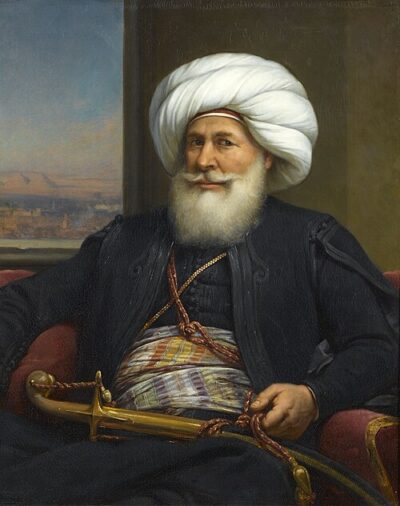
Muhammad Ali
Muhammad Ali was a Wali of Egypt and Sudan. Born March 4, 1769. Died August 2, 1849, in Alexandria. Positions held include Beylerbey of Egypt (1805–1848). Awards include Grand Cross of the Order of Franz Joseph.
Facts
24 facts · 2 confirmed by two sources · 8 cited · 14 from one source
Where this comes from
Papalocal keeps its own record. It started from these sources; what each one said is kept here as it was copied, so a change on their side never changes this page by itself. Tap one to read its version.
What Wikidata says · copied November 16, 2026 · revision 2560382500
- Described as
- Wali of Egypt and Sudan (1769–1849)
- Other names
- Mohammed ali, Mohamed ali, mohamed ali, Mehemet Ali
- Born
- March 4, 1769 · 4 references
- Died
- August 2, 1849 · 3 references
- Died in
- Alexandria · 1 reference
- Buried in
- Muhammad Ali Mosque
- Name at birth
- محمد علي المسعود بن إبراهيم آغا القوللي
- Citizen of
- Ottoman Empire
- Occupation
- military leader; politician; statesperson; governor · 2 references; viceroy · 1 reference; businessperson · 1 reference
- Positions held
- Beylerbey of Egypt (1805–1848)
- Awards
- Grand Cross of the Order of Franz Joseph
- Field
- politics · 1 reference; military affairs · 1 reference
- Spouse
- Amina Hanim; Ayn al-Hayat Khanum
- Children
- Tusun Pasha; Ismail Kamil Pasha; Ibrahim Pasha of Egypt; Sa'id of Egypt · 1 reference; Prince Mahomet Aly Pacha of Egypt · 1 reference
- Religion
- Sunni Islam
- Wikipedias with a page
- 74
Wikidata item Q182781 (wikidata.org/wiki/Q182781), public domain (CC0). Copied November 16, 2026.
What Wikipedia says · copied November 16, 2026 · revision 1384964792
Muhammad Ali (4 March 1769 – 2 August 1849) was an Ottoman viceroy who became the de facto ruler of Egypt from 1805 to 1848, and is widely considered the founder of modern Egypt. A governor of Albanian origin, Ali extended his control from Egypt to include Sudan, Hejaz, the Levant, Cyprus, Crete and parts of Greece at the height of his rule in 1840, and transformed Cairo from a mere Ottoman provincial capital to the center of an expansive empire.
Born in a village in Albania, when he was young he moved with his family to Kavala in the Rumelia Eyalet, where his father, an Albanian tobacco and shipping merchant, served as an Ottoman commander of a small unit in the city. Ali was a military commander in an Albanian Ottoman force sent to recover Egypt from French occupation following Napoleon's withdrawal. He rose to power through a series of political maneuvers, and in 1805 he was named Wāli (governor) of Egypt and gained the rank of Pasha. As Wāli, Ali attempted to modernize Egypt by instituting dramatic reforms in the military, economic and cultural spheres. He also initiated a violent purge of the Mamluks, consolidating his rule and permanently ending the Mamluk hold over Egypt.
Militarily, Ali recaptured the Arabian territories for the sultan, and conquered Sudan of his own accord. His attempt at suppressing the Greek rebellion failed decisively, however, following an intervention by the European powers at Navarino. In 1831, Ali waged war against the sultan, capturing Syria, crossing into Anatolia and directly threatening Constantinople, but the European powers forced him to retreat. After a failed Ottoman invasion of Syria in 1839, he launched another invasion of the Ottoman Empire in 1840; he defeated the Ottomans again and opened the way towards a capture of Constantinople. Faced with another European intervention, he accepted a brokered peace in 1842 and withdrew from the Levant; in return, he and his descendants were granted hereditary rule over Egypt and Sudan. His dynasty would rule Egypt for over a century, until the revolution of 1952 when King Farouk was overthrown by the Free Officers Movement led by Mohamed Naguib and Gamal Abdel Nasser, establishing the Republic of Egypt.
- Born, in its opening lines
- March 4, 1769
- Died, in its opening lines
- August 2, 1849
From the Wikipedia article “Muhammad Ali of Egypt” (en.wikipedia.org/wiki/Muhammad_Ali_of_Egypt), by its contributors, under CC BY-SA 4.0 (creativecommons.org/licenses/by-sa/4.0/). Copied November 16, 2026; not changed.
Confirmed Two sources agree. Cited One source, and it names where it got it. One source One source, without a reference of its own. Sources disagree The sources disagree. We show the best-supported value and keep theirs below.
