
Muhammad III of Granada
Muhammad III of Granada was a ruler of the Emirate of Granada from 1302 to 1309. Born August 15, 1257, in Granada. Died January 21, 1314, in Alhambra. Positions held include emir of Granada (1302–1309).
Facts
11 facts · 2 confirmed by two sources · 0 cited · 9 from one source
Where this comes from
Papalocal keeps its own record. It started from these sources; what each one said is kept here as it was copied, so a change on their side never changes this page by itself. Tap one to read its version.
What Wikidata says · copied November 17, 2026 · revision 2553831431
- Described as
- ruler of the Emirate of Granada from 1302 to 1309
- Other names
- Muhammad III
- Born
- August 15, 1257 · 1 reference
- Died
- January 21, 1314
- Born in
- Granada
- Died in
- Alhambra
- Cause of death
- drowning
- Citizen of
- Emirate of Granada
- Occupation
- monarch
- Positions held
- emir of Granada (1302–1309)
- Father
- Muhammad II of Granada
- Siblings
- Nasr of Granada; Fatima bint al-Ahmar
- Wikipedias with a page
- 24
Wikidata item Q704786 (wikidata.org/wiki/Q704786), public domain (CC0). Copied November 17, 2026.
What Wikipedia says · copied November 17, 2026 · revision 1358597282
Muhammad III (Arabic: محمد الثالث; 15 August 1257 – 21 January 1314) was the ruler of the Emirate of Granada in Al-Andalus on the Iberian Peninsula from 8 April 1302 until 14 March 1309, and a member of the Nasrid dynasty. He ascended the Granadan throne after the death of his father Muhammad II, which according to rumours, was caused by Muhammad III poisoning him. He had the reputation of being both cultured and cruel. Later in his life, he became visually impaired—which caused him to be absent from many government activities and to rely on high officials, especially the powerful Vizier Ibn al-Hakim al-Rundi.
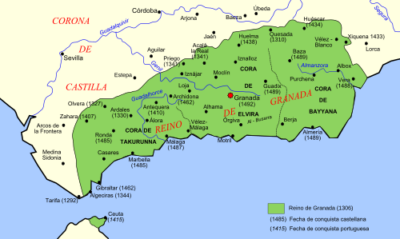
Muhammad III inherited an ongoing war against Castile. He built upon his father's recent military success and expanded Granada's territory further when he captured Bedmar in 1303. He negotiated a treaty with Castile the following year, in which Granada's conquests were recognised in return for Muhammad making an oath of fealty to the King of Castille, Ferdinand IV, paying him tribute. Muhammad sought to extend his rule to Ceuta, North Africa. To achieve this, he first encouraged the city to rebel against its Marinid rulers in 1304, and then, two years later, he invaded and conquered the city himself. Consequently, Granada controlled both sides of the Strait of Gibraltar. This alarmed Granada's three larger neighbours, Castile, the Marinids, and Aragon, who by the end of 1308 had formed a coalition against Granada. The three powers were preparing for an all-out war against Granada when Muhammad III was deposed in a palace coup. His foreign policy was increasingly unpopular among his nobility, and Vizier Ibn al-Hakim—who was, due to Muhammad's near-blindness, by now the power behind the throne—universally distrusted. Muhammad was replaced by his half-brother Nasr on 14 March 1309. Muhammad was allowed to live in Almuñécar, but—following an attempt by his followers to overthrow Nasr—was executed five years later in the Alhambra.
In contrast to the long reigns of his father and grandfather, Muhammad I, Muhammad III's reign was notably short; he was later known by the epithet al-Makhlu' ("the Deposed"). He was responsible for the construction of the Great Mosque of the Alhambra (later destroyed by Philip II in the sixteenth century) as well as the Partal Palace within the Alhambra. He also oversaw the construction of a nearby public bathhouse, the income from which paid for the mosque. He was known to have had a sense of humour and favoured poetry and literature. He composed his own poems, two of which survive today in Ibn al-Khatib's work Al-Lamha.
- Born, in its opening lines
- August 15, 1257
- Died, in its opening lines
- January 21, 1314
From the Wikipedia article “Muhammad III of Granada” (en.wikipedia.org/wiki/Muhammad_III_of_Granada), by its contributors, under CC BY-SA 4.0 (creativecommons.org/licenses/by-sa/4.0/). Copied November 17, 2026; not changed.
Confirmed Two sources agree. Cited One source, and it names where it got it. One source One source, without a reference of its own. Sources disagree The sources disagree. We show the best-supported value and keep theirs below.
