
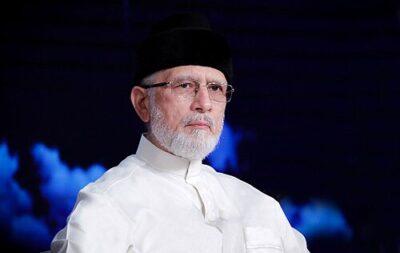
Muhammad Tahir-ul-Qadri
Muhammad Tahir-ul-Qadri is an Islamic scholar. Born February 19, 1951, in Jhang. Positions held include Member of the National Assembly of Pakistan. Educated at University of the Punjab.
Facts
16 facts · 1 confirmed by two sources · 2 cited · 13 from one source
Where this comes from
Papalocal keeps its own record. It started from these sources; what each one said is kept here as it was copied, so a change on their side never changes this page by itself. Tap one to read its version.
What Wikidata says · copied November 15, 2026 · revision 2568937789
- Described as
- Islamic scholar
- Born
- February 19, 1951 · 1 reference
- Born in
- Jhang
- Citizen of
- Pakistan · 2 references; Canada · 1 reference
- Occupation
- politician; translator; writer; ulema
- Positions held
- Member of the National Assembly of Pakistan
- Political party
- Pakistan Awami Tehreek
- Worked for
- Punjab University Law College (1978–1983)
- Education
- University of the Punjab
- Religion
- Islam; Sunni Islam
- Lived in
- Canada (2006–)
- Website
- http://www.tahir-ul-qadri.com/
- Wikipedias with a page
- 27
Wikidata item Q732388 (wikidata.org/wiki/Q732388), public domain (CC0). Copied November 15, 2026.
What Wikipedia says · copied November 15, 2026 · revision 1376878243
Muhammad Tahir-ul-Qadri (born 19 February 1951) is a Pakistani–Canadian Islamic scholar and former politician. He is the founder and chief patron of Minhaj-ul-Quran International (MQI) since 1980. He also founded the Pakistan Awami Tehreek (PAT) and served as its leader from 1989 to 2019.
Born in Jhang, West Punjab, Qadri studied classical Islamic sciences under numerous Islamic scholars throughout the Muslim world, gaining more than 500 ijazas and isnads in various fields of Islamic knowledge. After graduating from University of the Punjab, he served as a professor of international constitutional law at the university. Hix expertise in Islamic jurisprudence led him to being appointed as a jurist consult on sharia law for the Supreme Court and the Federal Shariat Court. Qadri laid foundation to Minhaj-ul-Quran International in 1980, Minhaj University Lahore in 1986 and Minhaj Welfare Foundation in 1989. In the same year, he also founded the Pakistan Awami Tehreek political party and successfully contested the 1990 Pakistani general election, serving as Member of the National Assembly until 2004 when he resigned in protest against President Pervez Musharraf's policies. After conflicts with "the Establishment", Qadri relocated to Canada in 2005 and began refocusing on religion.
Qadri returned to Pakistan in 2012 and led the Long March against Prime Minister Yusuf Raza Gilani in January 2013. In the aftermath of the Model Town incident in June 2014, Qadri spearheaded the Inqilab March against Gilani's successor Nawaz Sharif. In 2019, he announced his retirement from politics due to health issues and profound academic commitments. Since then, he has continued to give religious lectures in Canada.
A highly prolific writer, Qadri has authored more than 1,000 books in Urdu, Arabic and English. He has delivered over 6,000 lectures and has been featured in every edition of The 500 Most Influential Muslims since its first edition in 2009. In 2012, he was one of the reported nominations for the Nobel Peace Prize for his opposition to extremism and promotion of inter-faith dialogue.
- Born, in its opening lines
- February 19, 1951
From the Wikipedia article “Muhammad Tahir-ul-Qadri” (en.wikipedia.org/wiki/Muhammad_Tahir-ul-Qadri), by its contributors, under CC BY-SA 4.0 (creativecommons.org/licenses/by-sa/4.0/). Copied November 15, 2026; not changed.
Confirmed Two sources agree. Cited One source, and it names where it got it. One source One source, without a reference of its own. Sources disagree The sources disagree. We show the best-supported value and keep theirs below.
